Aalborg: Viking Graves, Utzon's Harbour and Limfjord Culture
Aalborg began as a Viking-age trading place on the Limfjord and grew into a city of spirits, cement, architecture and carnival. This guide leads with that story, then helps plan two days.
Cover: AI-generated illustration. © ANUSHKA DAHANAYAKE (PVT) LTD.
Aalborg grew up where the Limfjord narrows, and its location has shaped almost everything about the city. The name appears as Alabu on coins from around 1040, and the settlement sits beside Lindholm Høje, a hillside burial ground with Iron Age and Viking-period graves marked by stone settings. In 1342 the town received royal trading privileges, and a natural harbour and herring fishing drove its growth through the Middle Ages. Fires, a plundering in 1534 after a peasants' revolt and the Reformation brought hardship, but trade recovered, and Aalborg became one of Denmark's main provincial towns.
Merchant houses and industrial reinvention
The best-known survivor of the merchant era is Jens Bang's Stone House, finished in 1624 for the merchant who gave it his name, and its stone front still shows how a wealthy trader wanted to be seen. Close by stand Budolfi Cathedral and Aalborghus Castle, a restrained Renaissance complex from around the mid-sixteenth century. Together with the Church of Our Lady and the old lanes, they explain the medieval and merchant city in a single walk.
Industrialisation came with a pontoon bridge across the fjord in 1865 and a railway in 1869. Heavy industry, including cement, spirits and tobacco, defined the city, and Aalborg Portland, the cement company, remained one of its major employers. Spirits production gave the city its akvavit tradition. In recent decades the economy moved toward services, education and green energy, with firms such as Siemens Gamesa producing wind-turbine rotors. Aalborg University was founded in 1974 and has more than 20,000 students, which is why the city feels younger than its history suggests.
Architecture, art and the harbour
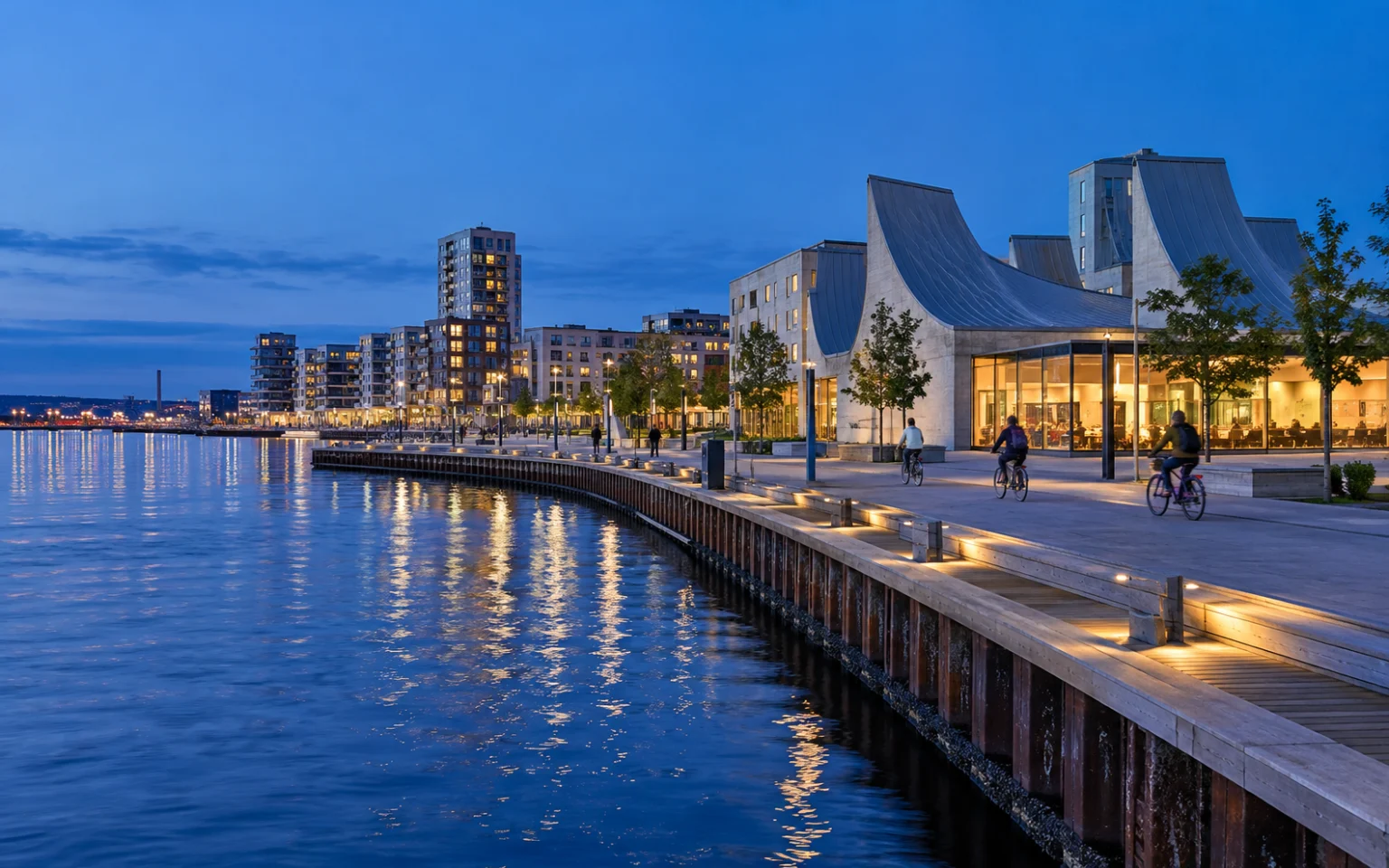
The waterfront shows how an industrial port was redesigned for public life, with promenades, cultural buildings and public seating replacing cranes and warehouses along the water. Locals use it for everyday movement, which is why the paths feel lived-in rather than staged. The Utzon Center, opened in 2008, was designed with Jørn Utzon's son Kim and is dedicated to the architect who grew up in Aalborg and later designed the Sydney Opera House. Nordkraft, a former power station, now hosts cultural events, and the House of Music and promenade turn the water's edge into a place for walking and cycling.
Kunsten Museum of Modern Art, inaugurated in 1972 to designs by Alvar Aalto, Elissa Aalto and Jean-Jacques Baruël, brings Nordic modernism to the north of Jutland. Its pale building and well-lit galleries are as much part of the visit as the collection, and the museum lets visitors see how a Finnish master adapted his language of light and natural material to a Danish site. A European Commission survey in 2014 found Aalborg citizens the most satisfied with their city in Europe, and the city is nicknamed the Paris of the North, a phrase that sits comfortably beside its student life.
Carnival and daily culture
The Aalborg Carnival, held in late May, draws about 100,000 visitors and fills the streets with costumed parades, music and student groups. It reveals a lively, open side of a city that otherwise values calm, direct courtesy, and it is the clearest reminder that the old trading town still gathers its streets for a party. Ordinary evenings centre on cafés, a symphony orchestra, theatres and the Jomfru Ane Gade nightlife strip, which is loud late at night.
Food and the fjord
Aalborg is a fjord town, so fish and seafood appear on most menus, and a traditional open sandwich or a simple café lunch gives better value than a nightlife-strip meal. Ask clearly about allergens and current ingredients. A third day can reach the North Sea coast, the Rebild hills or another North Jutland town, though public-transport frequency decides what is realistic.
A two-day itinerary
Day one: old city and waterfront. Begin around Budolfi Cathedral and the old centre, noting Jens Bang's house and the outer view of Aalborghus Castle, where public access varies by section and event. Respect offices and barriers. Use the Aalborg Historical Museum if local context matters. For lunch, move away from the loudest nightlife strip. In the afternoon walk to the Utzon Center and the House of Music, continue east toward Nordkraft, and cross the fjord only if the return route fits daylight and weather. Exhibitions and events change, so check the programme.
Day two: art and Viking landscape. Start at Kunsten on a day it is open, since the visitor page lists Monday closure except selected holiday periods. Travel to Lindholm Høje in the afternoon. The hillside contains Iron Age and Viking-period burial sites whose stone settings are most meaningful with the museum's interpretation. Paths cross an exposed landscape, so bring wind and rain protection, stay on designated routes and never climb on or rearrange the stones. If archaeology is not a priority, use the day for Kunsten, residential streets and a slower waterfront circuit.
Getting there, costs and etiquette
Intercity and regional trains serve Aalborg station, and the airport lies close to the city with public-transport links. North Jutland's bus system covers the city and Lindholm area, so buy the appropriate ticket before travel. Walking handles most central journeys, cyclists should use marked infrastructure, and the Limfjord bridges can be windy. May and June combine long daylight with lower demand, July and August bring festivals and higher room prices, and winter favours museums and restaurants. Rain can arrive quickly.
Budget for Danish-level accommodation and meals, local transport and one or two paid attractions a day. Cards are widely used, but carry a second payment method. Restaurant service is included in the price, so tipping is optional. The modern waterfront is relatively level, but cobbles and the slopes at Lindholm Høje need advance checking. When strong wind or rain removes the pleasure from the promenade, combine Kunsten with an indoor programme at Nordkraft or the historical museum, and check the day's exhibitions first. Keep walking groups out of cycle space, ask before photographing people closely, lock bicycles and stay away from unprotected water edges. Skagen deserves its own plan; our Skagen guide covers the light and the painters.
For the bigger picture, read what makes Denmark special, explore the Denmark destination hub, compare the capital with our Copenhagen first-time guide, or browse all countries for more country guides.
Questions and answers
How many days should a first Aalborg visit take?
Two days suit the waterfront, historic centre and one or two museums. Add another day for Lindholm Høje, a coastal excursion or a slower food-focused visit.
Can Aalborg be explored without a car?
Yes. The centre and waterfront are walkable, city buses cover outer sights, and trains connect Aalborg with other Danish cities. Rural North Jutland is easier by car.
Is Aalborg mainly a nightlife city?
No. Jomfru Ane Gade is known for nightlife, but Aalborg also offers architecture, Viking archaeology, modern art, industrial heritage and the Limfjord landscape.
When should visitors go to Aalborg?
Late spring to early autumn gives longer days and waterfront activity. Winter is quieter and works for museums, although wind, short daylight and reduced hours shape the plan.
Sources
Copenhagen · 55.6761° N, 12.5683° E
This story belongs to Aalborg, Denmark. A small kingdom whose pride runs from a tenth-century rune stone to fairy tales, furniture and a kitchen revolution.