Acadia Without Parking Stress: Island Explorer and Sunrise Planning
A car-light Acadia guide explaining vehicle reservations, Island Explorer connections, parking decisions, coastal routes and sunrise trade-offs.
The easiest way to reduce Acadia parking stress is to decide which journeys do not need the car. Use seasonal Island Explorer service for connected park stops, reserve Cadillac Summit Road only if it genuinely fits the plan, and give the car one legal parking decision instead of moving it for every view.
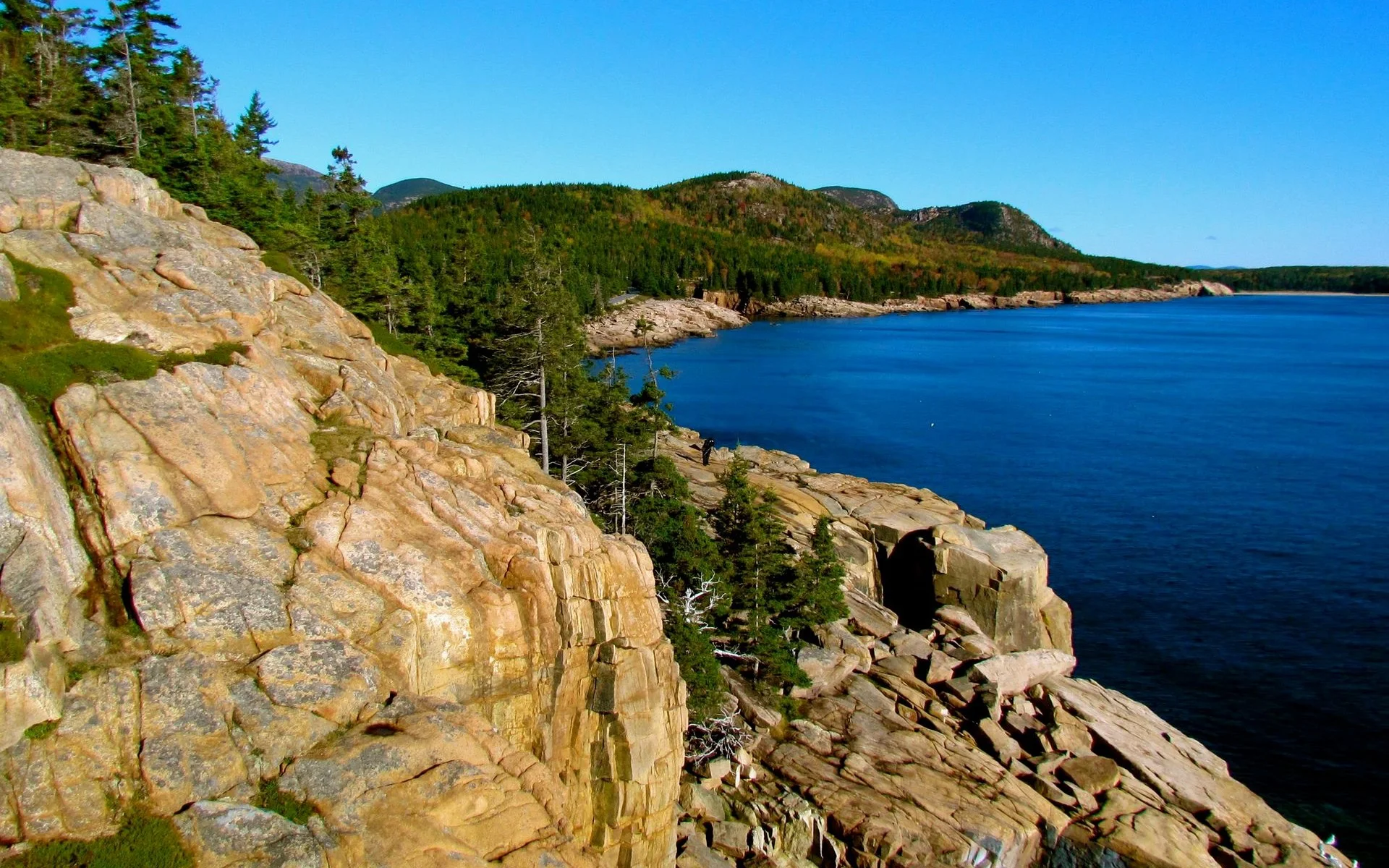
Cover photograph: Otter Cliff in Acadia National Park, by Jeff Gunn / Wikimedia Commons, CC BY 2.0. Cropped and converted to WebP.
Why Acadia matters: a coast given to the public
Long before it was a national park, Mount Desert Island was Wabanaki homeland. The National Park Service notes that the area has been peopled for more than 12,000 years, and that some Wabanaki called the island Pemetic, meaning "range of mountains". The Wabanaki, the People of the Dawnland, include the Maliseet, Micmac, Passamaquoddy and Penobscot, whose nations still live in Maine today. Wabanaki guides were with Samuel de Champlain when he arrived in 1604, and the nearby Abbe Museum holds the largest and best documented collection of Maine Indian basketry.
The park itself grew out of generosity. From the late 1800s, summer visitors known as rusticators came by steamboat and yacht, and some of them set out to protect what drew them. Charles W. Eliot and George B. Dorr, with help from John D. Rockefeller Jr., gathered land, and in 1916 President Woodrow Wilson established Sieur de Monts National Monument from 5,000 acres Dorr had given. It became Lafayette National Park in 1919, with Dorr as its first superintendent, and took the name Acadia in 1929. The Park Service calls it the first national park created from private lands gifted to the public.
Rockefeller's other legacy is the one most visitors use. Between 1913 and 1940 he and his family built 45 miles of rustic carriage roads, closed to cars, and financed 16 of the 17 stone-faced bridges that carry them over streams and gorges. Pink granite, spruce forest and a cold Atlantic shoreline complete the picture.
For people in Maine, Acadia is a source of pride because it was given, not taken: a coast set aside by people who could have kept it private. Protecting that gift today largely comes down to how many cars try to reach the same viewpoints at once, which is where the practical planning starts.
Start with the two reservations people confuse
An entrance pass and a Cadillac Summit Road vehicle reservation are different. During the reservation season, driving the summit road requires the timed vehicle reservation described by the National Park Service. It does not provide a reserved parking space elsewhere, and a park pass alone does not authorize the summit road.
If summit reservations are unavailable, the trip is not ruined. Acadia's carriage roads, coastal landscapes, lakes, mountains and interpretation remain.
Decide whether the Island Explorer serves the day
The fare-free seasonal Island Explorer connects Bar Harbor, campgrounds and many destinations. Use the current route information and the park's public transportation page. Service frequency, bicycle capacity and seasonal dates matter.
A workable car-light day pairs destinations on one route or at connected stops. Do not assume every trailhead has frequent service late in the day. Photograph or download the return timetable.
Give the coast one continuous block
Skip the drive between Sand Beach, Thunder Hole and Otter Point; use the shuttle where available and walk an appropriate section of Ocean Path. Tide, waves, wet granite and congestion affect the experience. Remain behind barriers and away from wave-washed ledges; a calm photograph does not show the force of the next swell.
When parking is full, continue to the next legal option. Road shoulders and vegetation are not overflow lots.
Choose a sunrise for the right reason
Cadillac Mountain is famous for sunrise, but coastal fog can erase the horizon and early starts add cold, darkness and sleep loss. Reserve it when the group values the experience even if cloud blocks the sun. Bring layers and a light; never stop on the summit road outside authorized areas.
An alternative morning may be quieter: an early carriage-road walk, Jordan Pond area after checking access, or a shoreline route when conditions are safe. Sunrise is a weather event, not a required Acadia achievement.
Use Bar Harbor as a transport hub, not only a bed
Staying in Bar Harbor supports walking to restaurants and boarding seasonal buses without moving a vehicle. Campgrounds and other Mount Desert Island towns can work better for travelers prioritizing a different area. Choose the base by the first two mornings, not by a generic island ranking.
For a short stay, avoid crossing the island repeatedly. Group the east-side Park Loop Road sights, then give western Mount Desert Island or the Schoodic Peninsula a separate day if time allows.
Build the timetable backward from the return
For a shuttle-supported walk, begin with the last acceptable return bus, then subtract walking time, rest time and a missed-bus margin. Only then choose the outward departure. This matters on one-way walks and routes where the next bus is much later. Save the timetable offline and verify whether stops are on one side of the road or in both directions.
For a driving day, write one parking decision for morning and one for afternoon. Park Loop Road can include one-way sections, so missing a stop may require a long legal loop; never reverse or stop in a travel lane. A full lot means moving to the next legal plan, not waiting where traffic cannot pass.
Separate Mount Desert Island from Schoodic
Schoodic Peninsula is part of Acadia but lies on the mainland across Frenchman Bay. It is not a quick extension after a crowded island afternoon. Give it its own half or full day with drive time, bicycle rules and seasonal service checked. Western Mount Desert Island likewise deserves a separate block when the aim is quieter roads and trails.
For a two-day first trip, keep one day on the east side with the main park loop and one day for carriage roads, a mountain suited to conditions or a different island area. A third day provides the best fog contingency.
Plan sunrise without sacrificing safety
Prepare clothing, headlamp, route and reservation the night before. Check wind, cloud and road status. Drive slowly for wildlife and people walking in darkness. At the summit, remain on durable surfaces and within open areas; do not cross vegetation to separate from the crowd.
After sunrise, fatigue can make a long hike or drive unsafe. Schedule breakfast and a low-effort morning module, or return to lodging. A later clear morning can provide better landscape visibility than a cloudy sunrise.
Use closure-specific substitutes
If Cadillac Summit Road is unavailable, use a lower-elevation carriage-road or shoreline plan. If surf makes exposed Ocean Path sections unsafe, move to forest, pond or cultural interpretation. If fog removes views, keep close-range granite, forest and historic sites. If buses are not operating, reduce the number of locations and leave out the same route by car.
Check current conditions for facilities as well as roads. A closed restroom, bridge or parking area can change the accessible route even when the attraction remains open.
Keep a fog-and-rain alternative
Review current conditions. In poor visibility, prioritize forest and carriage-road experiences suited to conditions, cultural interpretation and a slower Bar Harbor day. Strong wind and surf should remove exposed rock routes from the plan. Fog is part of this coast's character, and the Jordan Pond area, the forest trails and the carriage-road bridges all reward a slow walk in soft light.
Autumn traffic, winter closures and spring maintenance change what is practical. The park's directions and transport guidance should be checked for the actual season.
Check accessibility beyond the word “path”
Acadia's accessibility page identifies facilities, viewpoints and trail conditions. Carriage roads can still have grades and loose surfaces. Confirm bus boarding, restrooms and the exact segment instead of treating the whole park as one condition. Ask about accessible viewpoints along Park Loop Road, step-free restrooms at the main visitor areas, and whether a particular carriage-road section is firm enough for a wheelchair or stroller after rain. Rangers at the visitor center can suggest a route that matches the group's needs on the day.
Budget for the island, not only the park pass
The park entrance pass, Cadillac vehicle reservation, lodging and bicycle rental are separate costs. Bar Harbor rooms can be expensive during peak periods, while a cheaper mainland stay adds driving and parking. Compare the complete day. Bring a refillable bottle and food where permitted, but secure it from wildlife and pack out waste.
If traveling with a bicycle, confirm whether the current bus route accepts it and whether capacity can be reserved; do not assume every departure will have room. E-bicycle classifications and carriage-road rules should be checked directly with the park before arrival.
Common mistakes are confusing the entrance pass with the summit reservation, assuming every island bus runs late, parking on vegetation and scheduling sunrise after a late arrival. A written transport fallback removes all four.
The United States destination hub links the national collection, and what makes the United States special sets parks like Acadia in a wider context. Continue through New England with the Boston guide or compare the Pacific Northwest in the Portland guide.
Questions and answers
Do you need a vehicle reservation for Acadia?
A vehicle reservation is required for Cadillac Summit Road during the reservation season, separate from the park entrance pass. Other park roads do not use that same reservation, but legal parking remains limited.
Why is Acadia National Park significant?
The National Park Service describes it as the first national park created from private lands gifted to the public. It began as Sieur de Monts National Monument in 1916, became Lafayette National Park in 1919 and took the name Acadia in 1929, on an island the Wabanaki have known for more than 12,000 years.
Is Cadillac Mountain sunrise guaranteed to be clear?
No. Fog, cloud, rain and wind are normal coastal conditions. Treat sunrise as a weather-dependent experience and keep another morning plan.
Sources
New York City · 40.7128° N, 74.0060° W
This story belongs to United States. A country of home towns and large ideas, from Independence Hall and the first national park to jazz, skyscrapers and volcanic islands.