Banff Without a Car: Canada's First National Park on Foot
Three railway workers, a hot spring and a federal reserve started Canada's national park system at Banff. This guide tells that story and shows how to see it without a car.
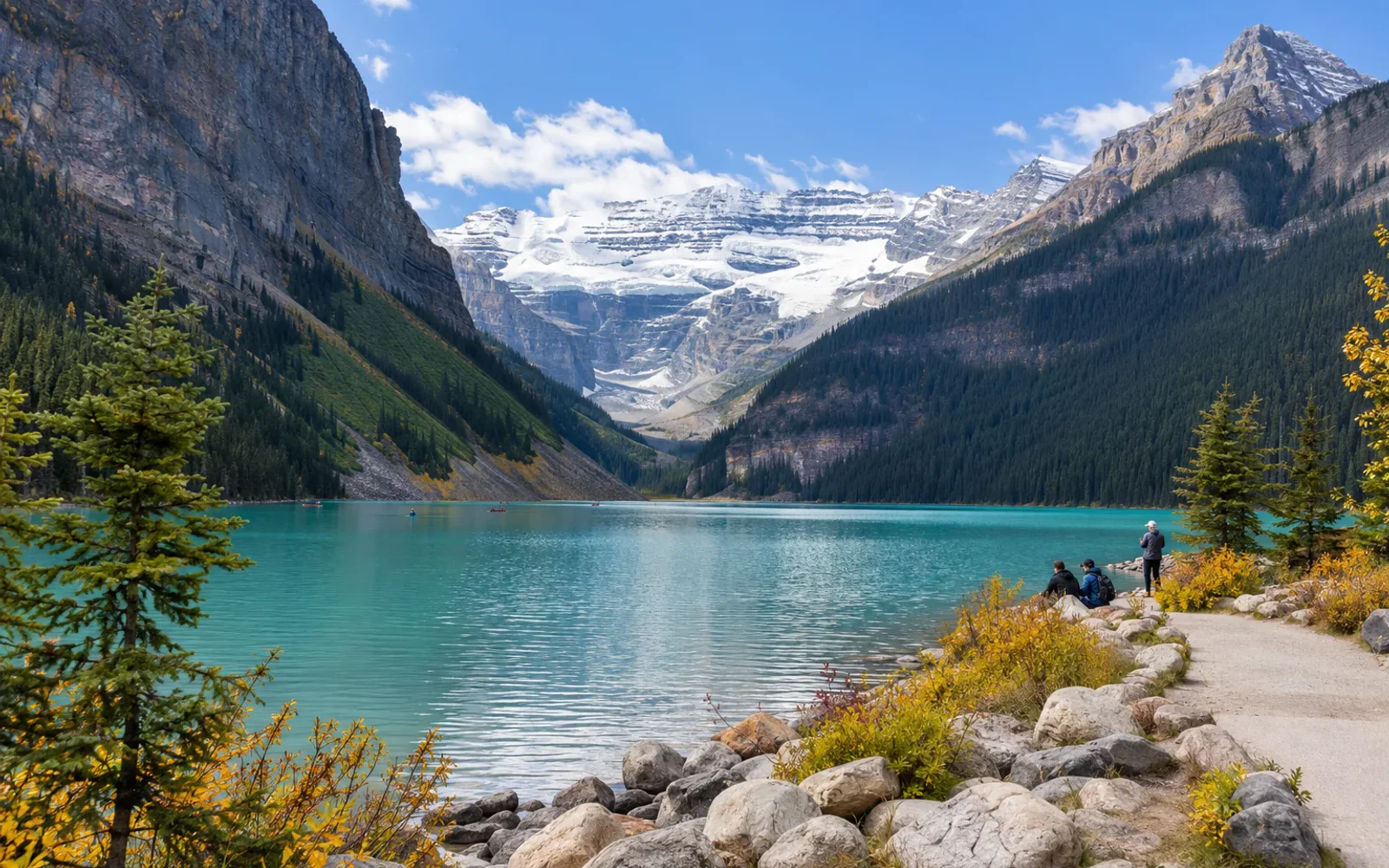
Cover: AI-generated illustration. © ANUSHKA DAHANAYAKE (PVT) LTD.
Banff began as an accident of geology and railway ambition. In 1883, three Canadian Pacific Railway workers found hot springs and a cave on the flank of Sulphur Mountain. A dispute over who owned the springs ended in 1885, when the federal government set aside a reserve of about 26 square kilometres around what is now the Cave and Basin National Historic Site. In 1887 that reserve grew to 673 square kilometres as Rocky Mountains Park, the start of Canada's national park system. The town takes its name from Banffshire in Scotland, the birthplace of CPR financier George Stephen, who suggested it in 1884.
The park that railways built, and the people who were here first
The railway company wanted travellers to fill its trains, so it built a château above the Bow River. The Banff Springs Hotel opened on 1 June 1888, and the railway's president, William Cornelius Van Horne, chose the site himself. Grand hotels, a station and a spa town followed, and Banff became the model for how a protected landscape could also be a destination.
The land had been used long before any of this. The Stoney Nakoda, whose home territory lies east of the Rockies, and neighbouring Blackfoot nations travelled through these valleys. From the late nineteenth century until 1978, the town hosted Banff Indian Days, an annual gathering in which Stoney Nakoda families camped beside the town, held parades and competitions for visitors and residents alike. The Whyte Museum's archives now work with Stoney Nakoda community members to identify the people in its historic Indian Days photographs. That history makes the park's founding story more complicated than a tale of discovery.
Banff also carries a harder chapter. During the First World War, an internment camp operated here and at Castle Mountain from 1915 to 1917, holding mostly Ukrainian immigrants who were put to work on park projects.
What locals point to with pride
Culture has grown alongside the scenery. The Banff Centre Mountain Film Festival held its first screening on 31 October 1976, and its touring programme now reaches audiences far from the Rockies. The Whyte Museum of the Canadian Rockies keeps the region's art, archives and mountaineering history in one place.
In 1984 UNESCO inscribed the Canadian Rocky Mountain Parks, including Banff, Jasper, Yoho and Kootenay, as a World Heritage Site for their peaks, glaciers, lakes and the Burgess Shale in Yoho, a fossil bed that preserves soft-bodied sea animals from the Cambrian period, more than 500 million years ago, in startling detail. Few protected areas anywhere show their deep time so plainly. Since 1990 Banff has also been the only incorporated municipality inside a Canadian national park, which explains why housing, shuttles and wildlife rules are discussed so openly in town. Roam Transit, the local bus network, began running in June 2008 and made a car-free visit realistic.
Smaller dates fill in the picture of a mountain town that took itself seriously. The railway station that still greets coach and train passengers dates from 1910, and in 1991 Banff hosted the Winter Deaflympics, the only time Canada has staged those Games. A town of roughly 8,300 residents, by the 2021 census, now looks after a far larger crowd of visitors every summer, which is why the park asks so much of them in return.
A three-day route that follows the story
Day one, the town. Start at the Banff Visitor Centre for current trail, wildlife and weather information. Walk to Cave and Basin to stand where the 1883 discovery happened and see how the first reserve was run, then follow the Bow River paths toward the Whyte Museum and the Cascade of Time Garden. Roam Transit reaches the Banff Gondola and the Upper Hot Springs, which have their own tickets and capacity limits.
Day two, the lakes. Lake Louise and Moraine Lake are the demanding days because of reservations. Parks Canada says Moraine Lake Road is closed to personal vehicles year-round, so the Parks Canada shuttle, Roam and authorised commercial operators carry visitors in season. Shuttle inventory is released in stages, so read the current shuttle FAQ and book transport before building the day. The public lakeshore at Lake Louise gives the classic view toward Victoria Glacier; longer hikes such as Lake Agnes need proper footwear and realistic fitness.
Day three, one corridor. Johnston Canyon, Lake Minnewanka or a slow day among the Bow River museums each fills a day. Treat the Icefields Parkway as a separate journey, since services are limited and conditions vary.
Getting there, staying safe and paying for it
Calgary is the air gateway, and several coach companies run to Banff. Reserve both directions and leave a generous buffer before a flight. Stay in Banff town for the widest transit network; Lake Louise village suits early starts but has fewer services, and Canmore sits outside the park with more beds but longer transfers.
National park admission applies to adult visitors unless exempt, so buy it from an authorised channel and confirm that a hotel booking does not already include it. Parks Canada advises staying at least 30 metres from elk, deer, sheep and moose, and 100 metres from bears, wolves, cougars and coyotes. Feeding wildlife is unlawful. Carry bear spray where recommended, keep it where it can be reached and make noise on trails. Snow can linger on high trails long after the town turns green, and summer smoke or a sudden storm can end a plan, so pack layers and download maps because mobile coverage is patchy.
Accessibility varies by shuttle and viewpoint. Contact operators before booking if lift access or mobility-device space is needed. The lakeshore at Lake Louise is easier to reach than most hiking routes. Costs come mainly from lodging, park admission and reserved transport, so book only the days a realistic itinerary will use.
For the wider picture, read what makes Canada special and browse the Canada destination hub. Visitors continuing west can pair Banff with the Vancouver first-time visitor guide, while those wanting a city contrast can turn to Toronto in three days.
Questions and answers
Can you visit Banff National Park without a car?
Yes. Regional coaches reach Banff, Roam Transit connects the town with several major sights, and Parks Canada or commercial shuttles serve Lake Louise and Moraine Lake seasonally. Reservations and schedules require advance planning.
Can private cars drive to Moraine Lake?
Personal vehicles are generally not permitted on Moraine Lake Road. Visitors use Parks Canada, Roam or authorised commercial transport when the seasonal road and services operate. Confirm the current season's rules before booking.
How far should visitors stay from wildlife?
Parks Canada advises at least 30 metres from elk, deer, sheep and moose, and at least 100 metres from bears, wolves, cougars and coyotes. Never feed, entice, follow or crowd wildlife.
Is Banff suitable for travellers who do not hike?
Yes. Scenic transit, viewpoints, the Banff townsite, Lake Louise lakeshore and managed attractions can form a rewarding visit. Accessibility varies, so check each stop and shuttle directly.
Sources
Toronto · 43.6532° N, 79.3832° W
This story belongs to Banff, Canada. The second-largest country by area, shaped by Indigenous nations, two official languages, newcomers from every continent and a national park system begun at Banff.