Barcelona: Gaudí's Unfinished Basilica, Modernisme and Human Towers
The Sagrada Família begun in 1882, seven UNESCO-listed Gaudí works, Domènech i Montaner's Palau de la Música and the castells, with the practical advice that supports a first visit.
Barcelona is the capital of Catalonia, a city with its own language, its own festivals and a habit of building things nobody else would attempt. It has a basilica that has been under construction since 1882, a street grid that planners still study, concert halls made of mosaic and glass, and teams of amateurs who stand on each other's shoulders to build towers. Pride here is specific, and most of it can be seen on foot.
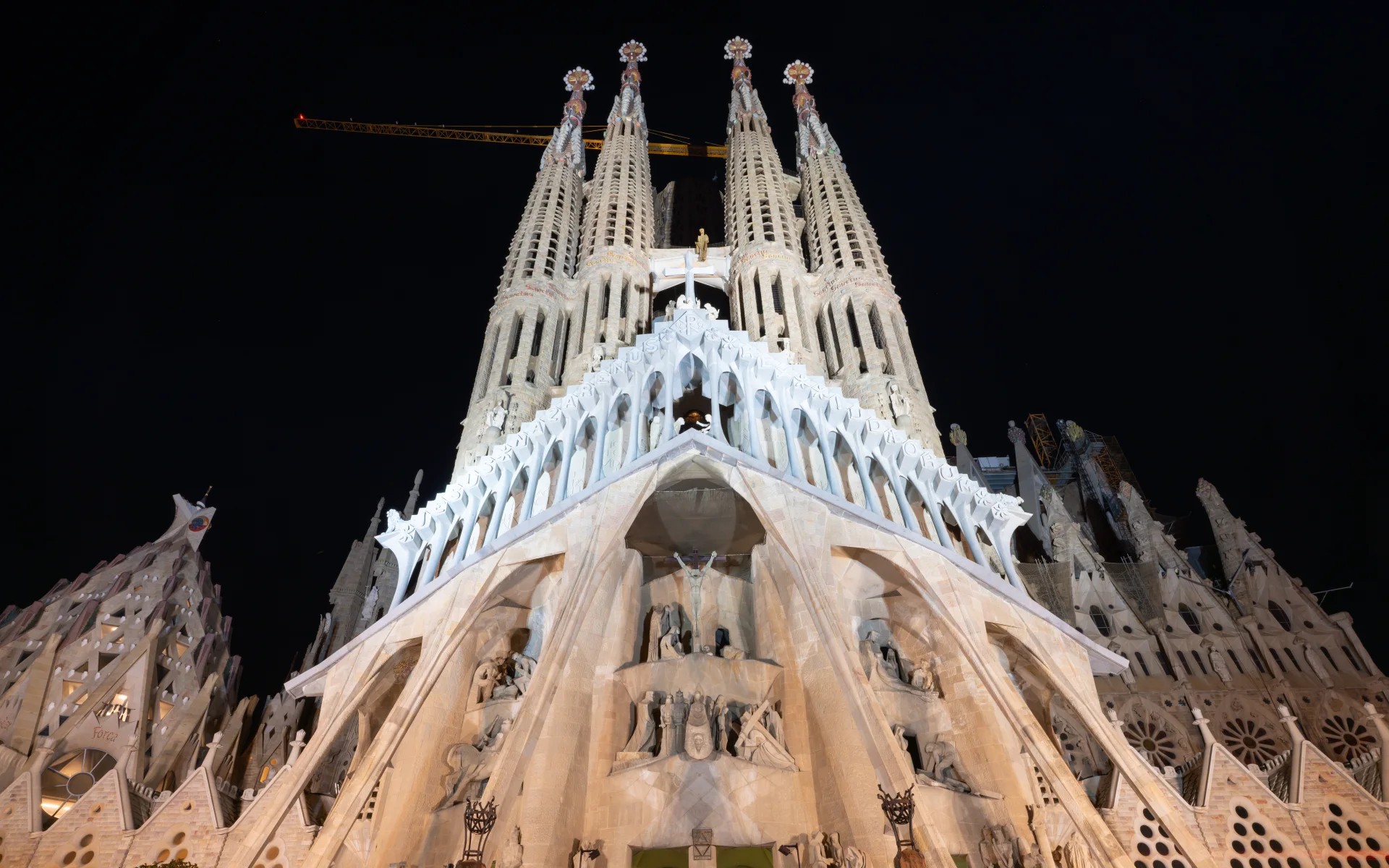
Cover photograph: Maksim Sokolov, “Sagrada Familia at night 01,” 13 July 2022, own work under CC BY-SA 4.0. Cropped to a 16:10 frame and converted to responsive WebP sizes; no landmarks were added or removed.
A basilica begun in 1882
Work on the Sagrada Família began on 19 March 1882. The first architect, Francisco de Paula del Villar, resigned, and Antoni Gaudí took over as chief architect in 1883. He worked on the basilica until his death in 1926, and the building is still rising, funded by visitors and donations; the central tower reached structural completion in February 2026, with the interior of its spire expected to follow in 2028. Pope Benedict XVI consecrated it as a basilica on 7 November 2010. Seven Gaudí works carry UNESCO World Heritage status: Park Güell, Palau Güell and Casa Milà (La Pedrera) were listed in 1984, and the 2005 extension added the Nativity façade and crypt of the Sagrada Família, Casa Vicens, Casa Batlló and the crypt at Colònia Güell.
Modernisme beyond Gaudí
Gaudí belonged to a wider movement, Catalan Modernisme. Lluís Domènech i Montaner built the Palau de la Música Catalana between 1905 and 1908, a concert hall inaugurated on 9 February 1908 and inscribed by UNESCO in 1997 together with his Hospital de Sant Pau. The Sant Pau complex is a garden of decorated pavilions instead of a single block, and the Passeig de Gràcia carries more façades from the same generation.
The grid and the old town
The Eixample, planned by Ildefons Cerdà from around 1859, gave Barcelona blocks with chamfered corners, so every intersection widens into a small octagon for light, air and turning carriages. Older Barcelona sits inside the Gothic Quarter, where stretches of the Roman town of Barcino survive among medieval lanes near the cathedral and the Plaça del Rei. Santa Maria del Mar in El Born is the city's masterpiece of Catalan Gothic, a fourteenth-century church whose tall, plain nave rewards a quiet half hour away from the Gothic Quarter crowds.
Human towers, books and roses
Castells, the human towers built by castellers in stages of six to ten levels, with a crowd called the pinya supporting the base, were added to UNESCO's Intangible Cultural Heritage list in 2010. Musicians playing the gralla, a Catalan woodwind, set the rhythm as each team climbs, and skills pass down within each group through practice. The towers appear at festivals such as La Mercè in September. On 23 April, Sant Jordi, the city swaps books and roses on the street. The 1992 Olympic Games opened the waterfront and the beaches of Barceloneta to the rest of the city.
What to eat and where to taste it
Catalan cooking centres on pa amb tomàquet, bread rubbed with tomato, then seafood rice, calçots grilled over flames in winter and crema catalana to finish. The Boqueria market off La Rambla is the best-known stage for jamón, seafood and fruit, though neighbourhood markets in Gràcia and Sant Antoni are calmer. FC Barcelona's motto, més que un club, explains why a football ground is also a point of civic pride for many Catalans.
Seeing it well: reservations and routes
Book first, then plan the day around it, and recheck the venue's hours before travel, because services, holidays and maintenance can close parts of a site. The Sagrada Família's official FAQ says tickets are named, tied to a set time and require photo identification; a late arrival can be refused. The basilica is accessible for visitors with reduced mobility, but the towers are not. Park Güell sells personal tickets with a 30-minute entry window after the booked time, and it does not allow re-entry. Casa Batlló, La Pedrera and the other Modernisme interiors compete for time and budget, so choose the one that interests you most; the Passeig de Gràcia works as an open-air architecture walk without buying every ticket.
A workable three days follows districts. Day one: the Gothic Quarter in the early calm, then El Born and Santa Maria del Mar. Day two: the Sagrada Família at its booked slot, Sant Pau nearby, then the Eixample blocks around the Passeig de Gràcia. Day three: Montjuïc for gardens and museums, or Gràcia for its squares. The Barcelona city page places these areas in context.
Practical help: getting around, heat and respect
Transport. The metro and buses cover the visitor districts. TMB says the L9 Sud metro serves both airport terminals, but single tickets and the T-casual card are not valid at Aeroport T1 or T2, so buy the separate airport metro ticket or use a bus. Walk within each district and take the metro between them.
Heat and the sea. Begin exposed walks early in summer and carry water for Montjuïc and Park Güell, which both have slopes. At the beach, follow the flags; the city's visitor advice says they signal sea conditions and must be respected. Park Güell's accessibility page describes the easier approaches for anyone with limited mobility.
Living alongside residents. The Gothic Quarter, El Born and Gràcia are also home to schoolchildren and pensioners. Keep voices low at night, do not sit on private steps, keep phones out of back pockets on La Rambla and in the metro, and try bon dia and gràcies. For emergencies, call 112.
The Sagrada Família's towers are one chapter of a country with very different regional identities. Read what makes Spain special for the whole picture, compare Barcelona with Valencia on the Mediterranean, follow Basque food culture to San Sebastián, or return to the Spain destination hub.
Questions and answers
How many days do you need in Barcelona?
Two full days are enough for one old-city route and one focused Modernisme route. A third day adds Montjuïc, Gràcia or a carefully planned waterfront visit without forcing constant cross-city travel.
Is Barcelona easy to visit without a car?
Yes. Metro, buses and walking cover the main visitor areas. A car is normally less useful because of traffic, parking and restricted central streets.
Which Barcelona attractions should be booked?
Reserve Sagrada Família and Park Güell through their official channels if they are essential to your trip. Choose at most one other paid Modernisme interior rather than stacking timed entries.
Sources
Madrid · 40.4168° N, 3.7038° W
This story belongs to Barcelona, Spain. A peninsula of strong regional cultures, from Altamira's cave art and the Alhambra to Gaudí's Barcelona and a pilgrim road walked for a thousand years.