Basel by Rhine and Museum: A Practical Two-Day City Guide
A realistic Basel plan connecting the old town, Rhine and one carefully chosen museum without treating the city as a quick border stop.
Cover: AI-generated illustration. © ANUSHKA DAHANAYAKE (PVT) LTD.
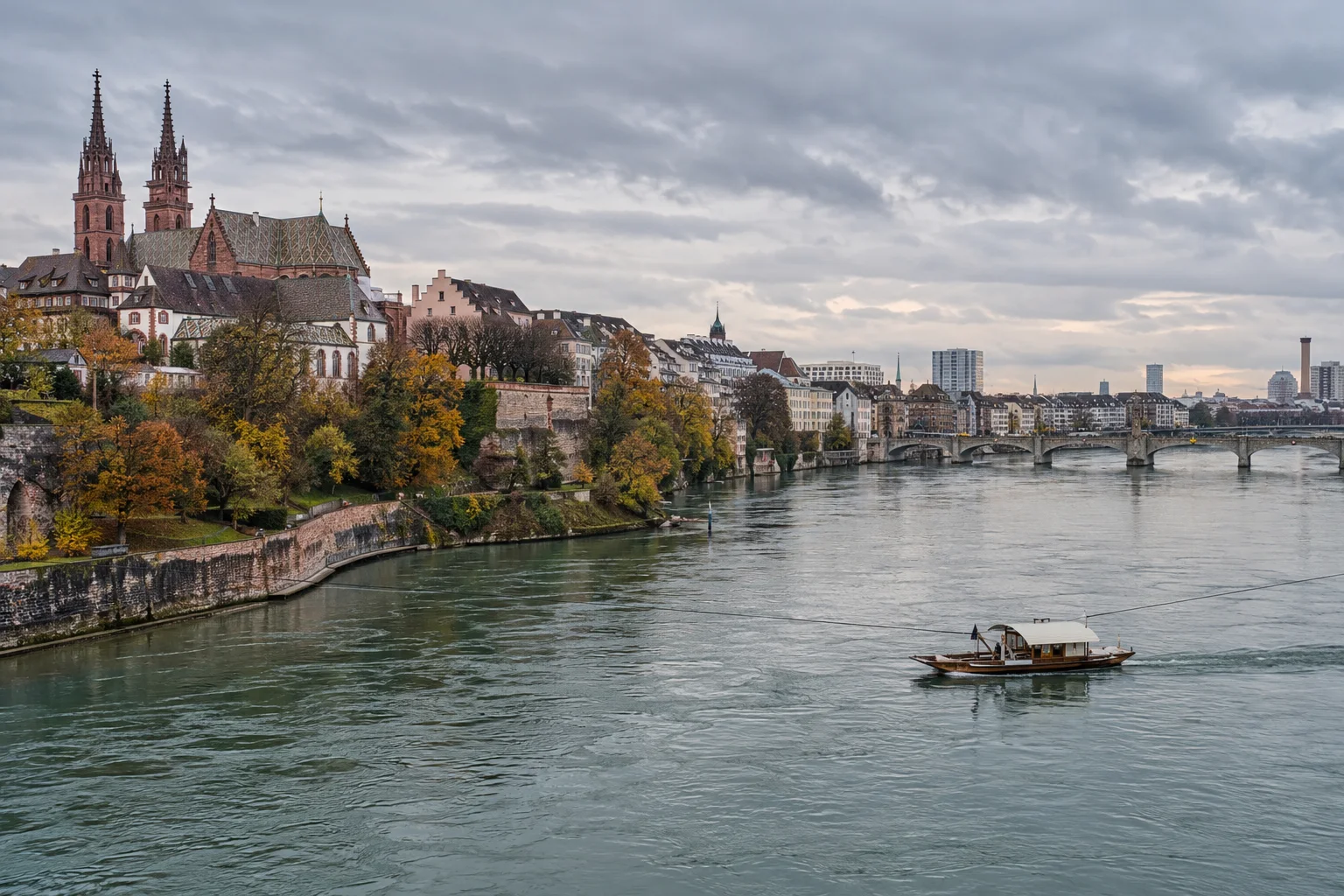
Basel is a river city before it is a checklist of museums. The Rhine divides Grossbasel and Kleinbasel, the Münster rises above a bend and small ferries use the current rather than an engine. At the same time, the city's art institutions can fill several separate trips. Two full days work when the first establishes the city and the second gives one museum enough attention.
Arrive with the correct Basel station in mind
Basel SBB is the main Swiss railway station and the usual arrival from Zürich, Bern and much of Switzerland. Basel Badischer Bahnhof is operated within the German railway system and can be more convenient for some cross-border routes. The stations are not interchangeable dots; check where your train arrives and how the hotel connects by tram.
Choose accommodation near Basel SBB for a short rail-based stay, in the old-town area for atmosphere, or in Kleinbasel for direct Rhine access and a more mixed evening scene. Ask about street noise and the exact entrance. Historic buildings may have stairs even when nearby transport is accessible.
Some overnight visitors receive a local guest card or transport benefit. Confirm current eligibility and activation with the accommodation, because an old online description may be out of date. If you are making journeys into France or Germany, check which ticket and mobile-roaming rules cover the full route.
Day one: station to Spalentor, Rathaus and Münster
Begin at Spalentor or approach it through the upper old town. Basel Tourism's signed walks provide a useful structure, but you need not complete every route. The lanes include gradients, cobbles and fountains, so comfortable shoes matter. Leave room around shop doors and private residential entrances.
Descend towards Marktplatz and the red Rathaus. The market has its own operating days and hours; visit it as a working place, not as a photo background for produce. Public areas of the Rathaus may be accessible at particular times, while formal tours and council activity have separate conditions.
Continue through the centre to the Münster. Respect services and posted photography rules. The tower climb involves roughly 250 steps and is unsuitable for some visitors, but the Pfalz terrace behind the cathedral gives a strong Rhine view without that climb. From here, the distinction between both riverbanks becomes easy to understand.
Cross the Rhine slowly
Walk down to a ferry landing if services are operating. Basel's reaction ferries attach to a cable and use the river current to cross. They are public transport experiences, not private sightseeing boats. Have the expected fare method ready, follow the ferryman's directions and keep children close during boarding.
On the Kleinbasel bank, walk part of the riverside before crossing back. In warm months it becomes a social space; in colder weather it offers open city views. Use Mittlere Brücke for the return and watch cycles and trams at approaches.
The Rhine is powerful. Strong local swimmers may use established summer routes and waterproof swim bags, but observing that practice does not make it safe for an unfamiliar visitor. Never enter after alcohol, near bridge structures or without knowing official access and exit points. Cold shock, current and commercial navigation are real hazards. A ferry ride provides the river experience without pretending competence.
Day two: choose one museum family
Basel's museum density makes selection essential. Kunstmuseum Basel suits travellers seeking a broad art collection. Its core is the Amerbach Cabinet, which the city and university bought in 1661 to stop it leaving Basel and opened to the public in 1671, one of the earliest civic art collections anywhere, rich in Holbein. Fondation Beyeler requires travel toward Riehen and deserves several hours. Museum Tinguely connects art with a different section of the Rhine. Smaller institutions may fit specialist interests better than the famous names.
Check the institution's own website for the exhibition, timed-entry rules, photography, bag storage and closed day. Do not rely on a general city list for current access. Choose one major museum and, at most, one small complementary stop. Exhibition fatigue is not cultural achievement.
Architecture visitors can also build a day around contemporary buildings, but many celebrated sites remain workplaces. Confirm whether public access exists instead of entering private corporate property. Photograph from public space without blocking gates or identifying employees.
Three countries require practical awareness
Basel's urban region touches France and Germany, and Alsace is close enough that Strasbourg works as a day by train. Trams, trains and buses can cross borders, yet Switzerland is not an EU member. Carry the documents required for your nationality, check data roaming and understand customs allowances. A day ticket bought for one zone may not cover a cross-border segment.
Euro notes may be accepted by selected businesses, but change and exchange rates can be poor; Swiss francs or card are the normal Swiss solution. If you shop abroad and return, tax-refund claims and import allowances are separate matters. Do not assume an open land border removes customs obligations.
Food, Fasnacht and respectful timing
Basel bakeries and restaurants provide regional specialities, but opening times vary and Sunday closes many ordinary shops. Plan one intentional local meal and use market or bakery food without eating on private steps. Service is included in menu prices; modest rounding is enough when service is good.
Fasnacht is a living local tradition with its own calendar and participating groups, and in 2017 UNESCO added it to its list of intangible cultural heritage, citing the way its satire, music and dialect hold the city together. If travelling during it, research the official schedule, crowd controls and photography etiquette. Give performers room, avoid flash in crowded areas and do not interrupt a formation for a portrait.
Buy from a named source
An art city offers more interesting objects than generic national souvenirs: museum publications, independent illustration, paper goods, small design studios and food with clear provenance. A museum shop purchase supports a different chain from an unlicensed street copy, but still check who made the item.
For a place-specific purchase, ask whether an illustration or craft was made by the person credited on its label, and whether it depicts Basel or only uses a generic Swiss motif. This is more useful than buying an untraceable copy of a local image.
Before departure, check railway engineering, museum admission, ferry operation and any cross-border ticket. Keep one unassigned hour for the Rhine or a delayed exhibition. Visit the Basel place page and Switzerland collection, then compare a steeper French-speaking city in the Lausanne guide.
Questions and answers
How many days does Basel need?
Two full days allow a coherent old-town and river route plus one major museum; add another day only if art institutions are the main reason for travelling.
Can visitors swim in the Rhine?
Only strong swimmers with current local knowledge should consider recognised summer practices. River current, boat traffic, water temperature and exit points make casual entry unsafe.
Is Basel useful without a car?
Yes. Mainline trains, trams, buses, walking routes and ferries cover the visitor city, while a car introduces parking and border complications.
Sources
Bern · 46.9480° N, 7.4474° E
This story belongs to Basel, Switzerland. A multilingual country where lakefront cities, alpine railways and strongly local identities sit within one remarkably connected landscape.