Bern Old Town and Arcades: A Practical Walking Guide
A useful Bern route from the station through the arcades to the Aare, with realistic timing and decisions for weather, mobility and river safety.
Cover: AI-generated illustration. © ANUSHKA DAHANAYAKE (PVT) LTD.
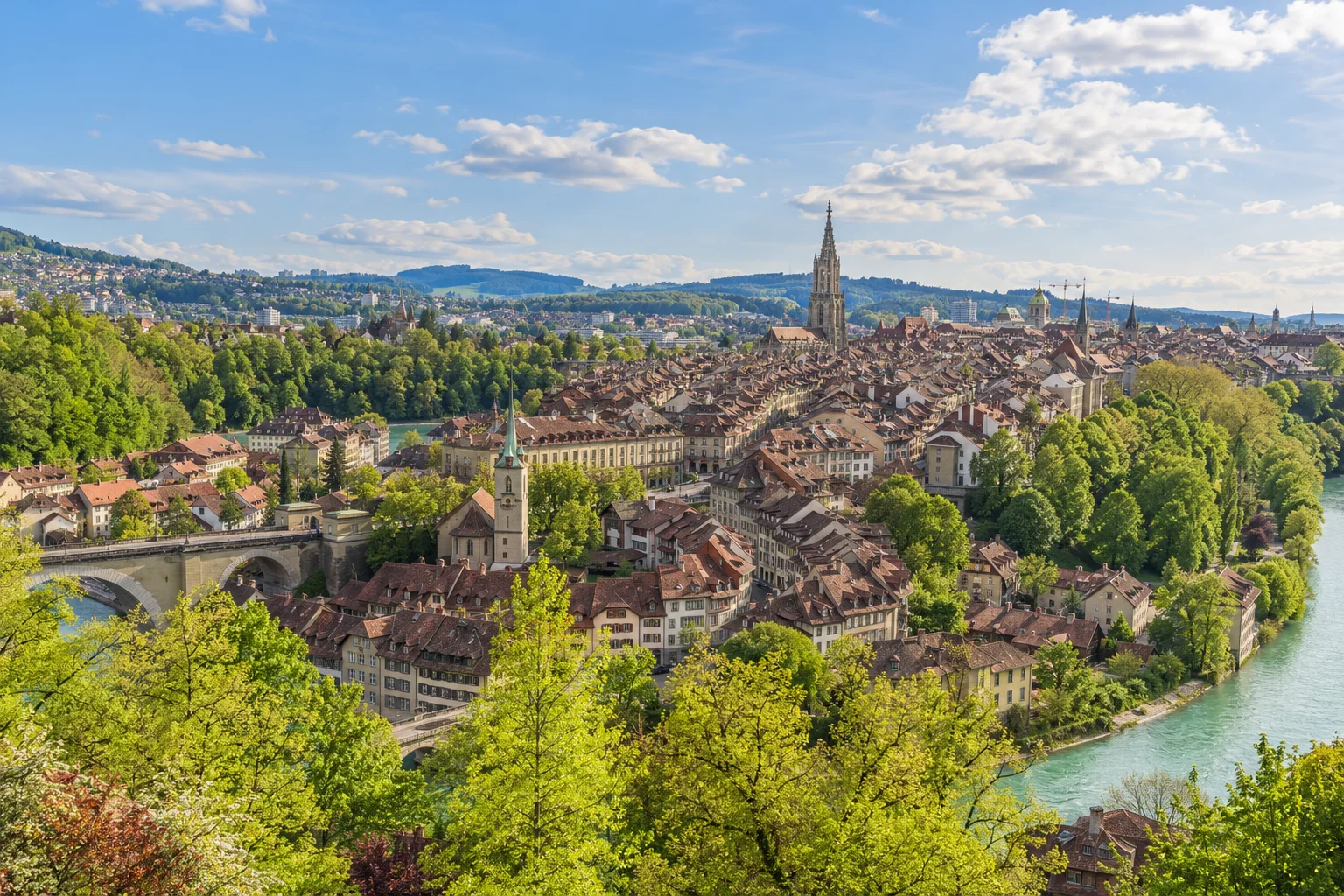
Bern reveals its plan quickly from above: a compact sandstone peninsula wrapped by the Aare, chosen by Duke Berthold V of Zähringen when he founded the town in 1191. UNESCO inscribed the Old City in 1983 because that medieval plan survives so completely. On the ground, it is the long sequence of arcades that makes the old town useful in rain, heat and ordinary daily life. One full day is enough for a clear first visit if you walk outward from the station, cross the river only when the route calls for it, and resist adding distant attractions merely because the city is the federal capital.
Start at the station, not the postcard
Bern Hauptbahnhof places you at the upper edge of the old town. Leave luggage in your accommodation or an official locker before walking; dragging a case over paving and into basement shops is unpleasant for everyone. From the station area, continue toward the Käfigturm and the sequence of central streets rather than taking a tram past the structure you came to understand.
The arcades are public circulation, shop frontage and weather shelter at once. Walk to one side, do not gather across entrances and watch for changes in level. Many shops occupy cellars reached by short stairways, so a continuous sheltered route does not mean every business is step-free. Travellers who need accessible entrances should identify specific venues ahead of time.
Read the fountains and clock without blocking the street
Bern's historic fountains help divide the long east-west route into understandable segments. They are heritage objects within active streets, not props around which traffic disappears. Observe tram tracks, cycles and crossings while looking upward.
At the Zytglogge, arrive before the hour only if the mechanism matters to you. The gathering can become dense, and the brief exterior display should not consume a large part of the day. A guided interior visit is a separate experience with its own schedule and stairs; book through a reliable official channel if that is a priority.
Continue toward the Münster and its terrace. Check worship and visitor times before entering, dress for a functioning church, and follow photography notices. The tower has many steps and is not the correct choice for every traveller. The terrace and nearby streets already provide a strong sense of the river and lower city.
Cross to the Rosengarten for the complete shape
Walk toward the Nydegg bridge and decide whether the uphill route to the Rosengarten suits your energy. Public transport can reduce the climb. From the garden, the old town's curve, tiled roofs and distant hills become legible in one view. Late morning gives clear orientation; evening can be attractive but should not be promised as a guaranteed sunset.
Return by bus or on foot, allowing extra time if surfaces are wet. The bear facility near the river is visible on this route, but animal welfare and crowd behaviour matter. Do not feed animals, reach past barriers or treat a living enclosure as a quick entertainment stop.
The Aare is beautiful and physically serious
Bern Welcome recommends Aare swimming only for experienced swimmers at their own risk; the current is powerful and exit points require knowledge. A visitor should not enter simply because other people do. Conditions, temperature, river level and individual ability all matter, and rescue can endanger others. Walking beside the river or sitting in an authorised public area provides the setting without the risk.
If you do have appropriate experience, obtain current local information and follow designated guidance and never improvise an entry. Never jump from bridges, swim alone, use alcohol beforehand or assume an inflatable changes the hazard. Families should keep children close along fast water.
Museums, parliament and rainy alternatives
Choose one indoor institution according to interest. The Bern Historical Museum and Einstein Museum provide historical context; Einstein lived at Kramgasse 49 from 1903 to 1905 while working at the patent office, and it was in Bern that he wrote the papers of his 1905 "miracle year"; the Zentrum Paul Klee requires a separate journey; federal institutions have access and security conditions. Tours of the Parliament Building, when available, should be checked and reserved through official sources. Carry identification if the instructions request it.
Rain does not ruin Bern because the arcades create kilometres of covered movement, but it does change viewpoints and river paths. Use wet weather to inspect shops, cafés and a museum, then take the Rosengarten view if visibility improves. Avoid filling the day with indoor stops so tightly that one delayed admission breaks the plan.
Food and spending with fewer assumptions
Central Bern is expensive, though transparent menu prices make comparison possible. Look for weekday lunch offers, bakeries and food halls, and reserve a special dinner instead of entering the first place beside a landmark. Confirm whether a restaurant serves continuously or closes between lunch and dinner.
Public fountains may provide drinking water unless marked otherwise, but read the signs. Carry a refillable bottle. Service is included in restaurant pricing; a modest round-up for good service is sufficient. Keep some flexibility for cards that fail or machines that require another payment method.
Buy the craft, not a borrowed crest
Bern's visual identity is often reduced to bears and official heraldry. Look instead for a named local illustrator, ceramicist, printmaker, food producer or bookshop. Ask whether an object was designed or made locally. A product can reference the city's arcades, river curve or sandstone without copying a municipal crest or federal mark.
For fragile goods, consider the entire journey home. Keep receipts and confirm customs allowances for food or higher-value purchases. “Swiss made” and similar origin claims have legal meaning in particular categories; do not infer more than the label actually states.
Decide whether to stay overnight
A day trip is practical because the station touches the centre, and Bern pairs easily with Basel or the mountains around Interlaken, but an overnight stay gives the arcades and river a quieter evening and allows one substantial museum. Before travel, check SBB engineering information, museum closing days, Parliament access and the forecast. Download the hotel route and note that Bern's German name conventions may appear in transport information.
Leave a little unscheduled time as well. Bern rewards looking into courtyards, comparing fountain details and pausing under the arcades more than racing between a checklist of named monuments.
Explore the dedicated Bern place page and Switzerland collection. For a French-speaking lake city with a different international role, continue to the Geneva guide.
Questions and answers
How long should a first Bern visit be?
One full day covers a coherent old-town route and the Rosengarten; stay overnight if you want museums, a river walk or a slower evening.
Is Bern's old town accessible in rain?
The long arcades provide shelter, but cobbles, basement-shop steps and slopes remain. Plan a step-free route using official transport and venue information.
Is it safe for visitors to swim in the Aare?
The current is powerful and conditions change. Only experienced swimmers with current local knowledge should consider designated practices; walking beside it is the safe default.
Sources
Bern · 46.9480° N, 7.4474° E
This story belongs to Bern, Switzerland. A multilingual country where lakefront cities, alpine railways and strongly local identities sit within one remarkably connected landscape.