Bilbao: Iron, Titanium and the Basque Table
A river port founded in 1300, an industrial centre that declined in the 1980s, then the Guggenheim and a 1893 transporter bridge. Bilbao's story, with practical help to see it.
Cover: AI-generated illustration. © ANUSHKA DAHANAYAKE (PVT) LTD.
Bilbao is a city that has been rebuilt on its own terms more than once. Diego López de Haro founded it as a river town in 1300, and its port grew rich on exports of wool and of iron from the quarries of Biscay. In the nineteenth and early twentieth centuries it became one of Spain's great industrial centres, with furnaces and shipyards lining the Nervión. By the 1980s that economy had declined, and the waterfront was, in one description, decrepit.
The Guggenheim and the city built around it
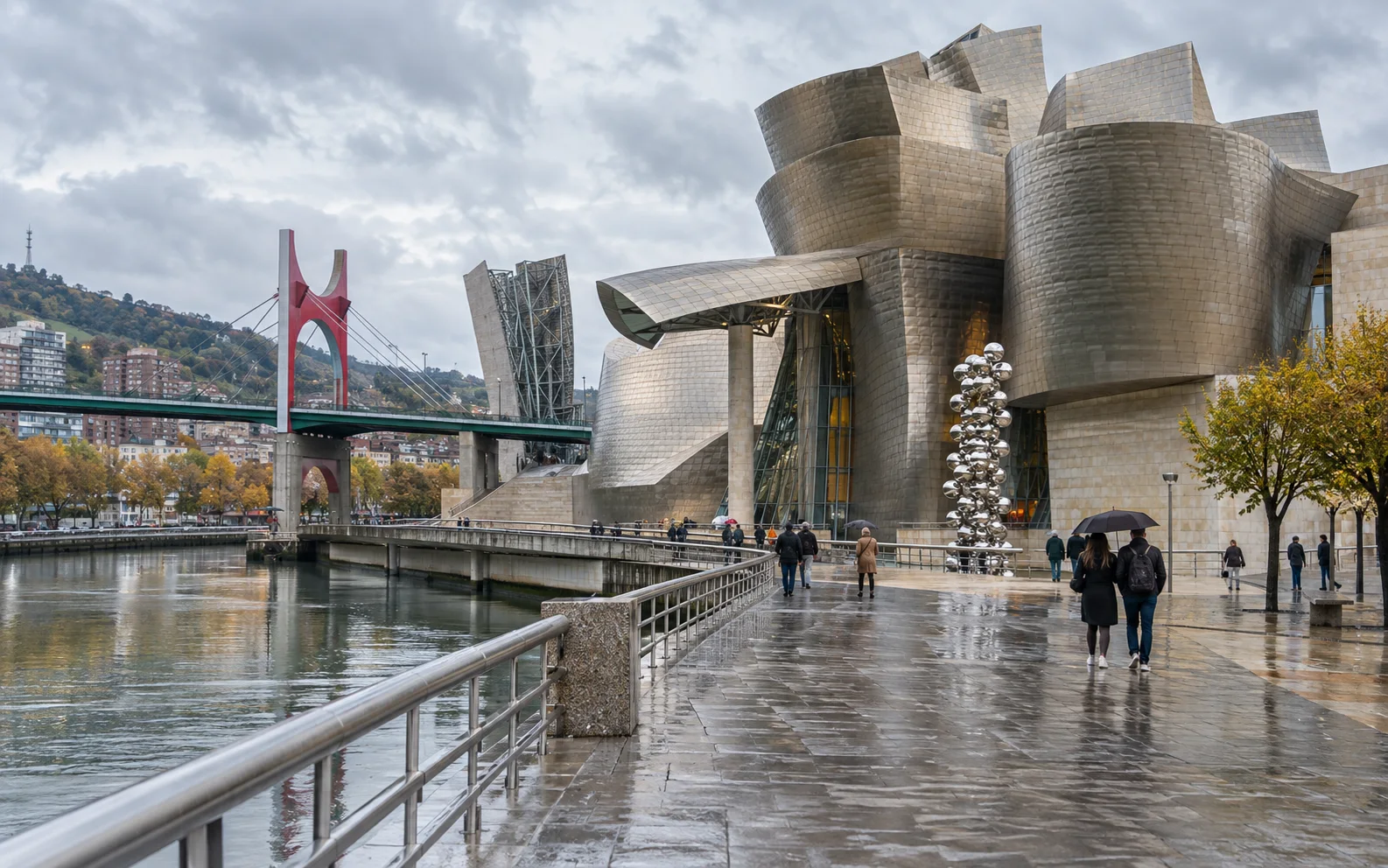
The turning point came on 18 October 1997, when King Juan Carlos I opened the Guggenheim Museum Bilbao. Frank Gehry clad the building in about 33,000 titanium plates over a steel frame, chosen over copper or lead, which were avoided as toxic, with limestone at the base. The museum stands on a former industrial site, has 11,000 square metres of exhibition space across nineteen galleries, and drew almost four million visitors in its first three years. Jeff Koons's flower-covered Puppy guards the entrance. The phrase "the Bilbao effect" now describes how a single cultural building can reshape a district, although critics also use it to talk about gentrification.
The museum was one piece of a larger plan. Norman Foster designed the metro, a tram followed, and the Azkuna Zentroa culture centre and the Abandoibarra and Zorrozaurre districts reclaimed former dockland. Bilbao won the Lee Kuan Yew World City Prize in 2010 and was named Best European City 2018 by the Academy of Urbanism.
The old town, the market and the bridge
The Casco Viejo grew from the medieval port and still centres on the Siete Calles, the seven original streets near the river. Beside it, the Mercado de la Ribera was inaugurated on 22 August 1929 on a site that people had traded on since the Middle Ages. Its Art Deco hall of about 10,000 square metres is often called the largest covered market in Europe, a claim worth treating as popular and not settled, though its scale is not in doubt.
Further downstream, the Vizcaya Bridge between Portugalete and Las Arenas (Getxo) opened in 1893. Alberto de Palacio, a disciple of Gustave Eiffel, designed it as a transporter bridge: a gondola hangs from a high crossbeam and carries passengers and vehicles across the estuary while ships pass beneath. It is the world's oldest transporter bridge, was listed by UNESCO on 13 July 2006, and still crosses roughly every eight minutes by day. Service stopped for four years during the Civil War when the upper section was dynamited.
Football is part of the city's identity too. Athletic Club fields only Basque players, a policy that makes the team a symbol of Basque identity. On the table, look for bacalao al pil-pil (salt cod in an emulsified garlic and olive-oil sauce), marmitako (tuna and potato stew), grilled fish and Idiazabal sheep's cheese, plus the bar-top pintxos that Bilbao shares with San Sebastián.
Walking order for two days and a coast day
Begin by walking the Nervión before going into the Guggenheim, because the river promenade, the La Salve bridge and surviving industrial structures explain why the museum sits where it does. Reserve through the official Guggenheim site and choose a few sections, not every label. On the second morning, enter the Siete Calles before the busy hours, look in at Santiago Cathedral if services allow, and finish at the Ribera Market, where traders are serving residents first: ask before photographing, keep aisles clear and buy something if you sample. The Artxanda funicular gives an overview of the valley, but it is windier and cooler than the river.
For a coast day, Metro Bilbao reaches Getxo and the bridge without a car. Pick one place and a long lunch instead of chaining towns along the same line. At the Vizcaya Bridge, the gondola crossing takes only minutes, and lifts also take visitors up to the high walkway, so check the official operating and accessibility notice for the crossing or platform you want. The metro itself, designed by Norman Foster, is part of the modern-Bilbao story and the easiest way to move between the Casco Viejo, Abando and the estuary.
Evenings suit the Ensanche and Indautxu districts, where residents, not tour groups, fill the bars. A sensible pace is one drink and one or two pintxos at each stop, with two or three stops in total, so the evening ends with a walk across the river and not a heavy dinner. Follow beach flags, and stay clear of exposed rocks in rough seas.
Rain, access, language and money
The A3247 bus links the airport with the centre; the metro does not reach the terminal, so check the airport transfer details. Abando suits trains and walking to both sights; the Casco Viejo is atmospheric but loud on weekend nights. The riverside is mostly level, whereas Casco Viejo cobbles and the climb to Artxanda are harder, so travellers with limited stamina should place a museum and a long walk on different days. Metro Bilbao and the major museums publish their own accessibility information.
Bilbao is green because it rains. A waterproof layer matters more than an umbrella on a windy river, and wet stone is slippery. Basque and Spanish are both official, and the Basque name of the city is Bilbo; recognising it and greeting in Basque is appreciated, though no one expects fluency. On a pintxos route order one or two pieces and a drink, ask how the bar counts payment (plates, toothpicks or a spoken tally), then move on rather than filling a plate. Spain's emergency number is 112.
Menus del día and market lunches keep spending controllable, and serious allergies should be explained clearly because a small bite can hide seafood, nuts, egg or gluten. Major festivals and matches raise room prices. Reserve the Guggenheim and any special restaurant; leave ordinary bars flexible.
Compare other routes on the Spain destination hub, read what makes Spain special, add another Basque city with the San Sebastián guide, or see Catalan design in the Barcelona guide.
Questions and answers
How many days do you need in Bilbao?
Two full days cover the Guggenheim, river, Casco Viejo and a focused museum or food stop. Add a third day for the coast, Getxo or another Basque destination.
Is Bilbao easy to visit without a car?
Yes. The centre is walkable, metro, tram, buses and trains serve neighbourhoods and coastal destinations, and the A3247 bus links Bilbao Airport with the city. The metro does not serve the airport terminal.
How does a pintxos crawl work?
Order one or two pintxos and a drink, keep track of what you have had, pay as the bar requests, then move to another bar instead of filling a plate at one counter.
Sources
Madrid · 40.4168° N, 3.7038° W
This story belongs to Bilbao, Spain. A peninsula of strong regional cultures, from Altamira's cave art and the Alhambra to Gaudí's Barcelona and a pilgrim road walked for a thousand years.