Brno: Mendel, Mies and the Moravian Capital's Proud History
A city that outlasted sieges, gave the world Mendel's laws of heredity and built a modernist masterpiece. This guide tells Brno's story first, then helps plan two days.
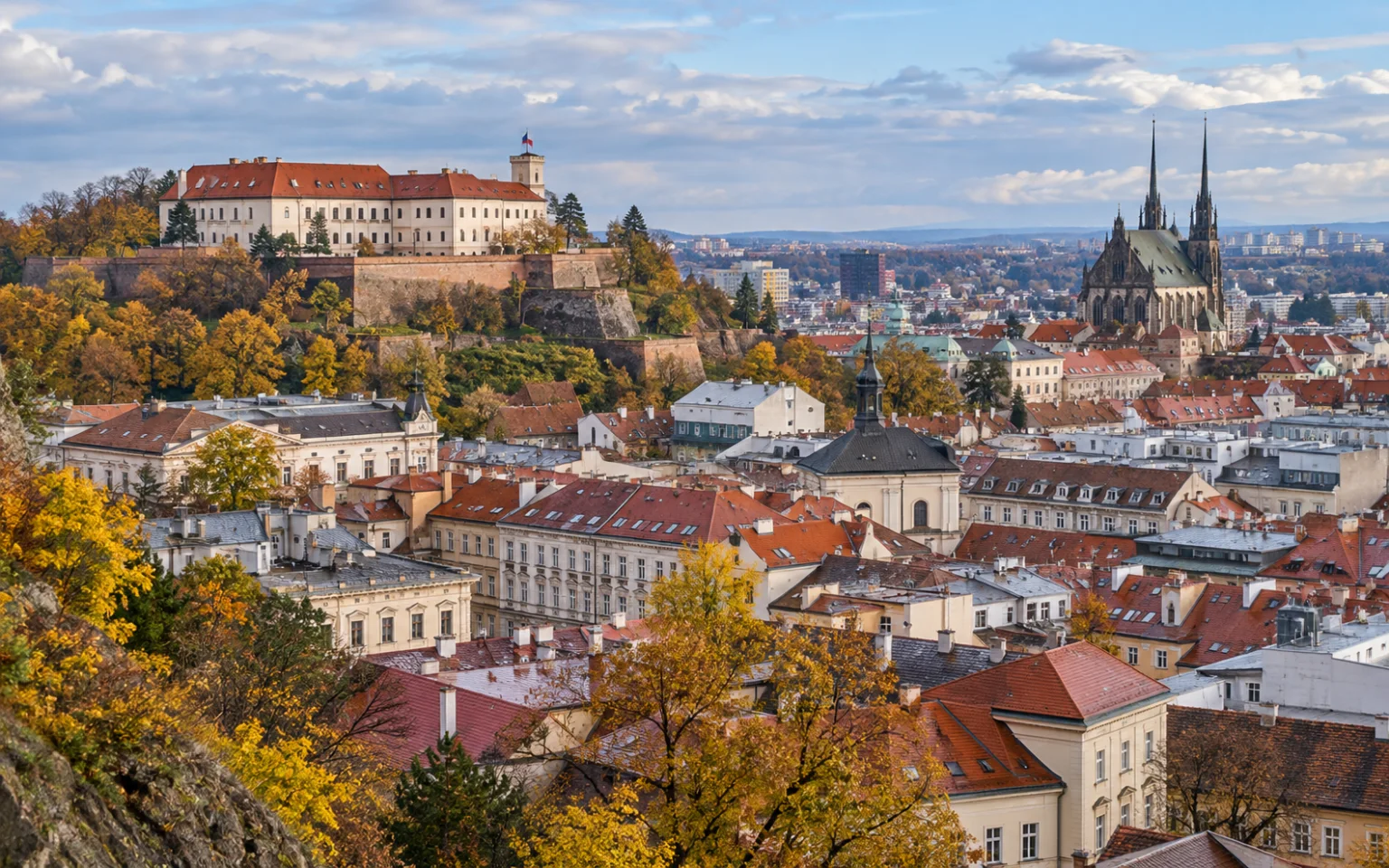
Cover: AI-generated illustration. © ANUSHKA DAHANAYAKE (PVT) LTD.
Brno is the second-largest city in Czechia and the cultural capital of Moravia, and its history is built on resistance, science and design. The city was first mentioned around 1091 in the chronicle of Cosmas of Prague. In 1243 King Wenceslaus I granted it a royal city charter, and it grew behind walls around the hill that later carried the Špilberk fortress. In 1641 the Moravian Diet, the Land Court and the Land Tables moved here from Olomouc, and in 1782 Emperor Joseph II confirmed Brno as Moravia's only capital.
A city that held out
A civic legend and a real siege explain a local quirk. Swedish troops besieged the city in 1645 during the Thirty Years' War and failed. The cathedral bells on Petrov Hill traditionally ring noon at eleven o'clock, a custom tied to that failed siege. The city withstood a Prussian siege under Frederick the Great in 1742 as well, and the fortress at Špilberk later served as a feared Habsburg prison. Its casemates now hold exhibitions about that darker role.
The monk who found the rules of heredity
Brno's most important gift to science came from a monastery garden. Gregor Mendel, an Augustinian friar at St Thomas's Abbey, ran pea experiments between 1856 and 1863, testing some 28,000 plants. He presented the results to the Natural History Society of Brno on 8 February and 8 March 1865, and published them in 1866. The work was largely ignored until 1900, when three botanists confirmed his findings independently. Mendel became abbot in the late 1860s, and the Mendel Museum of Masaryk University in the abbey preserves his story. The same abbey gave the young Leoš Janáček a scholarship in 1865. The composer later turned Moravian speech into opera.
A modern city, early
Brno acted early on modern ideas. The first horse-drawn tram service in what is now Czechia began running in 1869, and a train line from Vienna had arrived in 1839. Masaryk University was founded in 1919 as the Czechoslovak state formed, and in 1928 the Exhibition Centre opened, and functionalist buildings from those years still shape the city. Two years later the Masaryk Circuit began hosting motorsport.
Villa Tugendhat is the crown of that period. Ludwig Mies van der Rohe designed it for Greta and Fritz Tugendhat at the end of the 1920s, and UNESCO added it to the World Heritage List in 2001. The open living space, onyx wall, structural steel and the way the house opens onto its garden changed what a modern home could be. In 2017 UNESCO also named Brno a City of Music, reflecting a tradition that runs from Janáček to today's concert life.
Memory and reckoning
The twentieth century left marks that the city discusses openly. During the German occupation, 10,081 Jewish residents were deported from Brno to Theresienstadt in 1941 and 1942, and the Tugendhat family had left their villa years earlier. After the war, German-speaking residents were driven out, and in 2015 the city council apologised for that expulsion. Brno also lies near the site of the 1805 Battle of Austerlitz, which French forces won before they occupied the city. Visitors who read these chapters alongside the cheerful market and the modernist villa will understand why the city values both memory and openness.
What locals like to show
Zelný trh, the Cabbage Market, still hosts a working vegetable market at the heart of the old town. Under it, the Labyrinth interprets cellars once used for food storage and shelter. South Moravian wine, roast meats, fruit dumplings and seasonal mushrooms appear on menus, with Moravian wine as a point of regional pride. Market, Labyrinth and a regional lunch sit within the same few streets, so a first morning in the old town can take in all three without crossing the city.
Two days that follow the story
Day one: market, bells and fortress. Begin at Zelný trh while the market is active, keep passages clear and ask before photographing vendors. The Labyrinth under the square is reached on a guided route with stairs and confined passages, so travellers who dislike enclosed spaces can visit the Moravian Museum or the nearby courtyards instead. Continue to the Cathedral of St Peter and Paul, an active place of worship, then climb through the park to Špilberk. The casemates and exhibitions need separate time, and tickets differ by part of the site, so check what is included. The ramparts give broad views without a dense museum schedule. The hill is steady rather than extreme; wet leaves and winter ice make paths slippery. Visitors using wheelchairs should ask the castle about the best gate and lifts.
Day two: Tugendhat and modern Brno. Reserve the Villa Tugendhat interior tour well before arrival, since the official visitor information requires advance tickets for the indoor visit, while garden entry is a separate, weather-dependent option. The open plan and structure are best understood on the guided visit. Afterwards, visit the Mendel Museum at St Thomas's Abbey, check its current opening days, and spend the evening at a wine bar or concert, since Brno's music tradition is easiest to appreciate in a live room.
Getting around, safety and money
Brno's main station stands beside the historic centre, with direct trains to Prague, Vienna, Bratislava and other cities. Engineering works can alter routes, so check the operator on the ticket and allow time if a replacement bus is listed. The area between the station, Zelný trh and Moravské náměstí puts restaurants and tram lines nearby, and Černá Pole is convenient for Tugendhat but farther from late-evening choices.
Public transport uses timed tickets across trams, buses and trolleybuses, so buy through official machines, authorised apps or contactless terminals and validate if required. A day ticket helps when combining Tugendhat, the fortress and evening neighbourhoods. Brno is generally straightforward, but ordinary city precautions apply around the station and night trams. Keep valuables closed, use licensed taxis or established ride services and call 112 in an emergency. A service charge is not automatic everywhere; round up or leave roughly ten percent for good service after checking the bill. Carry some koruna along with a card for markets.
For the national picture, read what makes Czechia special, explore the Czechia destination hub or browse more country guides. Prague is the obvious companion, and Liberec shows a very different Czech industrial city.
Questions and answers
How many days do first-time visitors need in Brno?
Two full days cover the old town, Špilberk and one major interior such as Villa Tugendhat. Add a third day for the Moravian Karst or a slower food-and-design visit.
Can you visit Brno without a car?
Yes. The centre is walkable and trams and trolleybuses reach outer districts. Regional trains and buses make Brno a practical base for South Moravia.
Do Villa Tugendhat tours need advance booking?
Yes. Interior tours have limited capacity and often sell out well ahead. Book only through the villa's official site and check the exact tour language and accessibility.
Is Brno accessible for travellers with limited mobility?
Many low-floor trams and modern venues are accessible, but Špilberk's gradients, old-town paving and underground attractions require planning. Confirm the entrance and lift for each site directly.
Sources
Prague · 50.0755° N, 14.4378° E
This story belongs to Brno, Czechia. Two historic lands, Bohemia and Moravia, with castles on almost every hill, a UNESCO puppet-theatre tradition and a lager that spread worldwide.