Prague for First-Time Visitors: Castle, Clock, Synagogues and Pilsner
Prague through its castle, medieval bridge and clock, Jewish Quarter, music and beer, with a three-day plan for first-time visitors.
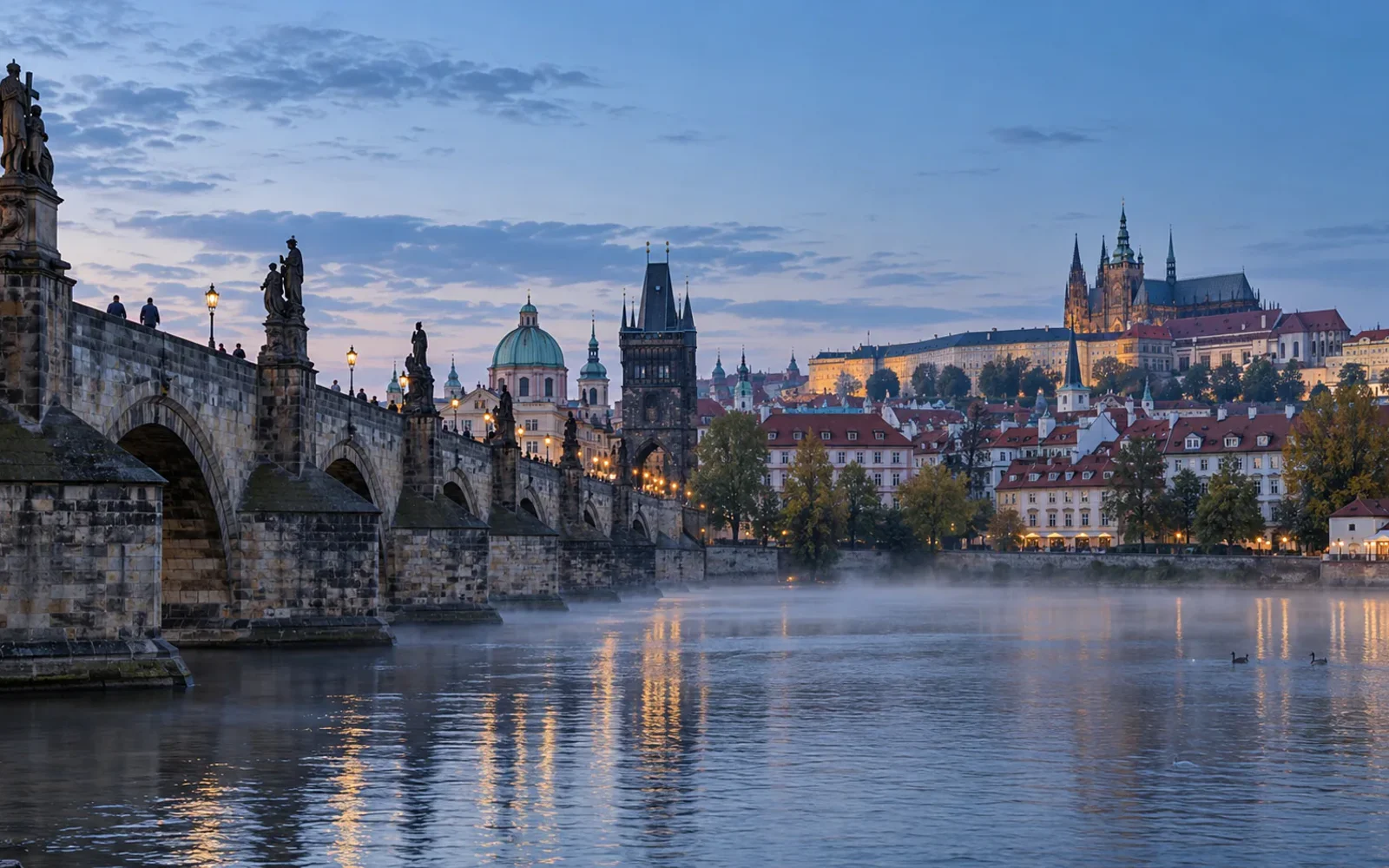
Cover: AI-generated illustration. © ANUSHKA DAHANAYAKE (PVT) LTD.
Prague is a city where every century left a landmark and the landmarks survived. Its historic centre, on both banks of the Vltava, has been on the World Heritage List since 1992, and within it stand a castle begun in the ninth century, a Gothic bridge laid out in 1357, a clock that has run since 1410 and one of the most important collections of Jewish heritage in Europe. Czechs take pride in a capital that gave the world pilsner, hosted the premiere of a Mozart masterpiece and ended communist rule without violence.
Castle, bridge and clock
Prague Castle grew from a fortified settlement and its first masonry dates from the late ninth century; it is counted among the largest castle complexes in the world, with St Vitus Cathedral, the Old Royal Palace, St George's Basilica and the small houses of Golden Lane inside its walls. The Charles Bridge was begun in 1357 under Charles IV and was completed around the start of the fifteenth century. Thirty mostly Baroque statues line its parapets. The astronomical clock on the Old Town Hall, the Orloj, dates in its oldest parts from 1410, made by the clockmaker Mikuláš of Kadaň with the astronomer Jan Šindel, and it is counted among the oldest astronomical clocks still working.
Old Town Square and the Lesser Town
Old Town Square is ringed by pastel facades, the twin spires of the Týn Church and the monument to the reformer Jan Hus, and the Powder Tower and the Art Nouveau Municipal House mark the old royal route along which kings once processed. Across the river, the Lesser Town, Malá Strana, is a Baroque quarter of palaces, gardens and the green-domed Church of St Nicholas. St Vitus Cathedral, inside the castle, holds the tombs of Bohemian kings and the Czech crown jewels. Walking from one to the other crosses nearly every era of European architecture within an hour.
Josefov: the Jewish Quarter
The Old-New Synagogue, built around 1270, is described as the oldest active synagogue in Europe. On the walls of the Pinkas Synagogue are inscribed the names of 77,297 Bohemian and Moravian Jews who died in the Holocaust, with birth and death dates. The Jewish Museum in Prague, founded in 1906 to preserve objects from synagogues demolished in the clearance of the old ghetto, now cares for these buildings and the Old Jewish Cemetery. Josefov was altered extensively in the late nineteenth century, so it is not an untouched medieval quarter, but its surviving buildings hold the memory.
Music, beer and the Velvet Revolution
Mozart's Don Giovanni had its world premiere at the Estates Theatre on 29 October 1787, with the composer conducting. The first batch of Pilsner Urquell was brewed in Plzeň on 5 October 1842, which gave the golden lager its name and started a style that spread around the world. On 17 November 1989 the protests began that became the Velvet Revolution and ended 41 years of Communist rule in Czechoslovakia. Dvořák and Smetana are honoured each year at the Prague Spring festival, which keeps the city's musical identity visible beyond the Mozart story. These events explain why Czechs speak of music, beer and peaceful change as national achievements.
Three days without the tourist traps
Day one: Old Town before the crowd. Reach the Charles Bridge around first light, when the river and bridge are still a working public space; stay clear of cyclists and do not climb or attach locks to historic statues. Continue to Old Town Square and watch the clock, then step away before the crowd compresses. Give the Jewish Museum sites a dedicated block, dress respectfully and observe photography rules.
Day two: Prague Castle. Take a tram uphill and walk down. Choose the main circuit of cathedral, palace, basilica and Golden Lane rather than every exhibition; towers have stairs and are not essential. Descend through Hradčany or the gardens to Malá Strana, a Baroque quarter whose churches are active places of worship, and finish at Kampa or by the river.
Day three: modern Prague. Choose one cluster: Vinohrady and Žižkov for cafés and parks, Holešovice for galleries and Stromovka, or Vyšehrad for fortifications and views. For a viewpoint, pick one of the castle approaches, Letná, Petřín or Vyšehrad; repeating all four wastes transit time. Check funicular status before planning Petřín.
Day trips deserve a full day. Kutná Hora is a rail trip, and Český Krumlov is often better as an overnight. Plzeň is the home of pilsner, and Terezín requires preparation and respect. Vienna and Berlin have their own guides.
Beer, food and where to eat
Czech beer is poured with a thick, creamy head, and the pub is a civic institution where locals meet daily. Meals are built on roast meats, sauces, dumplings and soups, though Prague also has strong vegetarian and international dining. Walk a few streets away from Old Town Square for lower prices and a quieter room, and check whether bread, condiments or service are charged before accepting extras.
Tickets, beer and everyday etiquette
Václav Havel Airport has no metro station, so use the official planner for the bus to a metro line or the separately priced Airport Express. PID tickets are time-based and shared across metro, trams and buses, and some paper tickets need validation, so understand your product before boarding, since inspectors issue real fines. Stay in Staré Město or Malá Strana for landmark access, Nové Město for restaurants and transport, or Vinohrady for a neighborhood base.
Menus in the busiest streets can carry inflated prices, so check whether bread or service is charged. Beer strength is often shown in degrees Plato, not alcohol percentage. Never exchange money with a person on the street. Summer is busy and hot, so tour the castle early, and winter ice affects steps and riverside paths. Many metro stations have lifts, but Prague Castle lists exceptions, including towers and parts of Golden Lane. Keep bags closed on crowded trams, and carry coins for public toilets. See the Czechia overview and what makes Czechia special for more of the country.
Questions and answers
How many days are enough for a first Prague visit?
Three full days allow Prague Castle, Old Town, the Jewish Museum sites and one neighborhood beyond the core. Two days require choosing fewer interiors.
How do public transport tickets work in Prague?
PID tickets are time-based. Paper tickets that require validation are stamped once before the first metro ride or upon boarding; app tickets must be activated before travel. Check current official rules.
When is Charles Bridge least crowded?
Early morning is usually quietest, but residents, photographers and maintenance still use it. Visit in daylight or blue dawn, keep pathways open and return later for the city's ordinary rhythm.
Sources
Prague · 50.0755° N, 14.4378° E
This story belongs to Prague, Czechia. Two historic lands, Bohemia and Moravia, with castles on almost every hill, a UNESCO puppet-theatre tradition and a lager that spread worldwide.