Porto First-Time Guide: Bridges, Tiles and a Hill-Smart Plan
Porto through its iron bridges, port wine, tiled station and tripeiro food, with a hill-aware three-day plan for first visits.
Porto is a granite city stacked above the River Douro, and its character comes from what moved along that river: barrels of wine, iron for bridges, tiles for churches and stories of a people who fed a fleet. The historic centre, the Ribeira waterfront, the bridges and the port lodges across the river are the places Portuenses point to with pride, and each has a date and a maker that explain why the city looks as it does.
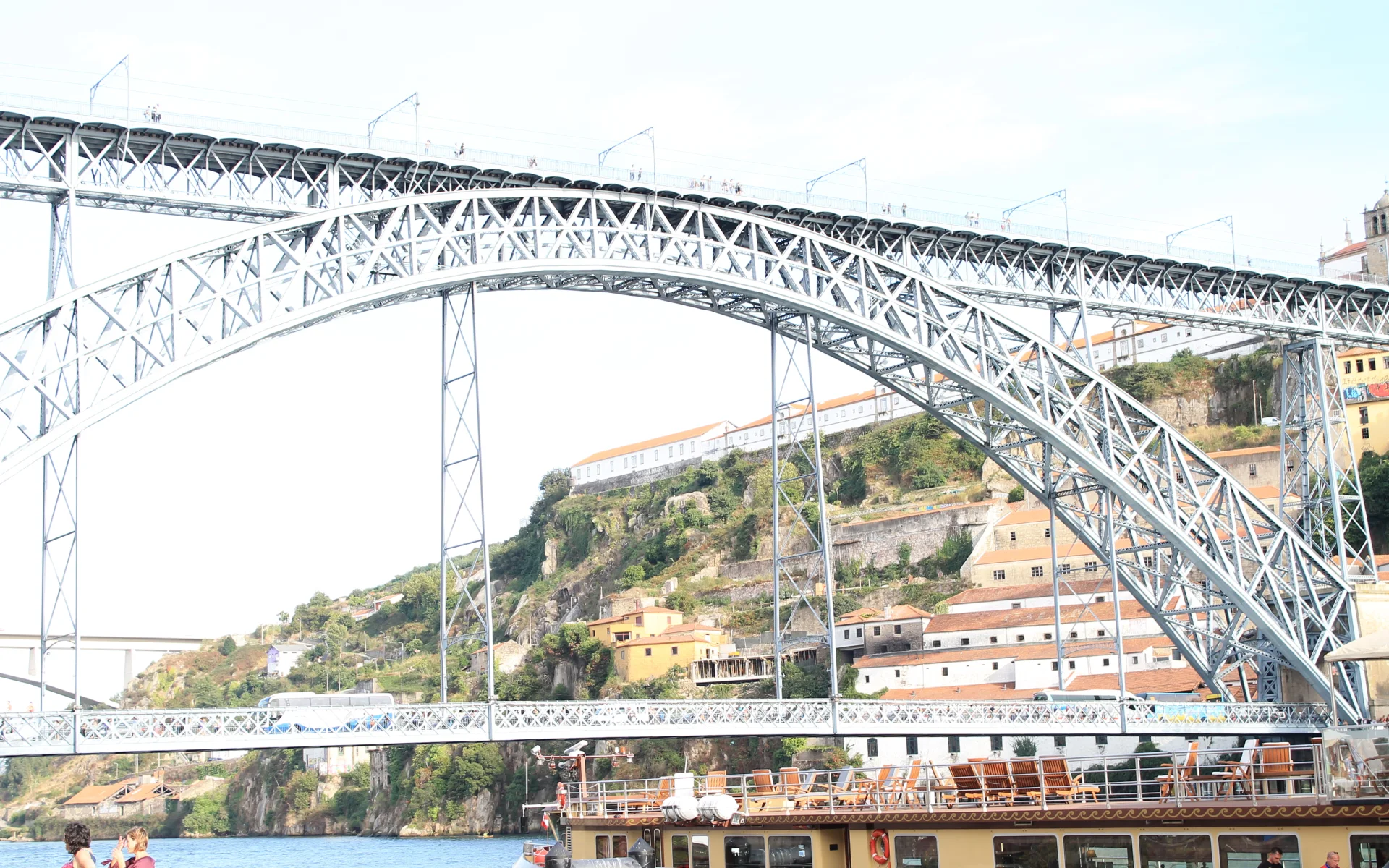
Cover photograph: Dom Luís I Bridge and a Douro passenger boat, photographed on 17 September 2016 by John Samuel / Wikimedia Commons, CC BY-SA 4.0. Centre-cropped and converted to responsive WebP sizes; no bridge, vessel or landscape element was generated or removed.
Bridges built by Eiffel's partners
The Dom Luís I Bridge was designed by Théophile Seyrig, a former partner of Gustave Eiffel, and was inaugurated by King Luís I on 31 October 1886, his birthday. Seyrig's design was preferred over Eiffel's own for this crossing. His earlier Maria Pia railway bridge upstream was built in 1876 and 1877 by Eiffel and Company. The two iron decks of the Dom Luís I carry the metro on top and cars and pedestrians below, and the walk across the upper deck gives the classic view of the Ribeira.
Port wine and Gaia
Across the river, Vila Nova de Gaia has been the centre of the port trade since British merchants established lodges there to age wine shipped down from the Douro Valley, and the names on the lodge roofs are among the city's best-known sights. The Marquis of Pombal's decree of 10 September 1756 demarcated the vineyards, which makes the Douro one of the first regulated wine regions in the world, and the wine region itself was inscribed by UNESCO in 2001. Rabelo boats on the quay recall the barrels that once came downriver. A good cellar tour explains grapes, fortification and ageing, not only the tasting.
Tiles, a convent and a station
São Bento station stands on the site of the Convent of São Bento de Avé-Maria, whose last nun died in 1892, and its entrance hall is covered with about 20,000 blue-and-white azulejos painted by Jorge Colaço between 1905 and 1916. They show battles, royal history and rural life, including port carried on a rabelo boat. Colaço's tiles are worth a pause even if you are not catching a train, and the city's churches, including Carmo and Santo Ildefonso, also wear tile facades.
Churches, books and modern Porto
The Baroque Clérigos Tower, long the tallest structure in the city, has watched over the historic centre for generations, and the Sé is a fortified cathedral whose cloister is tiled in blue and white. Livraria Lello, a neo-Gothic bookshop with a crimson staircase, draws queues, so go early or book a slot. The modern side includes the Serralves museum and park and Rem Koolhaas's Casa da Música, which show that the city's ambition did not stop at the nineteenth century. The Douro Valley upstream, a terraced wine landscape, is itself a World Heritage landscape.
Tripeiros, the francesinha and São João
People from Porto are called tripeiros, tripe-eaters, after the story that the city gave its meat to the expedition of 1415 and kept the offal for itself. The francesinha, a sandwich of cured meats and steak under melted cheese and a beer and tomato sauce, is the local signature and a heavy meal rather than a challenge. On the night of 23 June the city celebrates São João with street parties, grilled sardines and fireworks over the river.
Choose two or three days before booking
With two full days, keep the first two routes below and choose either one cellar tour or one major interior; do not add the Douro Valley. With three days, add Serralves or the Soares dos Reis museum and the Atlantic edge at Foz. A Douro Valley visit is a separate fourth day because the return journey, transfers and tasting schedule compete with Porto itself. This choice matters more than fitting every landmark into a checklist.
Three days that respect the contours
Day one: upper centre to Ribeira. Start at Bolhão Market and Rua de Santa Catarina, walk to Avenida dos Aliados and São Bento, then continue to the cathedral. Use the downhill route through the historic centre instead of improvising every alley, since stone is slippery in rain. Take one or two lanes back from the Ribeira waterfront and cross the Dom Luís I Bridge. The upper deck is windy and high; use the metro or the Funicular dos Guindais if it is uncomfortable.
Day two: Gaia and the palace. Reserve one cellar tour, eat beforehand and drink water. After the tour, cross back for the Palácio da Bolsa or Igreja de São Francisco, and choose one interior. For dinner, move uphill or toward Cedofeita; ask about couvert items before eating them.
Day three: art and the Atlantic. Spend the morning at Serralves, with contemporary art and a landscaped park, or at the Soares dos Reis National Museum. Casa da Música offers tours and performances. In the afternoon take a bus to Foz, where the Douro meets the sea, and obey barriers on exposed piers. A separate Douro Valley day suits trains, boats and winery visits; do not squeeze it into these three days. For a northern trip, see the Braga guide, and the Lisbon guide covers the capital.
Eating in Porto
Beyond the francesinha, Porto's table runs to grilled sardines in summer, salt cod in many forms, hearty soups and pastries from neighbourhood bakeries. Bolhão Market, with its iron and glass hall, is the place to see produce, flowers and cheese sold the way they have been for generations. Confirm couvert items before eating them, and ask about ingredients if you have an allergy; a short lunch standing at a counter is part of the local rhythm and keeps the evening free for a longer dinner.
Staying sensible about hills and weather
Look at contours, not just distance, when choosing a base. Baixa has metro connections and evening choices, Ribeira has atmosphere and noise, and Cedofeita suits galleries and restaurants. Metro line E links the airport with the urban network; use Metro do Porto's current journey planner, not an old quoted journey time. The Andante system uses zones and requires validation, so buy from official machines and ignore old fare amounts. Campanhã handles many long-distance trains while São Bento serves central and regional routes, so verify the station and any connection with CP before travel.
Wet granite and tile become slick, and summer heat is intense on bridge decks, so carry water and a light waterproof. The Clérigos Tower has many steps, though an accessible multisensory alternative exists, and Accessible Porto publishes itineraries; confirm step-free entrances directly. Compare the Porto Card with your real route before buying, and reserve only the cellar, restaurant or performance that matters. The Portugal overview and what makes Portugal special place the city in the wider country.
Questions and answers
How many days do first-time visitors need in Porto?
Three full days allow for the historic centre, Gaia, one major cultural stop and the Atlantic side of the city. Two days cover essentials if you limit cellar visits and skip a Douro Valley trip.
Can you explore Porto without a car?
Yes. Metro, buses, trains, funiculars and walking cover the city. A car is unnecessary in the steep historic centre and is useful mainly for a wider regional itinerary.
Do port wine cellar tours require reservations?
Popular lodges and English-language tours often do, especially on weekends and in summer. Book with the lodge directly and check whether tastings, stairs and accessibility suit your group.
Is Porto accessible for travellers with limited mobility?
The riverfront and newer transit can work well, but steep gradients, steps and cobbled lanes require route planning. Porto's official accessible itineraries describe specific sites and alternatives.
Sources
Lisbon · 38.7223° N, 9.1393° W
This story belongs to Porto, Portugal. A small country that faced the Atlantic, with the oldest alliance still in force, the first legally marked wine region and a quiet pride at home.