Munich for First-Time Visitors: Beer Halls, Royal Palaces and the Englischer Garten
Munich through its royal wedding festival, court brewery, palaces and park, with a clear route for first-time visitors using the MVV network.
Cover: AI-generated illustration. © ANUSHKA DAHANAYAKE (PVT) LTD.
Munich is the Bavarian capital that grew around a ducal court, and almost everything visitors love about it traces back to the Wittelsbach family: the court brewery that became the Hofbräuhaus, the wedding party that became Oktoberfest, the palaces of the Residenz and Nymphenburg, and the landscape park that opened the royal grounds to ordinary citizens. Munich people take pride in a city that keeps these traditions alive while building BMW cars, hosting a science museum of world rank and surfing in a city-centre river.
A royal wedding and a court brewery
Duke Wilhelm V founded the Hofbräuhaus in 1589, and its own history gives the date as 27 September; it was set up solely to supply the Bavarian court with brown beer, and King Ludwig I opened it to the public as a tavern in 1828. Oktoberfest dates from 12 October 1810, the wedding of Crown Prince Ludwig and Princess Therese of Saxe-Hildburghausen, and the Theresienwiese meadow where it is held still carries her name. Both institutions began with the court and were soon taken over by the city. Beer gardens under chestnut trees, at the Chinese Tower in the Englischer Garten and elsewhere, are the ordinary form of that inheritance.
The English Garden and the Eisbach
The Englischer Garten was begun in 1789 on the orders of Elector Karl Theodor and designed by Sir Benjamin Thompson, later Count Rumford, as a public park rather than a royal preserve. It has meadows, streams, a Japanese teahouse, the Monopteros temple on a hill and the Chinese Tower, one of the city's best-loved beer gardens. At its southern edge the Eisbach channel produces a standing wave where surfers ride all year; the city legalised surfing there in 2010 for experienced surfers, and beginners practise elsewhere. View it from a safe public position and never enter the fast water.
Palaces and collections
The Residenz was the seat of the Wittelsbach rulers, who governed Bavaria as dukes, electors and then kings until 1918, and it has been open to the public as a museum since 1920. Its Renaissance Antiquarium, the Treasury and the Cuvilliés Theatre are the main interiors. Nymphenburg Palace lies on the western side with a baroque park and a carriage museum. The Kunstareal gathers the Alte Pinakothek, the Neue Pinakothek and the Pinakothek der Moderne, and the Deutsches Museum on an island in the Isar, founded in 1903, remains one of the world's largest museums of science and technology.
Pinakotheks and the Kunstareal
The Alte Pinakothek holds more than 700 works from the fourteenth to the eighteenth centuries, with Dürer, Rubens and Rembrandt among its masters, and it forms part of the Kunstareal beside the Neue Pinakothek and the Pinakothek der Moderne. The area is a short walk from Königsplatz and the university streets of Maxvorstadt. A visit works best as a single morning at one museum, followed by a walk through the neighbourhood, not a race through all three.
Engineering, football and the Alps
BMW's headquarters, museum and BMW Welt sit beside the Olympiapark built for the 1972 Games, with its tent-like roof. FC Bayern Munich plays at the Allianz Arena, which glows red on match nights, and the Alpine foothills and the lakes of Starnberg and Tegernsee lie within an hour. Neuschwanstein is a long day trip and not a half-day extra; check the weather in the Alps separately from the city.
Marienplatz and the old town
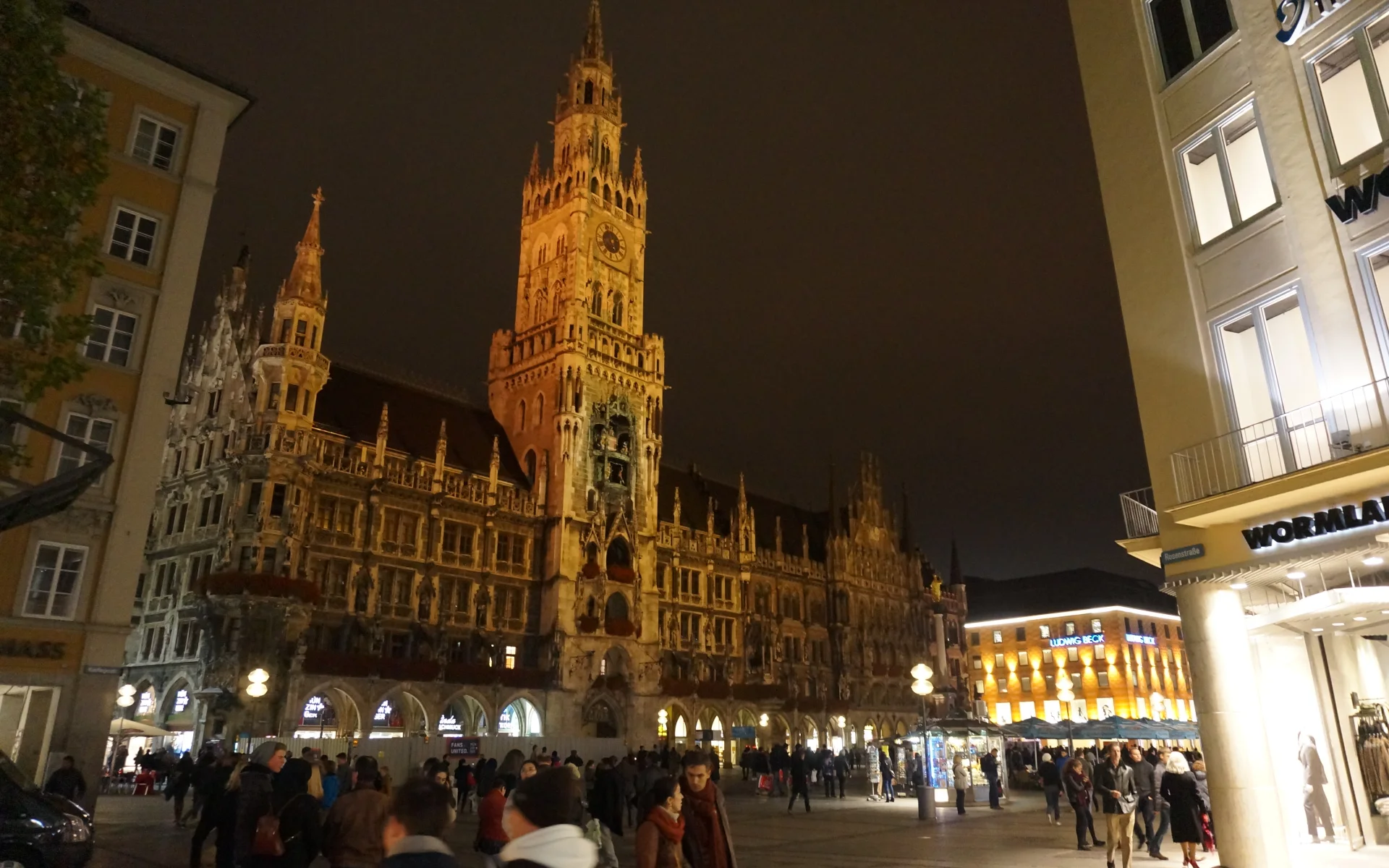
The heart of Munich is Marienplatz, where the neo-Gothic New Town Hall's Glockenspiel performs each day with mechanical figures. Around it stand the twin towers of the Frauenkirche, the city's emblem, St Peter's Church, whose tower gives the classic view over the rooftops, and the Viktualienmarkt, the open-air food market. The area is compact enough to walk in a morning and rewards early starts before the squares fill.
Three days that match the city
Day one: the old town. Begin at Marienplatz before the streets fill. The New Town Hall's Glockenspiel and the twin towers of the Frauenkirche frame the centre, and Viktualienmarkt is the open-air food market. Churches are active places of worship, so enter quietly and do not photograph services. The Residenz can fill the afternoon; decide whether the Residence Museum, Treasury or Cuvilliés Theatre matters most and check section schedules. The official ticket guidance says online tickets go directly to entry and cannot be exchanged.
Day two: science or art. The Deutsches Museum can occupy most of a day, so choose themes instead of trying to finish the building; its accessibility page describes step-free exhibitions and loan wheelchairs. Art lovers should pick one institution in the Kunstareal and then walk to the southern English Garden. The garden is larger than its central map symbol suggests, so decide which station to return to before walking north.
Day three: one distinct area. Nymphenburg suits palace and garden interest; allow for long garden distances. Olympiapark offers twentieth-century architecture and views, and can combine with BMW Welt. A quieter option links the Isar with Haidhausen, a residential quarter east of the river. This flexible day is also the easiest to move if rain or ice changes the plan. For a longer German route, Nuremberg and Berlin have their own guides, and what makes Germany special covers the whole country.
Getting around and staying well
From the airport, S1 and S8 reach the city by different routes, so compare the live journey with the nearest station to your accommodation. MVV connects S-Bahn, U-Bahn, trams and buses, and the city is Zone M; the fare structure explains how the surrounding zones set the wider validity, so enter the real origin and destination in the official planner. Paper tickets may need validating before boarding. Allow extra transfer time at Hauptbahnhof, Karlsplatz and Marienplatz.
Altstadt is closest to the sights but busy; Maxvorstadt suits museum days, and Haidhausen suits quieter evenings. Oktoberfest, football and trade fairs push room prices up, so check event calendars before booking, and avoid a distant bargain room. In beer gardens, follow the signs about table service and outside food. Winter can bring ice and cold platforms, summer can bring heat and thunderstorms, and the city's weather page links German Weather Service warnings. Anyone with a serious allergy should carry a clear German explanation. For fire or medical help, call 112, which reaches rescue services free of charge throughout Europe. See the Germany overview and the Munich section for the wider destination.
Questions and answers
How many days do you need in Munich?
Two full days cover the old centre and one major museum area at a useful pace. A third day adds Nymphenburg, Olympiapark or a slower English Garden and neighbourhood route.
Does a Munich visitor need a car?
No. S-Bahn, U-Bahn, trams and buses reach the principal visitor areas. A car adds parking complications and is mainly useful for a separately planned regional route.
What should be booked before visiting Munich?
Book only a must-see palace interior, major exhibition, football experience or performance. Check festival, football and trade-fair dates before committing to accommodation.
Sources
Berlin · 52.5200° N, 13.4050° E
This story belongs to Munich, Germany. A country whose contributions to the world each belong to a particular town, and whose regions still keep their own dialects, bakeries and festivals.