Berlin: Museum Island, the Brandenburg Gate and a City That Faces Its Past
Five UNESCO-listed museums, the Brandenburg Gate, the Reichstag and the memorials that Berliners made part of daily life, with practical advice on tickets, transport and access.
Berlin has been a Prussian royal seat, the capital of an empire, a bombed ruin in 1945 and a city cut in two for 28 years. It keeps all of that visible, and Berliners are proud of how openly they have faced it. The centre holds some of the best museums in Europe, a gate that became the symbol of reunification and memorials designed to be walked through rather than photographed.
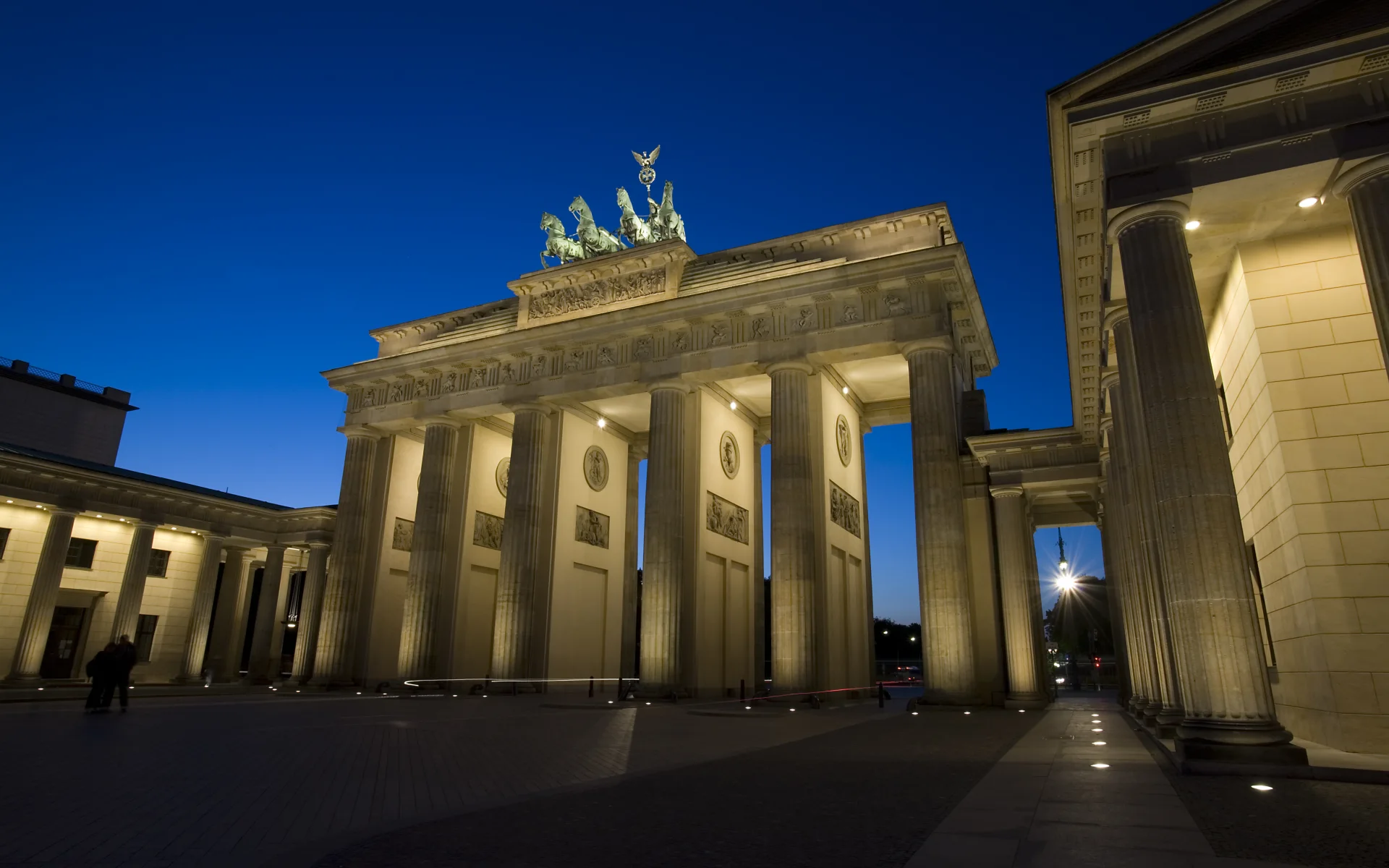
Cover photograph: Jorge Royan, “Berlin—Brandenburg gate at night,” 2007, own work under CC BY-SA 3.0. Cropped to a 16:10 frame and converted to responsive WebP sizes; no landmarks were added or removed.
Museum Island and the Reichstag
Museum Island, five museums built between 1824 and 1930 on the northern tip of an island in the Spree, was inscribed by UNESCO in 1999. The Altes Museum, the Neues Museum with its bust of Nefertiti, the Alte Nationalgalerie, the Bode Museum and the Pergamonmuseum form the ensemble; Alfred Messel's Pergamonmuseum, the largest of them, was built between 1910 and 1930. Nearby, the Reichstag was built between 1884 and 1894, burned on 27 February 1933 and was rebuilt for the Bundestag, which first convened there on 19 April 1999. Norman Foster's glass dome now lets visitors look down into the chamber.
The gate and the Wall
The Brandenburg Gate, designed by Carl Gotthard Langhans and built between 1788 and 1791 for King Frederick William II, is topped by Johann Gottfried Schadow's bronze quadriga. The Wall ran along its western side, closing it from August 1961 until 22 December 1989, when Chancellor Helmut Kohl walked through to meet the East German prime minister Hans Modrow. The Wall itself fell on 9 November 1989. Its line is marked across the centre by a double row of cobbles, the Berlin Wall Memorial on Bernauer Strasse preserves a section of the border strip and a watchtower, and the East Side Gallery keeps a long stretch of painted Wall beside the river.
A capital that faces its past
The Memorial to the Murdered Jews of Europe, designed by Peter Eisenman with Buro Happold, was inaugurated on 10 May 2005 and opened to the public two days later. Its 2,711 concrete slabs rise and fall on uneven ground, so the field changes from open to enclosing as you walk. The Topography of Terror documents the institutions of Nazi persecution on the site of the former Gestapo headquarters, and the Jewish Museum's zigzag building continues the story. These places sit among government offices, not in a remote memorial park, which is the point.
Green space, palaces and the Berlin table
Charlottenburg Palace is a Prussian royal residence in the west of the city, and the palaces and gardens of Potsdam, a short train ride away, show the same Prussian ambitions in park form. Within Berlin, the Tiergarten fills the centre, Tempelhof's former airfield is now an open park where the runways host kites and cyclists, and the Wannsee and Grunewald offer lakes and forest on the western edge. The food reflects the city's mix: currywurst from a stand, the döner kebab, a staple of Turkish-Berlin kitchens, Vietnamese restaurants and the food halls of Markthalle Neun. Opera houses, the Berlin Philharmonic and a club culture known worldwide share the same neighbourhoods.
Seeing Berlin in three days
Day one: the centre. Register for the Reichstag dome first; the Bundestag requires every visitor to register in advance with name and date of birth, and a request is not yet a confirmed place. Walk to the Brandenburg Gate and the Eisenman memorial, then choose the Topography of Terror. Leave a pause between memorials; the memorial's own regulations ask visitors to cross the stelae slowly and on foot.
Day two: the division. Give a morning to Bernauer Strasse, then pick one continuation: the East Side Gallery for the painted Wall, or the Tränenpalast near Friedrichstrasse for stories of separation. Finish in Kreuzberg or around Boxhagener Platz, where residential Berlin takes over from the monumental centre.
Day three: a collection and a district. Choose one open collection instead of a generic Museum Island day. The Pergamonmuseum is closed for renovation, with a partial reopening scheduled for 4 June 2027, so verify what is open before buying. Pair the museum with Prenzlauer Berg or Charlottenburg, or give the day to Potsdam. The Berlin city page shows how the districts relate.
Practical help: tickets, access and manners
Tickets and zones. BVG defines zone AB for Berlin and zone C for the surrounding area, including Potsdam and BER Airport, so those journeys need an ABC ticket. Validate paper tickets where required and keep them until the end of the trip. A hotel near an S-Bahn or U-Bahn station saves more time than a cheap room far out, because Berlin is large and the sights lie in different directions. The open-air Wall sites, the stelae field and the city's parks can be visited without a ticket, which keeps a history-heavy itinerary affordable; the museums and the Reichstag dome are where booking matters. Plan a quiet hour after each memorial instead of stacking them, and keep one indoor option in reserve for rain.
Access and weather. BVG says all buses and trams are accessible, while work continues on making every U-Bahn station barrier-free; its accessibility page lists the details, and the Topography of Terror publishes route and lift information. Winters are cold and dark, summer heat makes exposed memorial routes tiring, so carry layers or water.
Safety and conduct. Berlin's official guidance gives 110 for police and 112 for fire or ambulance. Keep valuables closed on crowded trains, respect quiet at memorials, ask before photographing people and keep courtyard gates and bicycle lanes clear.
More of Germany
Berlin is one chapter of a country with very different city stories. Leipzig tells a story of music and civic history, while What Makes Dresden Special follows the rebuilt Frauenkirche. Nuremberg covers another side of twentieth-century history, Hamburg is the port city of brick warehouses, and what makes Germany special frames them all. Or return to the Germany destination hub.
Questions and answers
How many days does a first Berlin visit need?
Two full days cover one central remembrance route and one division or museum route. Three days add a neighbourhood-focused day; use a fourth for Potsdam or another major collection.
Which Berlin transport zones do visitors need?
AB covers journeys within Berlin's city boundary. BER Airport and Potsdam are in zone C, so those trips require the appropriate ABC product. Confirm the current rules with BVG.
What should be reserved in Berlin?
Register for the Reichstag dome through the Bundestag and reserve any essential exhibition, concert or performance. Check renovation notices before buying museum tickets.
Sources
Berlin · 52.5200° N, 13.4050° E
This story belongs to Berlin, Germany. A country whose contributions to the world each belong to a particular town, and whose regions still keep their own dialects, bakeries and festivals.