What Makes Dresden Special: Baroque Splendour, the Rebuilt Frauenkirche and Royal Treasures
A baroque capital on the Elbe, destroyed in 1945 and rebuilt stone by stone, with royal treasure chambers, Raphael's Sistine Madonna, a celebrated opera house and one of Germany's oldest Christmas markets. A guide to what makes Dresden special.
Cover: AI-generated illustration. © ANUSHKA DAHANAYAKE (PVT) LTD.
On 30 October 2005, the bells of a church that had been a heap of blackened stone for half a century rang again over the Elbe. The reconsecration of Dresden's Frauenkirche closed a long chapter for a city that once called itself "Florence on the Elbe": Saxony's capital, built into a baroque showcase by its electors, devastated in February 1945 and rebuilt with patience and international help. Dresden's pride rests on that recovery, and on what it has always made well: porcelain, music, treasure and a Christmas cake with protected status.
Augustus the Strong and a city of display
Frederick Augustus I, Elector of Saxony and King of Poland, known as Augustus the Strong, set out in the early eighteenth century to make Dresden a court to rival Versailles. He commissioned the Zwinger, a ring of pavilions, galleries and fountains built for festivals, and filled his palaces with art, armour, scientific instruments and porcelain. The Saxon court kept collecting, and Raphael's Sistine Madonna is now the star of the Old Masters Picture Gallery in the Zwinger, alongside works by Titian, Rembrandt and Vermeer.
The Residenzschloss, the palace of the Saxon rulers, holds the treasure chambers that best explain the court's ambition. Augustus turned his private rooms into the Green Vault between 1723 and 1729, among the earliest treasure chambers opened as a museum. The mirrored Historic Green Vault shows objects of gold, silver, amber, ivory and gemstones; the New Green Vault displays individual masterpieces, including the Dresden Green, a natural green diamond of about 41 carats. In November 2019 thieves broke in and took royal jewellery sets of the early eighteenth century; dozens of objects were recovered in 2022 and five men were convicted in 2023, a crime followed closely across Germany.
White gold from Meissen
Augustus's passion for Asian porcelain drove one of Europe's great technical breakthroughs. After experiments by Ehrenfried Walther von Tschirnhaus, the alchemist Johann Friedrich Böttger refined the formula for hard-paste porcelain, the first made in Europe. The royal manufactory began production in 1710 in the Albrechtsburg at Meissen, a short trip down the Elbe, and its crossed-swords mark, introduced in 1720, is still the manufactory's sign today. Dresden's Porcelain Collection in the Zwinger, one of the largest in the world, sets Meissen beside the Chinese and Japanese pieces that inspired it. Along the Augustusstrasse, the Fürstenzug, a procession of Saxon rulers on Meissen porcelain tiles, is an outdoor reminder of the craft.
The Frauenkirche, destroyed and returned
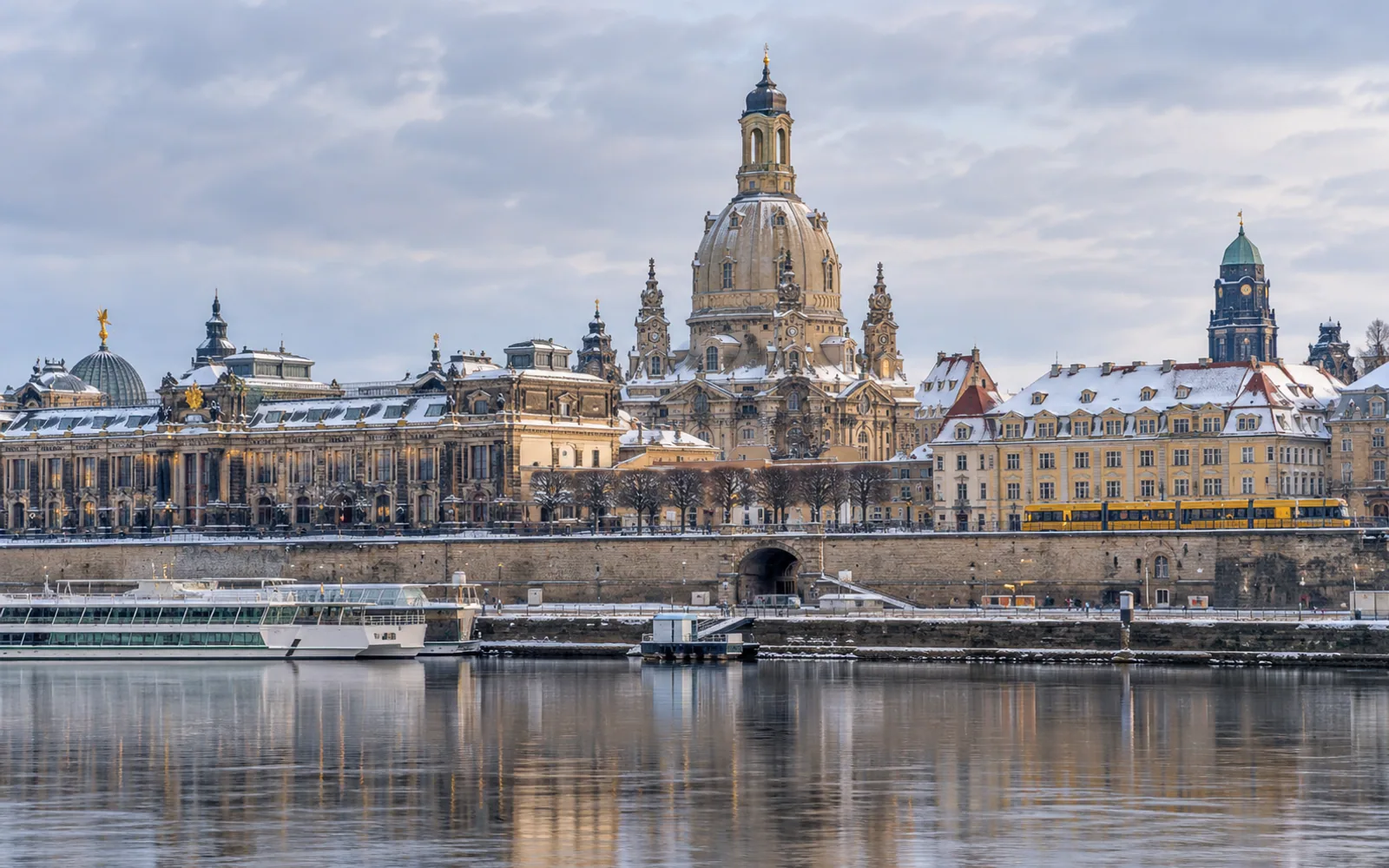
The city architect George Bähr designed the Frauenkirche, a Lutheran church with a vast stone dome, built between 1726 and 1743; Bähr died before it was finished. It survived the air raids of 13 and 14 February 1945 only to collapse in the heat two days later. Through the GDR years the ruin was left as a memorial. After reunification, a citizens' initiative and donors from many countries funded reconstruction; the foundation stone was laid in 1994, and builders used as many original stones as could be identified, their darker colour still visible in the pale walls.
The golden cross on the dome came from the London firm Grant Macdonald Silversmiths and was made by Alan Smith, whose father had flown as an aircrew member in the raid on Dresden. That detail, and the human chain formed each 13 February, are why Dresden is widely seen as a city of reconciliation. Remembrance here is serious and sometimes contested, so read the museum interpretation and treat memorial events with respect.
Music from the Staatskapelle to the Kreuzchor
The Staatskapelle Dresden was founded in 1548 by order of Maurice, Elector of Saxony, and is one of the oldest orchestras in the world. Richard Strauss worked closely with it as composer and conductor, and it gave first performances of several of his works. The orchestra plays in the Semperoper, the opera house designed by Gottfried Semper, rebuilt after a nineteenth-century fire and again after the war. The Dresdner Kreuzchor, the boys' choir of the Kreuzkirche, has sung in the city for centuries, and its Christmas vespers are a local fixture.
Stollen, Eierschecke and the Striezelmarkt
Dresden's Striezelmarkt, first held in 1434, is one of Germany's oldest Christmas markets. Dresden Stollen is a protected regional product, a dense fruit bread rich with butter, raisins and candied peel, dusted with sugar. The rest of the year, Eierschecke, a three-layered Saxon cake with a custard top, is the café speciality, and Elbe valley vineyards supply Saxon wines rarely seen outside the region.
A World Heritage listing lost
UNESCO inscribed the Dresden Elbe Valley on the World Heritage List in 2004, recognising the river meadows, palaces and villas as a cultural landscape. After the Waldschlösschen Bridge was built across the meadows, the committee removed it from the list in 2009. Dresden is one of very few places ever delisted, and the debate about development and protection still shapes local politics. The monuments themselves remain protected, and the green Elbe meadows still run through the city.
Old town, new town and the river between
Dresden's centre divides cleanly along the Elbe. On the south bank, the Altstadt holds the Frauenkirche, Neumarkt, Residenzschloss, Zwinger and Semperoper within a short walk. Brühl's Terrace, the "Balcony of Europe", runs above the river. Across Augustus Bridge, the Inner Neustadt has baroque streets, while the Outer Neustadt is Dresden's alternative quarter of courtyards, street art and the tiled Kunsthofpassage, and the best area for an evening meal.
Two days without museum fatigue
Spend the first day around the Neumarkt and the palace. The Historic Green Vault uses timed admission and makes a natural anchor; choose one more collection, then walk the Fürstenzug to the terrace. On the second day, take the Zwinger's Old Masters or the Albertinum for nineteenth-century and modern art, then cross to the Neustadt. A Semperoper tour or performance can replace a museum; both are separate tickets.
Up the Elbe and over the hills
Historic paddle steamers sail upstream to Pillnitz Palace in garden season, and trains reach Meissen for porcelain and its castle hill. The sandstone landscapes of Saxon Switzerland continue across the border into Bohemian Switzerland in Czechia; bring proper footwear and check conditions after storms or ice. Choose one excursion rather than all three.
Trains, tickets and timings
Direct trains link Dresden with Berlin in under two hours on the fastest services and with Prague, covered in our Prague first-time visitor guide; check the exact train and station. Leipzig, Saxony's other great city, is a short train ride away. The airport is linked by S-Bahn, and trams make a car unnecessary; buy the right VVO zone, since an intercity ticket is not a local pass.
The state collections' price sheet for 2026 shows that the ordinary Royal Palace all-in-one ticket includes the New Green Vault but not the timed Historic Green Vault, which needs its own admission or an eligible higher-tier product. Collections close on different weekdays, so check opening days shortly before you go. Many reconstructed streets are level, but cobbles and palace thresholds remain; venues publish accessible entrances, and river-boat access depends on the vessel and water level.
May to September suits the meadows and river; late November and December bring the Striezelmarkt and crowded weekends. Winter ice can make terraces slippery. Keep clear of tram and cycle lanes, watch belongings at markets and stations, and give demonstrations space when they affect central routes.
A skyline worth the wait
Dresden is the clearest place in Germany to see how a city chooses to rebuild what it loves. Our overview of what makes Germany special puts Saxony in context, a gift idea built on a home town's own landmarks can start with a porcelain tile or a Stollen tin, and the Germany country page collects every Dresden story we publish.
Questions and answers
Was the Dresden Frauenkirche rebuilt?
Yes. The baroque church collapsed after the bombing of February 1945 and stood as a pile of rubble for decades. It was rebuilt using original stones where possible, with funds raised worldwide, and reconsecrated in 2005.
Is Dresden a World Heritage Site?
Not today. The Dresden Elbe Valley was inscribed in 2004, but UNESCO removed it from the list in 2009 after the Waldschlösschen Bridge was built across the river meadows. The city's monuments remain protected and widely visited.
How many days do you need in Dresden?
Two full days suit the historic centre, one major collection and Neustadt. Add a third for Pillnitz, Meissen or Saxon Switzerland.
Sources
Berlin · 52.5200° N, 13.4050° E
This story belongs to Dresden, Germany. A country whose contributions to the world each belong to a particular town, and whose regions still keep their own dialects, bakeries and festivals.