Leipzig for First-Time Visitors: Music, History and Neighbourhoods
Bach's church, the choir founded around 1212 and the Monday demonstrations of 1989: Leipzig made its name by singing and by standing up in public.
Cover: AI-generated illustration. © ANUSHKA DAHANAYAKE (PVT) LTD.
Leipzig is the German city where a church choir that dates to the thirteenth century, a composer who spent his last 27 years in its service and a crowd of tens of thousands in October 1989 all belong to one continuous story. Music and public courage are the two things locals are proudest of, and a first visit becomes much easier to read once the dates are in order. This guide begins with them and then turns to routes.
A trading city from the beginning
Leipzig was first documented in 1015 and grew as a trade city at the crossing of the Via Regia and the Via Imperii; its trade fair dates to 1190. It sits where the White Elster, Pleiße and Parthe rivers meet, about 150 kilometres south-west of Berlin. Leipzig University was founded in 1409. Today it is Saxony's most populous city and Germany's eighth-largest, and after losing population and industry following reunification it recovered from around 2000 and is now Germany's fastest-growing city.
Bach, the Thomanerchor and a city of music
The Thomanerchor, the choir of St Thomas Church, is believed to have been founded in 1212, when the church became the church of the St Thomas college of Augustinian canons, a college that later formed the core of the university. The present late-Gothic hall church replaced a Romanesque nave in 1482-1496 and was consecrated on 10 April 1496. Martin Luther preached there on Pentecost Sunday in 1539.
Johann Sebastian Bach served as Thomaskantor from 1723 to his death on 28 July 1750. A Gothic Revival renovation in 1884-1889 removed most of the Baroque interior he knew, and Allied bombing damaged the tower on 4 December 1943, but Bach's remains were moved into the church in 1950, and the grave was inaugurated on 28 July of that year. The Gewandhaus Orchestra was established in 1743, and Bach, Mendelssohn and Wagner all worked in the city. A Mendelssohn statue was re-erected opposite the church on 18 October 2008.
The church is active: services, rehearsals and concerts can restrict sightseeing, and the choir does not perform on demand. Check the official calendar, enter quietly and avoid flash.
1813: the Battle of the Nations
The Battle of Leipzig, also called the Battle of the Nations, was fought on 16-19 October 1813; about half a million soldiers took part, and about 110,000 died by the end of the battle, with many more dying afterwards in field hospitals in and around the city. The Monument to the Battle of the Nations, designed by Bruno Schmitz with major influence from Clemens Thieme, was inaugurated on 18 October 1913, the hundredth anniversary, in front of about 100,000 people. At 91 metres it was the tallest monument in Europe when completed, and a circular crypt holds sixteen warrior statues guarding eight death masks. Reaching the viewing platform means many steps, so check current access.
1989: the Peaceful Revolution
Peace prayers began at Leipzig's St Nicholas Church in 1982 and later became the basis for the protests. The first demonstration followed a prayer service on 4 September 1989, when the organisers Katrin Hattenhauer and Gesine Oltmanns unfurled a banner reading "Für ein offenes Land mit freien Menschen". On 9 October 1989 authorities deployed about 8,000 police and military units, but the crowd grew to more than 40,000, and local leaders ordered their forces to withdraw; the feared massacre did not occur. The chant "Wir sind das Volk!" became iconic. By 16 October about 120,000 people protested, and Erich Honecker resigned two days later. The Berlin Wall fell on 9 November, and the Monday demonstrations ended around the first free multi-party elections in March 1990.
Leipzig suffered heavy Allied bombing from 1943 to 1945, and its Jewish community was largely destroyed during the Nazi era. Visitors can see the post-1989 story at the Forum of Contemporary History, whose exhibitions examine division, dictatorship and reunification, and at the Museum in the Round Corner, connected to the former Stasi district administration. Approach testimony and surveillance history carefully, and verify current exhibitions and language support.
A route through music, memory and the canal
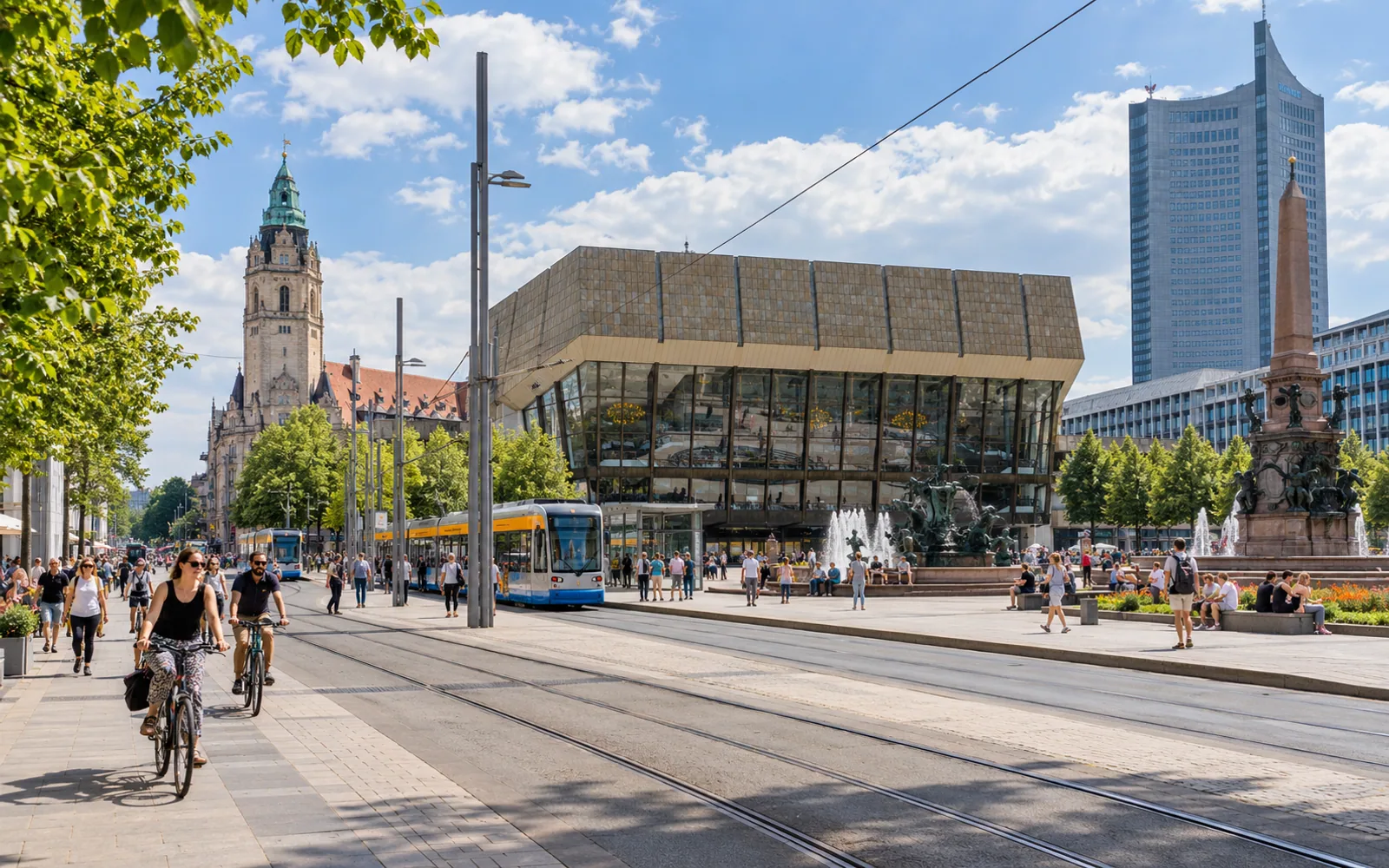
Day one. Start at St Thomas Church and the Bach Museum, then walk through the market square and arcades to St Nicholas Church. Continue to the Forum of Contemporary History, then finish at Augustusplatz with the Gewandhaus and opera. A concert is worth booking if the programme interests you, but do not buy simply to enter the building.
Day two. Take a tram west to Plagwitz and walk the Karl-Heine Canal, where former industrial sites now house studios, businesses and homes. The Spinnerei gallery complex has specific opening days, so check individual spaces. Alternatively follow Karl-Liebknecht-Strasse through Südvorstadt and Connewitz, a lived-in district: keep doorways and cycle lanes clear and control noise at night.
Day three. Visit the Monument to the Battle of the Nations or the southern lakes, former mining landscapes where you should use an officially managed beach and check water-quality notices.
Practical notes for a rail-centred city
Leipzig Hauptbahnhof is among Europe's largest terminal stations, and the City Tunnel opened in 2013 anchors the S-Bahn network. The airport has rail connections, but check frequency for your arrival time. LVB runs trams and buses within the MDV fare system; use the official planner for zones and never assume a regional ticket covers an ICE. The compact centre inside the ring is convenient; Südvorstadt and Plagwitz offer neighbourhood evenings with direct trams. The Leipzig Card includes local transport in zone 110 and partner discounts, so compare it with the trips on your actual itinerary; a mostly walking day may cost less with separate tickets.
Leipzig can offer better accommodation value than Germany's largest cities, but fairs and festivals create spikes. The city is generally safe: secure valuables at the station and festivals, avoid poorly lit canal edges late at night and follow instructions around demonstrations. Call 112 for fire or medical emergencies and 110 for police. Much of the centre is level, but trams cross plazas and cobbles remain; LVB provides accessible journey information, so confirm lift outages. Spring and early autumn suit walking; winter offers concerts and markets with short daylight.
Leipziger Allerlei is a vegetable dish with many interpretations, and Leipziger Lerche is a pastry created after songbird hunting was banned. Keep a second payment method for smaller businesses, and check kitchen closing times.
Leipzig's strongest lesson is that culture is still being made here. Compare more destinations through our Germany hub, then use the Berlin guide to build a realistic rail itinerary. Read what makes Germany special for the wider story, or compare another historic city in the Nuremberg guide.
Questions and answers
How many days do you need in Leipzig?
Two days cover the centre, music heritage and one neighbourhood. A third allows the lakes, more museums or the Monument to the Battle of the Nations.
Is Leipzig easy without a car?
Yes. The centre is compact and trams reach neighbourhoods and major sights. Regional trains serve nearby lakes and cities.
What should music lovers book ahead?
Check official schedules for the Gewandhaus, Leipzig Opera and St Thomas Church. Concert and choir dates vary and ordinary church services are not tourist performances.
Sources
Berlin · 52.5200° N, 13.4050° E
This story belongs to Leipzig, Germany. A country whose contributions to the world each belong to a particular town, and whose regions still keep their own dialects, bakeries and festivals.