Frankfurt for First-Time Visitors: A Practical Two-Day Guide
An imperial election city, the home of Goethe and the 1848 parliament, rebuilt from 1944 bombing: Frankfurt is more than a banking gateway.
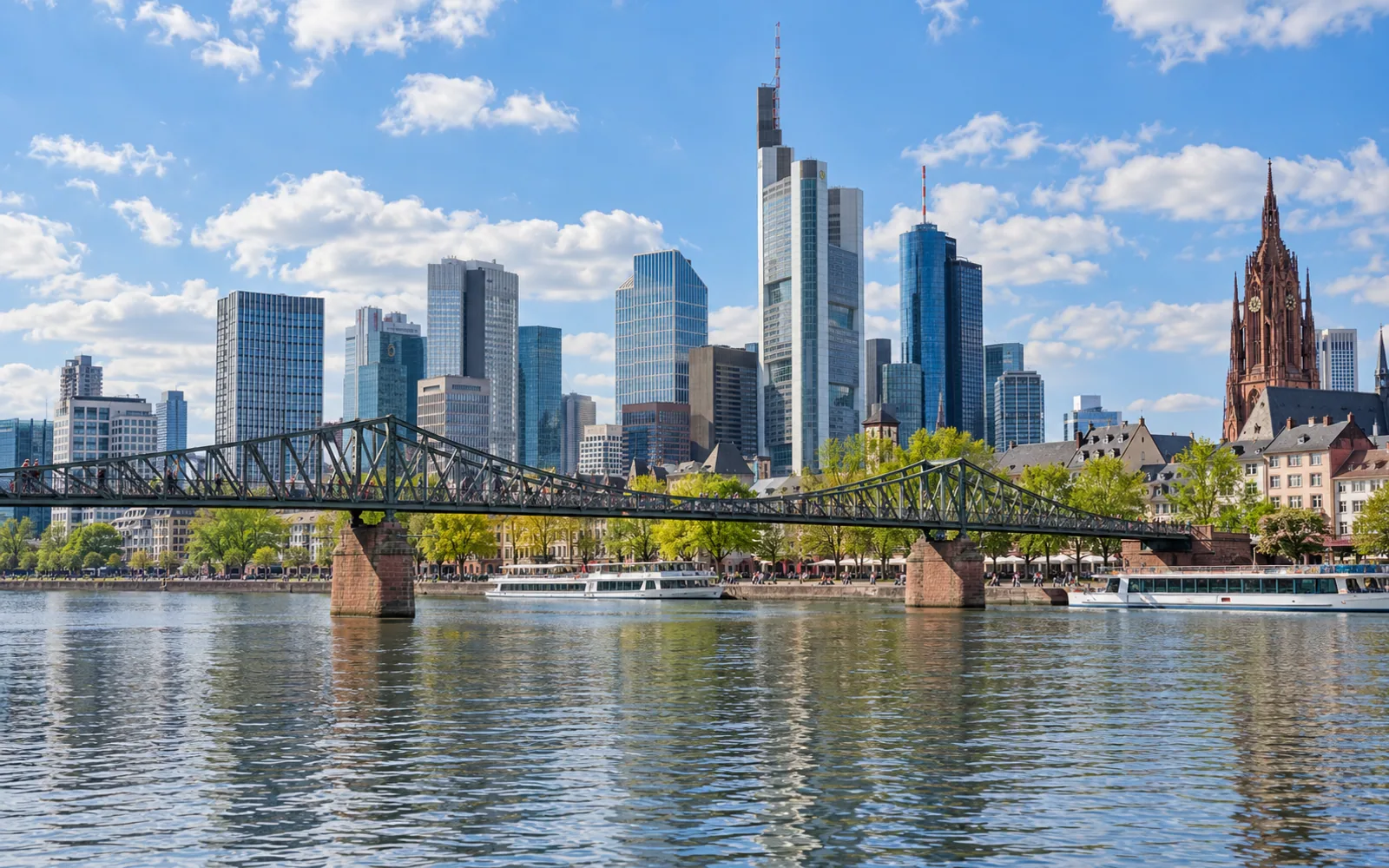
Cover: AI-generated illustration. © ANUSHKA DAHANAYAKE (PVT) LTD.
Frankfurt is usually described by its skyline, but its significance is older and more political. Emperors were elected and crowned here, a national parliament met here in 1848, and the poet Goethe was born in a house that stands, rebuilt, near the river. Locals are proud of that civic tradition, and equally of the work it took to reconstruct a medieval centre after the bombing of 1944. The towers give the city its nickname, Mainhattan, but the history sits at ground level.
The imperial election city
Frankfurt was first mentioned in 794 and became an imperial city in 1372. It remained a free city for nearly five centuries and was a site of Holy Roman imperial coronations. At the Kaiserdom, formally St Bartholomew's Cathedral, a church founded in 852 by King Louis the German stood on the site of a royal palace, and the present Gothic building was built in the fourteenth and fifteenth centuries. From 1356, under the Golden Bull, emperors were elected there, and the Wahlkapelle, the election chapel, was built in 1425. From 1562 to 1792, emperors-elect were crowned in the cathedral.
Despite its name, the Kaiserdom has never been a bishop's seat; the diocesan cathedral is in Limburg. A fire in 1867 led to a rebuild in its present style, the spire is 95 metres tall and the tower holds nine bells cast in 1877. Allied bombing in the Second World War gutted the interior, which was reconstructed in the 1950s.
1848, Goethe and the people's city
The 1848 Frankfurt Parliament, Germany's first democratically elected national assembly, met at St Paul's Church. Frankfurt was annexed by Prussia in 1866 and has been part of Hesse since 1945. Goethe University was founded in 1914 by citizens, a reminder that Frankfurt's wealth often funded public institutions.
Johann Wolfgang Goethe was born in a house in Frankfurt on 28 August 1749. The house was first built around 1618 by the Flemish goldsmith Matthis van Hinsberg. Goethe wrote Götz von Berlichingen and The Sorrows of Young Werther in Frankfurt, and the first drafts of Urfaust, an early version of Faust. Allied bombing destroyed the house on 22 March 1944; reconstruction began in 1947, and it reopened in 1951 under Theodor Heuss, then President of Germany. The Free German Hochstift's founder, the geologist Otto Volger, had bought the house in 1863, and it has operated as a museum since.
A centre rebuilt
Allied bombing largely destroyed the medieval Altstadt, and about 5,500 residents were killed. In the Dom-Römer project, the Technical City Hall, built in 1972-1974, was demolished from April 2010, and the district between Römerberg and Domplatz opened to the public on 9 May 2018. The 2012 plan called for 15 reconstructions and 20 new buildings, and the Haus zur Goldenen Waage was called the most complex single project. Today, look for the interpretation that helps visitors tell what is historic, restored or newly built, and allow time to walk the lanes between the houses as well as crossing the square. The result has been debated, but the reconstruction shows how much residents wanted a centre they could recognise.
Frankfurt is also a financial city: the European Central Bank, the Deutsche Bundesbank and the Frankfurt Stock Exchange are based here, and Messe Frankfurt is one of the world's largest trade fair operators. The Frankfurt Book Fair is held here, and Frankfurt Central Station is Germany's second-busiest railway station.
A city of newcomers
Frankfurt is the fifth-largest city in Germany, with about 779,000 residents in 2025, and it sits at the core of the Rhine-Main region. Roughly half the population has a migrant background, and about a quarter are foreign nationals. That mix is visible across the city's neighbourhoods and markets, and it sits alongside a cultural life that includes many museums, the Alte Oper concert hall and the book fair. A first-time visitor can read Frankfurt less as a monument than as a working crossroads, one with an unusually well-documented civic past.
A route through two days
Day one. Begin at Römerberg before group tours peak. Walk to the Kaiserdom, then continue to the Main and cross the Eiserner Steg; do not add to the love locks, whose weight creates maintenance work. Walk the Sachsenhausen bank and choose one Museumsufer institution instead of trying several. End with dinner in a Sachsenhausen apple-wine tavern, where Ebbelwoi is served with regional food such as green sauce. The drink is dry and unfamiliar to some visitors, so order a small serving first.
Day two. Choose a public viewpoint only if the weather is clear; the skyline is also visible free from bridges and riverbanks. Continue to the Palmengarten or the Senckenberg museum, and spend the later afternoon in one neighbourhood: Bornheim for cafés, Westend for residential architecture, or Ostend for the European Central Bank area and river.
Practical notes for a transport hub
RMV integrates S-Bahn, U-Bahn, trams and buses. RMV distinguishes the airport from the city fare zone, so use the official journey planner for exact fares. Stay near the city centre, Hauptbahnhof or a frequent U-Bahn or S-Bahn stop. The station district is convenient but can feel confronting around a few streets at night, and visible drug use near parts of it can unsettle visitors; choose a well-lit parallel street, do not photograph people, and call 112 for medical or fire emergencies and 110 for police.
Frankfurt Airport has two passenger terminals and long internal distances; confirm the airline's terminal and follow official signs. Hotel rates fluctuate sharply during trade fairs, so check the Messe calendar. Step-free travel depends on the specific station entrance and lift status; the river promenades are generally easier than the cobbles around Römerberg. Spring and early autumn suit walking, summer heat can build between paved streets and winter brings Christmas markets. Shops are normally closed on Sundays.
Frankfurt rewards travellers who stop seeing it as a connection: read what makes Germany special, compare the capital in the Berlin guide, continue to the Heidelberg guide or Munich, or browse the Germany destination hub.
Questions and answers
How many days do you need in Frankfurt?
Two full days cover the historic centre, river and one or two museums. Add a third for neighbourhoods or a day trip rather than compressing several excursions.
Is Frankfurt easy without a car?
Yes. The centre is walkable and the RMV network connects the airport, station and neighbourhoods. A car adds parking and environmental-zone complications.
Is an airport layover enough to see Frankfurt?
Only with a generous buffer and permission to enter Germany. Count immigration, baggage, transport, security and terminal walking before deciding to leave the airport.
Sources
Berlin · 52.5200° N, 13.4050° E
This story belongs to Frankfurt, Germany. A country whose contributions to the world each belong to a particular town, and whose regions still keep their own dialects, bakeries and festivals.