Annecy First-Time Visitor Guide: Lake, Old Town and Mountains
Counts, a bishop in exile, a prison-palace in the river and a lake restored from pollution: why Annecy is France's quietest Alpine showpiece.
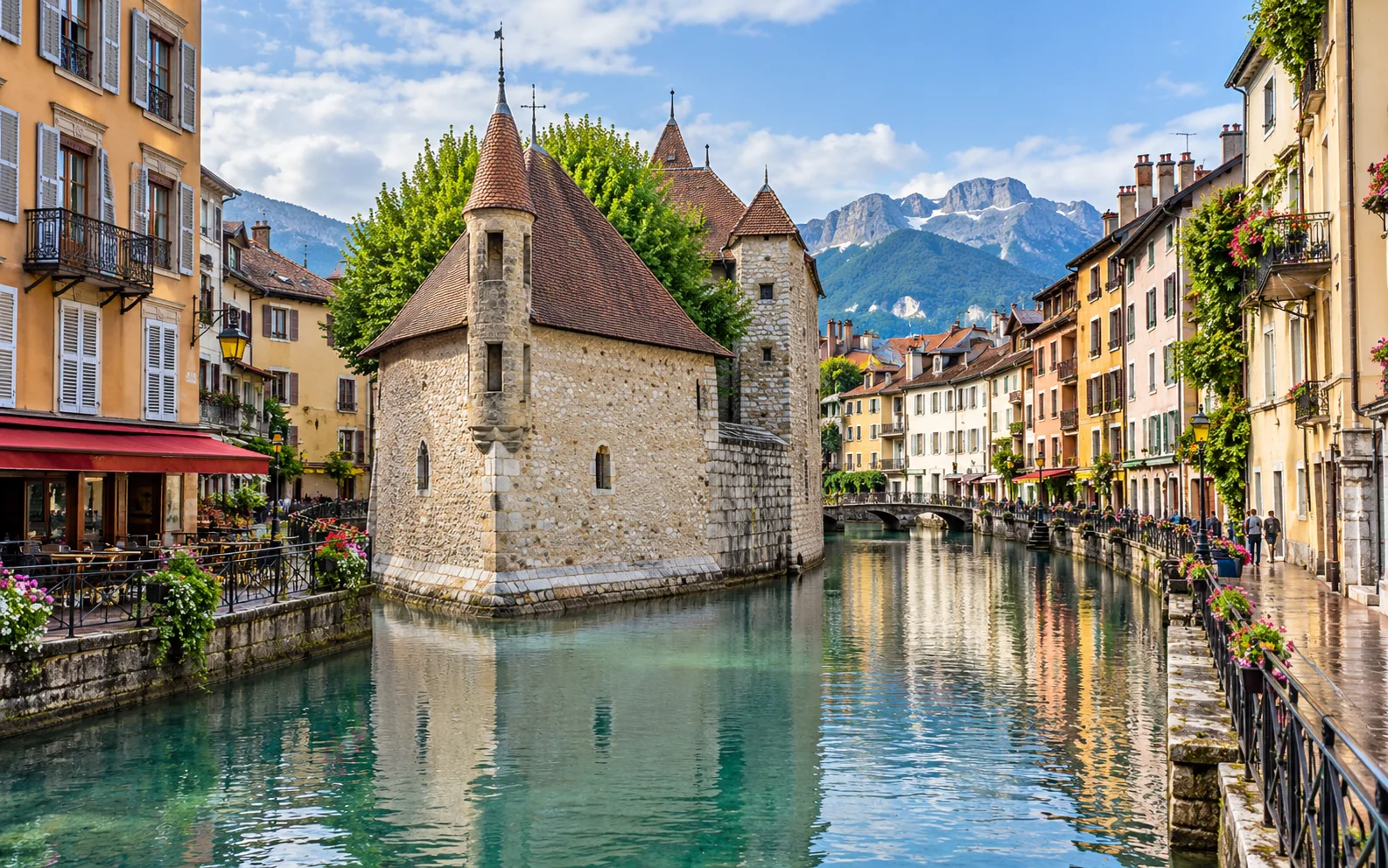
Cover: AI-generated illustration. © ANUSHKA DAHANAYAKE (PVT) LTD.
Annecy looks like a pastel postcard, but its charm is the product of history and a rescue. Counts and bishops shaped the old town, a river runs through it in canals that once powered industry, and the lake beside it was nearly lost to pollution before a 1957 project restored it. Locals are proud of the clarity of that water, of a Savoyard identity that became French only in 1860 and of an animation festival that fills the town each June. Knowing that story turns a pretty walk into a readable one.
Counts, bishops and a prison in the canal
From the tenth century Annecy was the seat of the counts of Geneva (the Genevois). Control passed to the counts of Savoy in 1401, and in 1444 the town became the regional capital of the Genevois, Faucigny and Beaufortain. The twelfth-century Palais de l'Isle, built on an islet in the Thiou canal, served as a prison and courthouse. It was classified as a historic monument in 1900 and is now the town's emblem.
In 1535, as Calvinism rose in Geneva, the old Bishopric of Geneva was transferred to Annecy. Francis de Sales, born in 1567, was bishop of Annecy from 1602 to 1622, and Jane Frances de Chantal (1572-1641) founded the Salesian order in the town. That Counter-Reformation chapter is why Annecy still carries the memory of a bishop's town as well as a count's. Annecy was attached to the Mont-Blanc department during the French Revolution, returned to the King of Sardinia in 1815, and became French when Savoy was annexed under the Treaty of Turin in 1860. It then became the capital of the new Haute-Savoie department. The Hôtel de Ville was completed in 1851.
The lake that was saved
Lake Annecy is about 14.6 kilometres long and 3.2 kilometres wide, lies at roughly 447 metres above sea level and reaches a maximum depth of 82 metres. Sources describe it as the third-largest lake in France if the French part of Lake Geneva is excluded. Small mountain rivers feed it, and an underwater spring, the Boubioz, rises at a depth of 82 metres. The Thiou, the short river that runs through the old town, begins at its outflow.
The lake stayed in good condition until the 1940s and then degraded as human activity grew around it. In 1957, scientists and local officials created SILA, the Lake Annecy water treatment district, backed by Mayor Charles Bosson. Its first projects were a collection belt around the shore and a treatment plant outside the catchment. The lake now supplies about 70 per cent of the Grand Annecy area with drinking water, and the clean-up has been used as a model by campaigners elsewhere. Paul Cézanne painted Le lac bleu here in 1896. The lake also hosts sport: stage 18 of the 2009 Tour de France was an individual time trial around it, and the town was the start of stage 10 in 2018. Annecy's bid for the 2018 Winter Olympics lost to Pyeongchang.
The festival that animates June
The Annecy International Animation Film Festival was created in 1960 and is held in early June. It grew out of the Journées Internationales du Cinéma d'Animation, after Savoy film-club directors noticed that film stars dominated attention at Cannes and proposed an animation festival of their own. It was initially held every two years and became annual in 1998. The first International Animation Film Market, MIFA, was held alongside it in 1985. In June, rooms fill well ahead and the old town is busy.
A route through old town and lake
Day one. Walk along the Thiou canal, the Palais de l'Isle and the arcaded streets early, before narrow routes become crowded. Choose a museum, and continue through the Jardins de l'Europe to the lakefront and Pont des Amours. A gentle walk toward the Imperial area gives open water views without needing a boat. Tartiflette and raclette are filling mountain dishes but are not obligatory in hot weather; look for seasonal Savoyard produce and explain dairy allergies carefully.
Day two. Choose one way around the lake. A boat trip provides scale and connects selected lakeside communities. The tourism office lists the full lake circuit at 42 km, which suits a confident rider; a short section near Veyrier-du-Lac is easier. By bus, choose one village such as Talloires or Menthon-Saint-Bernard and learn the return timetable before leaving town.
Day three (optional). Semnoz, La Tournette and the Aravis approaches are different commitments: pick a route that matches fitness, season and transport, check official conditions and start early. If the forecast is unstable, choose a lower forest walk or a museum.
Practical notes for water and mountains
Use designated beaches and follow lifeguard flags or local notices. Alpine water can be cold below the surface, and sudden immersion can cause shock. Enter gradually, supervise children continuously and never mix alcohol with swimming or boating. Hire paddleboards and boats only from reputable operators, wear the buoyancy aid and return when told. Thunderstorms build quickly, so cancel exposed hikes when the forecast is unstable.
Annecy station is close to the centre and receives regional and longer-distance trains; check seat and connection details during holiday periods. SIBRA buses serve the urban area and seasonal destinations. A car is useful for remote outings but burdensome in the centre, and traffic around the lake can make short distances slow. Staying near the station or old town simplifies arrival, dinner and a rainy-day plan, and summer weekends bring high prices and congestion.
The lakefront is mostly level, while old-town cobbles, arcades and historic buildings can be difficult. Ask museums for the usable entrance, lift and accessible toilet. Respect residents by keeping night-time noise down, do not feed waterbirds or enter reed beds, and carry a reusable water bottle. Check SIBRA, boat schedules, beach status and weather before travel, since seasonal services do not run identically all year.
Forty-eight hours before arrival, recheck the train, accommodation access, forecast and any reservations. Geneva is close enough for a combined trip; see our Geneva guide. Read what makes France special, explore other options on the France destination hub, or compare another food-focused city in the Lyon guide.
Questions and answers
How many days do you need in Annecy?
Three days allow the old town, a lake circuit or boat day and one mountain or village excursion. Two days work if you keep the plan close to town.
Can you visit Annecy without a car?
Yes. Trains reach the centre, the old town is walkable, and buses, seasonal lake services and bicycles cover many nearby places. Remote trailheads need more planning.
Can you swim in Lake Annecy?
Yes at designated beaches when conditions permit. Use supervised areas where available, follow local rules, and remember that deep lake water can remain cold even in warm weather.
Sources
Paris · 48.8566° N, 2.3522° E
This story belongs to Annecy, France. A country that sends people to the baker twice a day, protects a cheese by law and refuses to be averaged into one postcard.