Amalfi Coast for First-Time Visitors: A Low-Stress Four-Day Plan
A medieval sea republic that peaked at 70,000 people, a cathedral holding Saint Andrew's relics, hand-made paper and terraces cut into limestone cliffs.
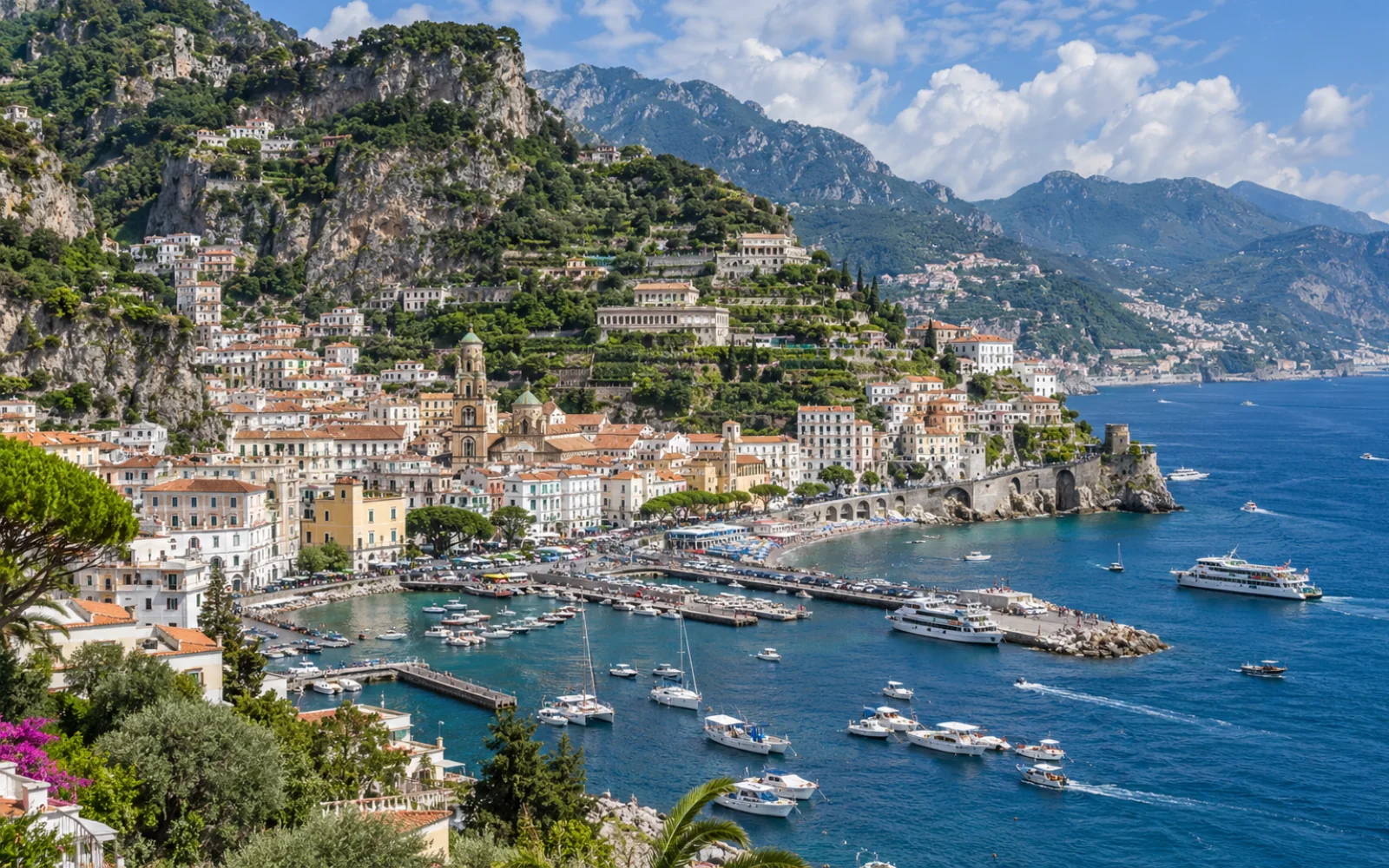
Cover: AI-generated illustration. © ANUSHKA DAHANAYAKE (PVT) LTD.
Few small towns have shaped the Mediterranean as Amalfi did. The settlement broke free from Byzantine control in 839, elected its first duke in 958 and, under Duke Manso between 966 and 1004, reached an estimated 70,000 to 80,000 people, more than ten times today's population. It was an independent maritime republic for centuries, trading across the Mediterranean, and its sea laws were still recognised in the Mediterranean until 1570. The Normans took the republic in 1073, Pisan ships helped take it in 1135 and 1137 and a tsunami in 1343 destroyed the port and lower town. What remains is a town that was once a world power.
A cathedral built on trade
Amalfi's cathedral, begun in the ninth century and altered by Norman and later builders, is dedicated to Saint Andrew. His relics were brought from Constantinople in 1206 or 1208, and stairs to the crypt were built in 1203. The Cloister of Paradise, a burial place for leading families, shows Arab-influenced arches that trade carried home. Cathedral steps are significant, so ask about accessible arrangements and service closures. The harbour arsenal, in which the Compass Museum opened in December 2010, houses a museum devoted to navigation, a fitting subject for a town that grew rich on the sea.
Paper, lemons and terraces
The paper mill that makes Amalfi's hand-made paper was converted into a museum in 1969, preserving the craft. Lemons are the other local pride. The sfusato amalfitano is a protected product that sources say has been grown on the coast since at least the eleventh century, on stone terraces cut into the cliffs and supported by walls built over generations; terracing here is described as developing between the tenth and thirteenth centuries. Not every bright-yellow souvenir is local craft, so buy from identifiable producers and never pick fruit from private terraces.
UNESCO included the coast on the World Heritage List in 1997, honouring its terraced farms, vertical towns and Mediterranean landscape as much as the views. Ravello above, Positano below and the smaller villages between all depend on the same labour of stone walls and steps.
Arriving without a car
From Naples, a common route is a train to Salerno, then a ferry or bus to Amalfi when services operate, while another approaches via Sorrento and the slow road through Positano. Compare whole journeys, including station changes, luggage and the last connection, and do not assume a direct airport shuttle. A private transfer may make sense for a group with luggage, a late arrival or mobility needs, but obtain a clear written price. Seasonal ferries can be cancelled by sea conditions, so keep a bus or land-transfer alternative in hand and avoid copying a summer boat itinerary into winter. These constraints are part of why the towns stayed small and intact.
The coast on the move
The practical problem is the geography. The coast is only about fifty kilometres long, yet one narrow road carries buses, deliveries and private vehicles, ferries depend on season and sea, and villages climb sharply from small waterfronts. A successful visit uses one base, limits daily moves and accepts that a missed connection is not a reason to sprint.
Base choice. Amalfi is a bus and seasonal-ferry hub, though it has stairs and day-trip crowds. Positano is photogenic but extremely steep, so understand how many steps lie between your hotel and the ferry pier. Ravello is peaceful after day visitors leave but needs bus or taxi transfers. Salerno has mainline trains, more level streets and better value, which suits mobility needs. Wherever you stay, ask for the exact luggage route.
Day by day. Use arrival day for Amalfi's cathedral and paper museum, away from the central funnel. Go up to Ravello early for Villa Rufolo and Villa Cimbrone, and expect gardens, views and slopes. Take a ferry to Positano when the sea allows, checking the operator's current timetable and service notices that morning. Keep a fourth day for the Path of the Gods or a slow boat trip.
Ravello deserves several hours, not a rushed photo between buses, and music festivals and weddings can affect garden availability. Returning through Atrani or Minori on foot only suits groups whose fitness and the weather allow it, because coastal paths include tunnels, road edges and stairs. Check the last bus rather than assuming a ferry will replace it after dark, and eat locally without demanding a sea-view table.
The Path of the Gods is a mountain path with exposure, uneven surfaces and little shade. Wear proper footwear, carry water and turn back if heat, thunderstorms or vertigo make progress unsafe. Cliff paths can close after rain or fire risk, so never cross barriers.
Buses, ferries, costs and respect
SITA Sud operates important buses; check its current route and ticket instructions before boarding. Summer buses can fill and lose time in traffic. Ferry operators have separate tickets, and "ferry available" does not mean step-free, so travellers using wheelchairs or pushchairs should ask about the vessel and gangway. Drivers must research ZTL rules, size limits and booked parking, because roadside space is scarce.
Accommodation, restaurants and private transfers can be expensive. Build the budget from the room plus tax, daily transport, one paid garden or activity and meals, and add a contingency for a taxi if the last bus is full. Check whether fish is priced by weight before ordering. Staying in Salerno with fewer coast trips may offer more comfort and value than a cliff hotel reached by stairs.
Accessibility is the coast's hardest truth, because many buildings, lanes and beaches use steps. Summer brings heat, traffic and crowding, so move early, carry water and rest through the hottest hours. Keep noise down in vertical residential streets, and treat stairways as circulation space for residents and porters, not portrait studios.
The cathedral, paper and lemon terraces described above are best read at walking pace, so treat what follows as an onward route, not a checklist. Pair this guide with Naples for first-time visitors, Sicily's one-week route and the Italy destination hub, or read what makes Italy special for the wider story.
Questions and answers
Where should a first-time visitor stay on the Amalfi Coast?
Amalfi is a practical car-free hub for buses and seasonal ferries; Salerno offers easier rail access and better value; Positano is scenic but steep and expensive. Choose according to transport and mobility, not photographs alone.
Do you need a car on the Amalfi Coast?
Usually no. The coast road is narrow, parking is scarce and seasonal restrictions may apply. Ferries and buses work better when combined with schedule checks and generous time margins.
When do ferries operate?
Most useful coast services are seasonal and can be cancelled by sea conditions. Check the operator for your exact date and keep a bus or land-transfer alternative.
Is the Amalfi Coast accessible?
It is challenging. Towns contain steep slopes and stairs, while boats and buses have varying access. Amalfi or Salerno can be more manageable bases, but verify every transfer and hotel entrance directly.
Sources
Rome · 41.9028° N, 12.4964° E
This story belongs to Amalfi Coast, Italy. A country told city by city, where a craftsman solved a problem the rest of Europe copied and the city never forgot whose solution it was.