Victoria: Lekwungen Land, a Fort and a Harbour Capital
From Lekwungen villages and an 1843 Hudson's Bay fort to a legislature, Chinatown and famous gardens, Victoria's story comes first here, with car-light advice after it.
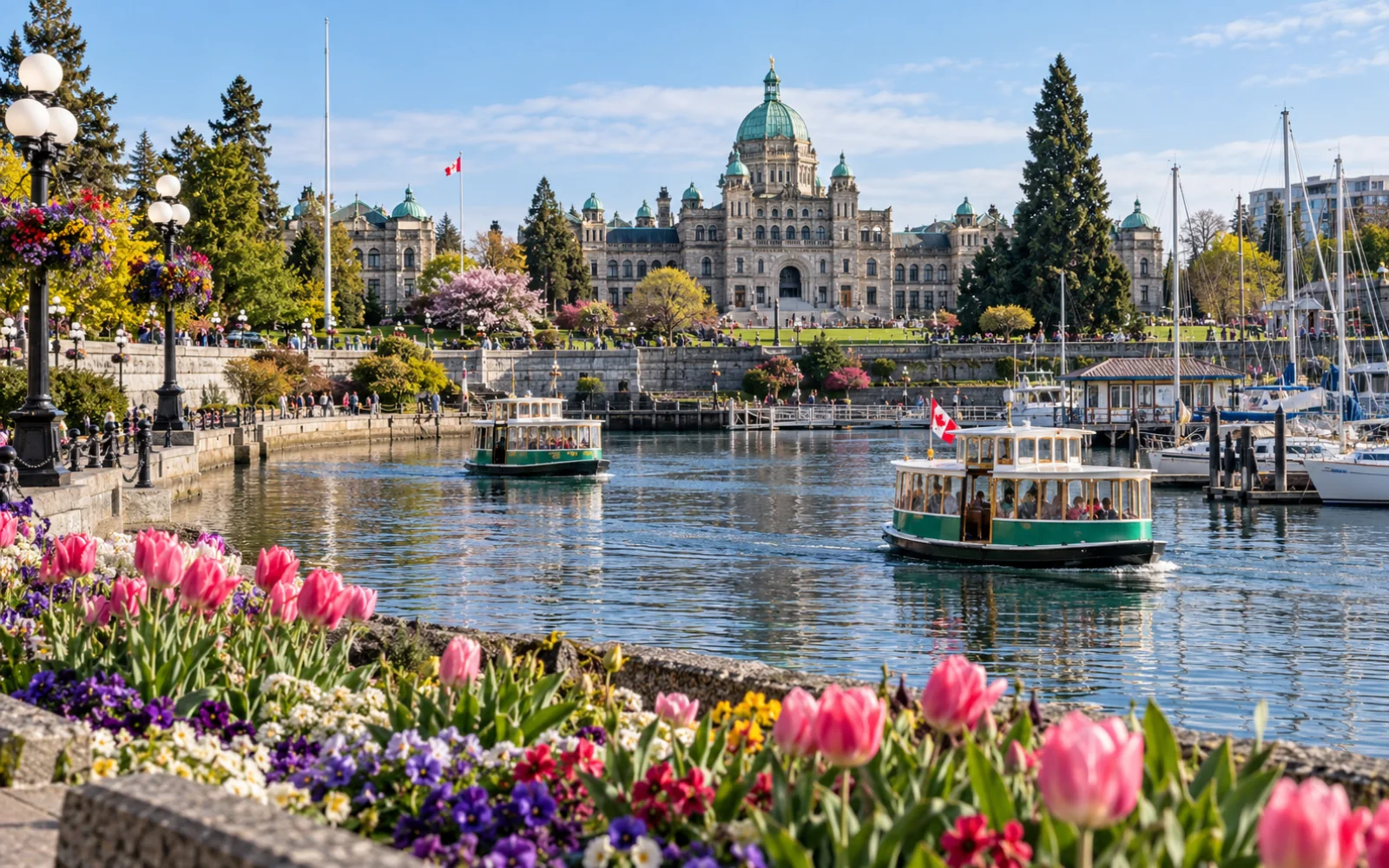
Cover: AI-generated illustration. © ANUSHKA DAHANAYAKE (PVT) LTD.
Long before Victoria had a name, the Lekwungen-speaking Songhees and Esquimalt peoples and the W̱SÁNEĆ (Saanich) peoples lived around this harbour, drawing on its land, its fishing waters and its sheltered shore. The Songhees kept a village directly across the harbour from the fort that arrived in 1843, when the Hudson's Bay Company set up a trading post and renamed it Fort Victoria that November after the queen. The place has been a negotiated space ever since, and understanding that is part of seeing the city well.
From trading post to provincial capital
Victoria's role grew quickly. In 1868 Governor Frederick Seymour designated it the colonial capital, and when British Columbia joined Confederation in 1871 it became the provincial capital. The Parliament Buildings, finished in 1897 above the Inner Harbour, are a Victorian-era set piece of domes, stone and carved detail, outlined in lights after dark. The Empress Hotel opened across the water in 1908 and made afternoon tea a tourist custom that continues in several tea rooms around the city.
Wealth from coal built a different landmark, and it shows how fast fortunes were made on Vancouver Island in the nineteenth century. Craigdarroch Castle was built between 1887 and 1890 for the coal baron Robert Dunsmuir, who died in 1889 before it was finished. His widow Joan lived there until her death in 1908, and architect Warren Heywood Williams had designed the house as a statement of how far a Scottish miner's family had risen. Later the building served as a military hospital and as Victoria College, before the preservation society took it over, and the rooms now show both the grandeur of the family and the many lives the house has had since. A National Historic Site today, it houses one of North America's finest collections of Victorian residential stained and leaded glass.
Chinatown, gardens and craft
Victoria's Chinatown is described as the second oldest in North America after San Francisco, and its narrowest lane, Fan Tan Alley, is a short walk through shops and workshops. Chinese-Canadian merchants and families shaped the district, and its balconies, shopfronts and courtyards still show that heritage. Local businesses ask for ordinary courtesy, so do not block passages for photographs.
The Butchart Gardens opened in 1904 on a quarry site and have become among the best-known gardens in Canada. The planting changes through the year, so winter should not be marketed as identical to spring. Allow several hours, because the gardens reward slow walking. Paths include gradients, and rain changes comfort.
Closer to downtown, the Royal BC Museum and the Thunderbird Park area present Indigenous art and the natural history of the province, and the Inner Harbour is a working waterfront shared by seaplanes, ferries and kayaks. Victoria is also a food town built on seafood, farm produce from the Saanich Peninsula, local cider and craft beer. The city's best meals are often in small rooms away from the harbour front.
Living Indigenous presence
Victoria's Indigenous history is not only an opening chapter. The Songhees, Esquimalt and W̱SÁNEĆ nations remain part of regional life, and Indigenous-led tours, galleries and carved-pole displays are among the best ways to understand the harbour beyond the fort story. Look for Indigenous-owned businesses and interpretation, ask permission before photographing ceremonies or artists at work, and read place names aloud only after hearing how a community pronounces them.
The same attention suits the rest of the city. Victoria's civic pride shows in its preserved Victorian streets, its harbour edge kept open to walkers, and its museums, which collect everything from fur-trade records to natural history. Visitors who choose one museum, one garden and one waterfront walk each day see more than those who hurry through a longer list.
Whales and responsible watching
The Salish Sea around Victoria is home to marine mammals, and whale watching is one of the city's most popular excursions. Fisheries and Oceans Canada sets viewing rules that matter for endangered populations, so choose an operator that follows official guidance on distance and speed. Sightings are never guaranteed, and a good guide explains the animals rather than chasing them.
A three-day route through the story
Day one: the harbour. Walk the Inner Harbour causeway, tour the Parliament Buildings and visit the Royal BC Museum, then reach Chinatown and Fan Tan Alley in the evening. Return to the harbour in evening light, without expecting a large-city nightlife district, and choose a seafood dinner in Old Town over a chain restaurant on the waterfront.
Day two: gardens and the castle. Visit the Butchart Gardens in the morning, and Craigdarroch Castle in the afternoon. Public transit reaches both, so most itineraries need no rental car, though Butchart Gardens lies outside the centre, so check the bus route and the last return.
Day three: coast. Walk Dallas Road, Beacon Hill Park and the Ogden Point breakwater, or join a whale-watching trip if conditions allow. Nearby beaches and small cafés suit a slow final day.
Getting there, weather and money
Many visitors arrive from Vancouver or Seattle, and BC Ferries' foot-passenger check-in makes a car-free trip workable. A car adds ferry fees and parking costs that are rarely worth it for a short stay, and BC Transit buses cover most visitor destinations. Reserve sailings in summer and on holiday weekends.
Victoria's maritime climate is mild, with a dry summer and a wet winter, so a waterproof layer is more useful than an umbrella on windy days. Coastal paths can be slick and logs on beaches can shift in surf, so keep a respectful distance from the water's edge. Ordinary urban precautions apply at night. Tipping is customary, and prices peak in July and August. Accessibility is good along the harbour and in the main museums, but gardens and heritage buildings have slopes and stairs, so check each venue.
Victoria suits travellers who want a heritage city on the water. Compare it with Atlantic Canada in our Halifax guide, combine it with Vancouver, look south to Seattle, or browse the Canada destination hub.
Questions and answers
How many days should visitors spend in Victoria?
Three full days cover the Inner Harbour, a museum, neighbourhoods, a coastal walk and either gardens or a wildlife trip. Add more time before exploring the wider island.
Can Victoria be visited without a car?
Yes. Central Victoria is walkable, buses reach major sights including Butchart Gardens, and bikes are useful on regional trails. A car is mainly for a wider Vancouver Island journey.
Is Victoria on Vancouver Island the same place as Vancouver?
No. Victoria is on Vancouver Island, while Vancouver is on the mainland. Ferries and flights connect them, but the journey requires planning and cannot be treated as a short bridge crossing.
Sources
Toronto · 43.6532° N, 79.3832° W
This story belongs to Victoria, Canada. The second-largest country by area, shaped by Indigenous nations, two official languages, newcomers from every continent and a national park system begun at Banff.