Seattle First-Time Visitor Guide: Market, Sound and Rainier
Pike Place Market, the Space Needle and Mount Rainier tell the Seattle story. Use this guide for the history first, then the ferry, rail and weather planning.
Seattle sits between Puget Sound and Lake Washington, with the Olympics to the west, the Cascades to the east and, on a clear day, the white cone of Mount Rainier filling the southern sky. Its identity comes from water, hills and a market that never stopped feeding the city.
A market that farmers asked for
Pike Place Market opened on 17 August 1907, when the city council set aside a day for farmers to sell directly to the public instead of through wholesalers. The Main Arcade followed on 30 November 1907. The City of Seattle describes it as the oldest continuously operating public market in the country, and other sources say "one of the oldest"; either way, it is still a working district of farmers, fishmongers, craftspeople, residents and social services, not a food court. Its historic district designation protects the multi-level arcades and the steps down to Elliott Bay.
The tower from the 1962 World's Fair
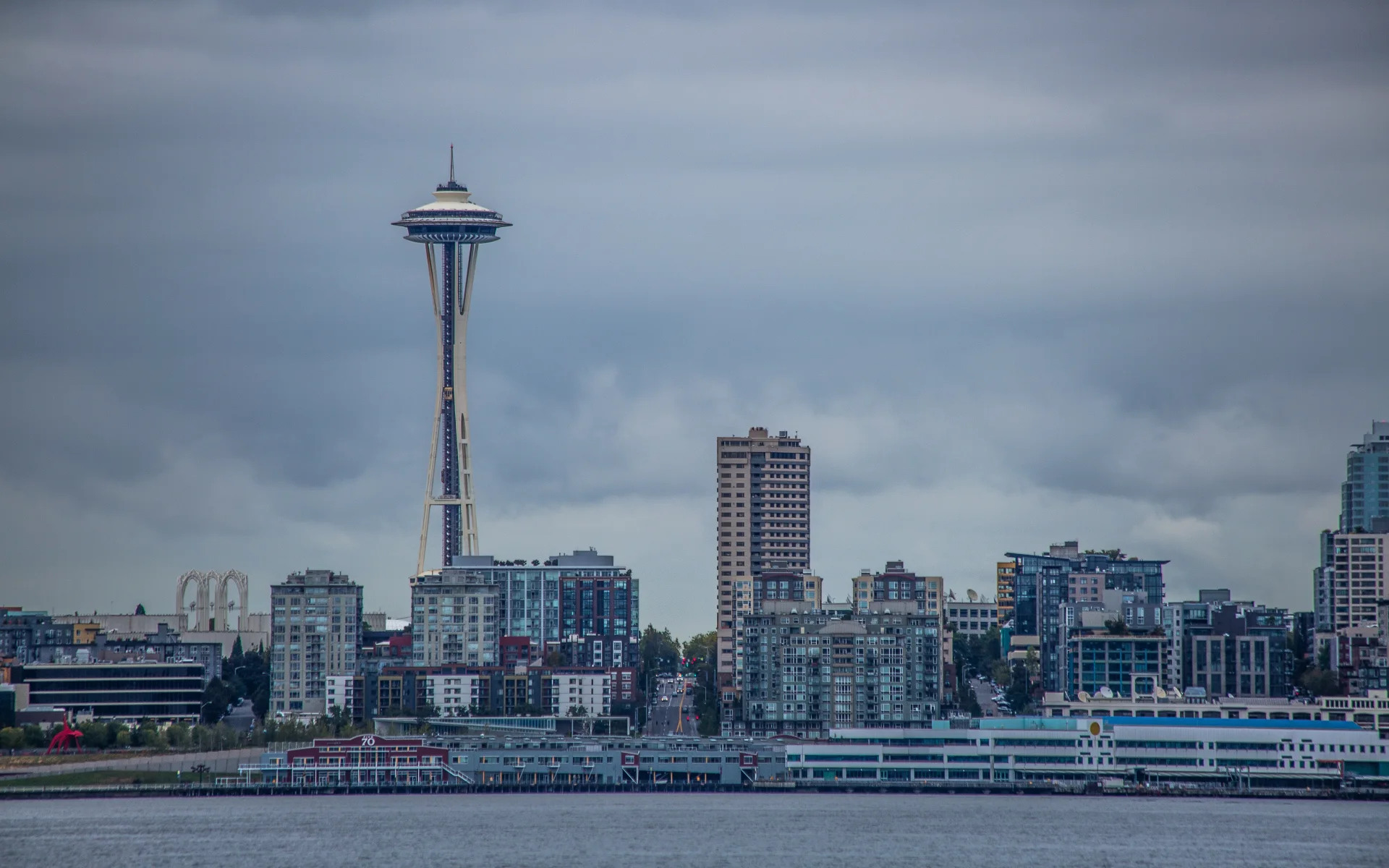
The Space Needle was built for the 1962 Century 21 Exposition, the Seattle World's Fair, and stands 605 feet tall on the grounds that are now Seattle Center. At completion it was the tallest structure west of the Mississippi, as the official Space Needle facts page notes, and it was built in about a year. The six-month fair drew close to ten million visitors, by most estimates, and about 2.3 million of them went up the tower. It left the city a campus that still holds the Museum of Pop Culture, Chihuly Garden and Glass and the monorail that runs to Westlake.
Locks, ferries and a volcano
The Hiram M. Chittenden Locks in Ballard opened in 1917 to link Lake Washington and Puget Sound by ship canal, and a fish ladder beside them lets migrating salmon climb past the gates. Ferries from Colman Dock cross the Sound to Bainbridge Island and are used as everyday transport as much as sightseeing. Mount Rainier, about 14,410 feet high, was made a national park by Congress on 2 March 1899, the fifth in the United States, and the National Park Service manages the park a day-trip drive away. Seattle also stands on the homelands of Coast Salish peoples, and Indigenous-led organizations are the best route to that history.
Coffee, grunge and invention
Independent roasters operate in nearly every neighborhood, and the city's clubs launched the early-1990s grunge of Nirvana, Pearl Jam and Soundgarden. Aviation and software followed the water-borne industries, which explains the cranes on the skyline and the price of a hotel room. Seattle Center, the site of the 1962 fair, is also where the Museum of Pop Culture sits, which makes it a natural place to follow the city's music and invention indoors on a wet day.
Choosing days around the story
With one day, start at Pike Place early enough to see it operating, descend to the waterfront and add one extra: the aquarium, a long walk or a viewpoint. With two days, give the second to Seattle Center and choose one paid attraction plus one lesser stop; stacking every ticket produces queues and little understanding. With three days, either walk onto the Bainbridge ferry or stay for one neighborhood cluster. Do not combine the island and Ballard in a single day.
Buy from vendors at the market, ask before close portraits and keep ramps and counters clear. Use the official market map and directory because traders keep different hours. For a step-free route, the market's accessibility guidance identifies the elevators from Alaskan Way, the garage and Western Avenue; check the live map for lift outages first.
The Space Needle uses timed entry; its FAQ explains reservations and security rules. Treat visibility as uncertain, since low cloud can hide the region even on a pleasant ground-level day.
The Bainbridge crossing
Check the Seattle–Bainbridge schedule and alerts before leaving the hotel. Walk-on passengers do not reserve this route. WSDOT's first-time rider guide covers the turnstiles, boarding ramp and seating, and its accessibility page says to check alerts for lift or restroom outages. Carry a windproof layer. On the island Winslow is walkable from the terminal; decide your return sailing before wandering off, with a later one as a fallback.
If weather is poor or local culture matters more, spend the day in Capitol Hill and the Central District, the Chinatown–International District and Pioneer Square, or Ballard. Name specific community institutions rather than treating districts as scenery, and do not flatten the International District into one generic quarter. Ballard needs a longer bus ride; check the locks' current visitor conditions before going.
The monorail between Westlake and Seattle Center has its own payment arrangements, and ordinary contactless transit transfers do not automatically cover every regional service. A bus or a walk suits groups comfortable with gradients. From Seattle Center, Lower Queen Anne or South Lake Union make short extensions; Ballard is a separate decision because cross-city traffic and bus time add up.
Rail, rain, smoke and park trips
Follow signs from baggage claim to SeaTac/Airport Station; Sound Transit's airport guide describes the skybridge, the free cart and night buses. Tap an ORCA card or contactless bank card at the yellow reader, and use the same card or device throughout; the transfer guidance says no tap-off is needed on Link or buses. Downtown is simplest for the market and Colman Dock but steep; Belltown suits Seattle Center; Capitol Hill adds evening choices.
Light rain need not cancel anything: wear a waterproof layer and grippy shoes. Wildfire smoke in summer and early autumn is a different matter. Seattle's smoke guidance advises checking air-quality reports and replacing strenuous walks with indoor museums. Mount Rainier and Olympic National Parks each need a separate transport, parking and access plan, and entry procedures change by year, so verify them shortly before travel.
For a police, fire or medical emergency, call 911; the city's guidance sends non-urgent police matters to 206-625-5011. Link trains have level boarding, but station lifts and steep approaches still matter, so identify a second route. Leave one meal flexible so the visit is not spent in a queue, and ask for the price before ordering high-value seafood.
Cover photograph: K Danko, “Seattle skyline with Space Needle,” 6 September 2015, geotagged from Elliott Bay and licensed CC BY-SA 3.0. Cropped to the article's responsive 16:10 format; no landmark or scene element was added, removed or relocated.
Continue through our United States destination hub, compare another no-car city in the Chicago guide or nearby Portland, or continue south with our California coast road trip.
Questions and answers
How many days do you need for a first Seattle visit?
One day covers Pike Place Market, the waterfront and one viewpoint. Two days add Seattle Center. With three days, choose either a Bainbridge Island ferry trip or one Seattle neighbourhood cluster.
Can you visit Seattle without renting a car?
Yes. Link light rail connects Sea-Tac Airport with central Seattle, and buses, the monorail and ferries cover this plan. A car is mainly useful for a separately planned regional trip.
Should a first-time visitor reserve the Bainbridge ferry?
No reservation is offered for the Seattle–Bainbridge route. Walk-on passengers should check the live schedule and alerts, buy or show the correct ticket and arrive before boarding closes.
What should you do in Seattle when it rains or smoke arrives?
Use a waterproof layer for ordinary rain and move exposed viewpoints to the clearest period. During wildfire smoke, follow official air-quality advice and replace strenuous outdoor plans with indoor venues.
Sources
New York City · 40.7128° N, 74.0060° W
This story belongs to Seattle, United States. A country of home towns and large ideas, from Independence Hall and the first national park to jazz, skyscrapers and volcanic islands.