Rotorua: Te Arawa Land, a Lost Terraces Wonder and the Steam That Built a Town
From Ngāti Whakaue's gift of land in 1880 to the 1886 Tarawera eruption and Te Puia's carving schools, Rotorua's geothermal story is a story of people.
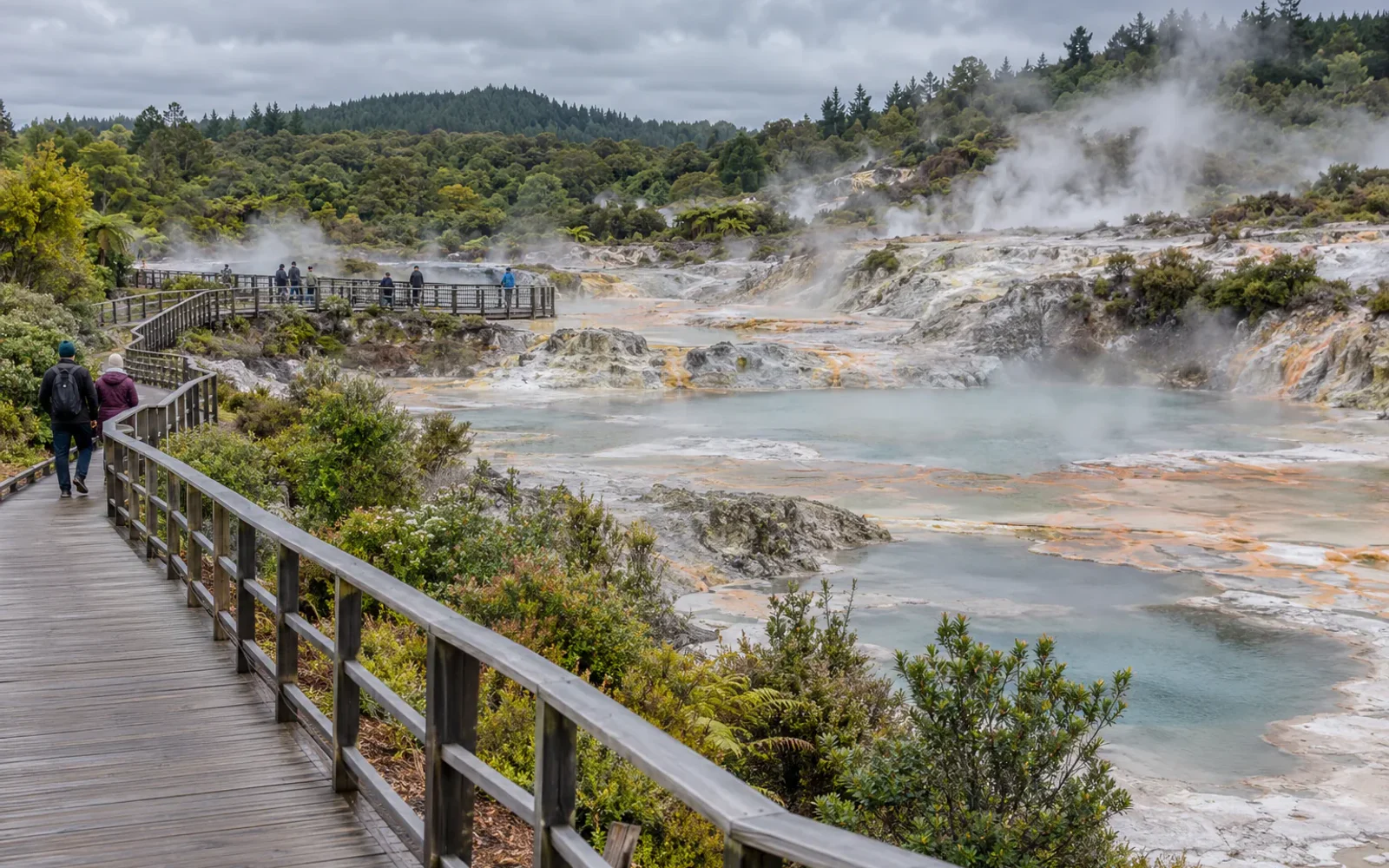
Cover: AI-generated illustration. © ANUSHKA DAHANAYAKE (PVT) LTD.
Rotorua is often sold through steam, but the steam sits on land with an unusually dense human story. Te Arawa people, including Ngāti Whakaue at Ōhinemutu and Tūhourangi at Whakarewarewa and the Tarawera lakes, hosted early travellers who came to see natural wonders. A volcanic eruption in 1886 destroyed the most famous of them, and the government then built a spa town on the surviving geothermal land. Understanding that sequence changes how the parks and villages read.
The terraces and the eruption
The Pink and White Terraces, silica formations beside Lake Rotomahana, were the country's premier visitor attraction in the nineteenth century, and the Tūhourangi held the district, with Te Wairoa serving as the tourist gateway. Ōhinemutu on the shore of Lake Rotorua developed as a stopover on the route. In the early hours of 10 June 1886, Mount Tarawera erupted, destroying or submerging the terraces; estimates put the death toll at about 120, and the village of Te Wairoa was buried. Te Ara describes the terraces and their loss. Tūhourangi people continued to provide services around Rotorua's thermal area after the eruption, but government control of thermal attractions followed.
A spa town and its bath house
The Rotorua Bath House in Government Gardens was built in 1906 to 1908 by the new Department of Tourist and Health Resorts, on land that Ngāti Whakaue gave to the town in 1880 under the Fenton Agreement. Heritage New Zealand lists it as a Category I building, describing it as an imposing timber-framed building meant to establish Rotorua as an international spa resort. It was the government's first major investment in tourism and is the only bath house to survive from the town's first 45 years. Bathing stopped in 1966, the museum opened in the south wing in 1969, and earthquake-related work has since restricted access, so confirm what can be visited.
Living villages and the arts of carving and weaving
Ōhinemutu, home to Ngāti Whakaue families, is a living village. RotoruaNZ's guidance says visitors may use public paths and view Tamatekapua meeting house from outside; St Faith's Church has its own visiting hours and entry arrangements. Remain on footpaths, keep road access clear, do not enter the meeting house and ask before photographing people or ceremonies.
Te Puia houses the national schools of wood carving (Te Wānanga Whakairo Rākau), weaving (Te Rito) and stone carving, with sources dating the Māori arts institute to the 1920s, and its Pōhutu Geyser is the largest active geyser in the Southern Hemisphere, erupting about 20 times a day. Whakarewarewa is a living village offering community-led perspectives. Wai-O-Tapu and Waimangu, south of the city, show different volcanic landscapes and need transport. Choose one park instead of three, and look at ownership, interpretation and walking distance. Learn a few names correctly, since macrons change pronunciation and meaning, and remember that iwi and hapū have specific histories instead of a single packaged culture.
Three days around one system
The order matters: start with the city and the story of the terraces, then see a single geothermal system, and keep the last day for forest or water. That sequence lets the steam make sense as part of a landscape that people have lived in, worked in and hosted visitors on for generations.
Day one, city and Ōhinemutu. Begin at Government Gardens and the lakefront; Sulphur Point and nearby paths show geothermal influence, but closures protect visitors, so stay on marked routes. Walk to Ōhinemutu, then use the afternoon for the museum's current offerings or a hosted city tour.
Day two, one geothermal park. Never cross a rail, lean over vents or test ground with a hand; geothermal water can be near boiling and thin crust can collapse. Steam can hide paths, so keep children close and follow staff immediately if a route closes. Add a hosted cultural evening only if it is led and owned by the community, and arrive on time, follow pōwhiri protocol and keep phones away when asked.
Day three, forest, lake or recovery. Whakarewarewa Forest has towering Californian redwoods and mountain-bike trails; walkers and riders use different routes, so never wander onto a downhill bike line. On the lakes, use a reputable operator, wear the provided flotation device, clean equipment to reduce pest transfer and follow rāhui. For a soak, book a legitimate thermal facility with health guidance; limit heat exposure if pregnant or managing heart or blood-pressure conditions. Roadside natural-looking water is not automatically safe or permitted for bathing.
Volcanic safety and weather
Rotorua sits within the Taupō Volcanic Zone, and normal steam does not mean an eruption is imminent. Check GeoNet's Rotorua monitoring page for current volcanic status, which does not replace local site closures. Hydrogen sulphide causes the familiar smell, but anyone with respiratory concerns should move away if unwell. Rain is possible year-round and boardwalks turn slippery, so wear shoes with grip and carry a waterproof layer; summer sun is strong and winter mornings can be frosty. One geothermal park can take several hours, so follow it with a calm lakefront or meal and allow transfer time, because rural attractions do not sit side by side.
Getting around, access and cost
Central Rotorua is mostly flat, with restaurants, Government Gardens, the lakefront and the bus interchange within walking distance. Rotorua Airport has limited routes compared with Auckland, intercity coaches connect the North Island, and attraction shuttles fill gaps; confirm pickups, since attractions can be many kilometres from the centre. Drivers should never stop suddenly when steam or a lake view appears, and should lock vehicles and keep valuables out of sight.
Geothermal parks contain slopes, gravel, steam and long routes, so ask about accessible circuits, seating and mobility-device policies before buying. Major geothermal and cultural experiences are ticketed and can be expensive; pick one of each and fill the rest with free walks, gardens and lakefront time. Support Māori-owned businesses and local guides, refill water, keep to formed tracks and take rubbish away.
Continue through the New Zealand destination hub, read what makes New Zealand special, follow the same volcanic zone south with the Taupō guide, or pair the trip with our Queenstown first-time guide before travelling south.
Questions and answers
How many days should you spend in Rotorua?
Three full days allow one major geothermal park, a properly hosted cultural experience, and forest or lake time. Two days cover highlights if you choose attractions carefully.
Can Rotorua be visited without a car?
The central city is flat and walkable, with local buses and attraction shuttles. A car or tour helps with geothermal areas and lakes outside the centre, but it is not essential for every itinerary.
Is it safe to walk near Rotorua's geothermal features?
Yes on authorised paths and boardwalks. Never cross barriers or touch water and ground near vents; temperatures and crust stability can be dangerous even when a surface looks solid.
How can visitors experience Māori culture respectfully?
Choose an iwi- or Māori-owned hosted experience, listen to protocols, learn correct place and people names, ask before photographing and treat performances and stories as living culture rather than entertainment props.
Sources
Auckland · 36.8485° S, 174.7633° E
This story belongs to Rotorua, New Zealand. A country where land and people are bound together: a mountain park given by a Māori chief, the Treaty of Waitangi and the first vote for women.