Rome First-Time Visitor Guide: The Eternal City, Booked Smart
Ancient arenas, a dome open to the sky and a pasta canon defended like law: what makes Rome special, with the bookings and routes that let a visit work.
Few cities keep their past in daily use the way Rome does. Roman temples stand beside apartment blocks, medieval churches are built into ancient ruins, and Baroque fountains splash in squares that began as stadiums. Romans call it the Eternal City without irony, and the evidence is hard to argue with.
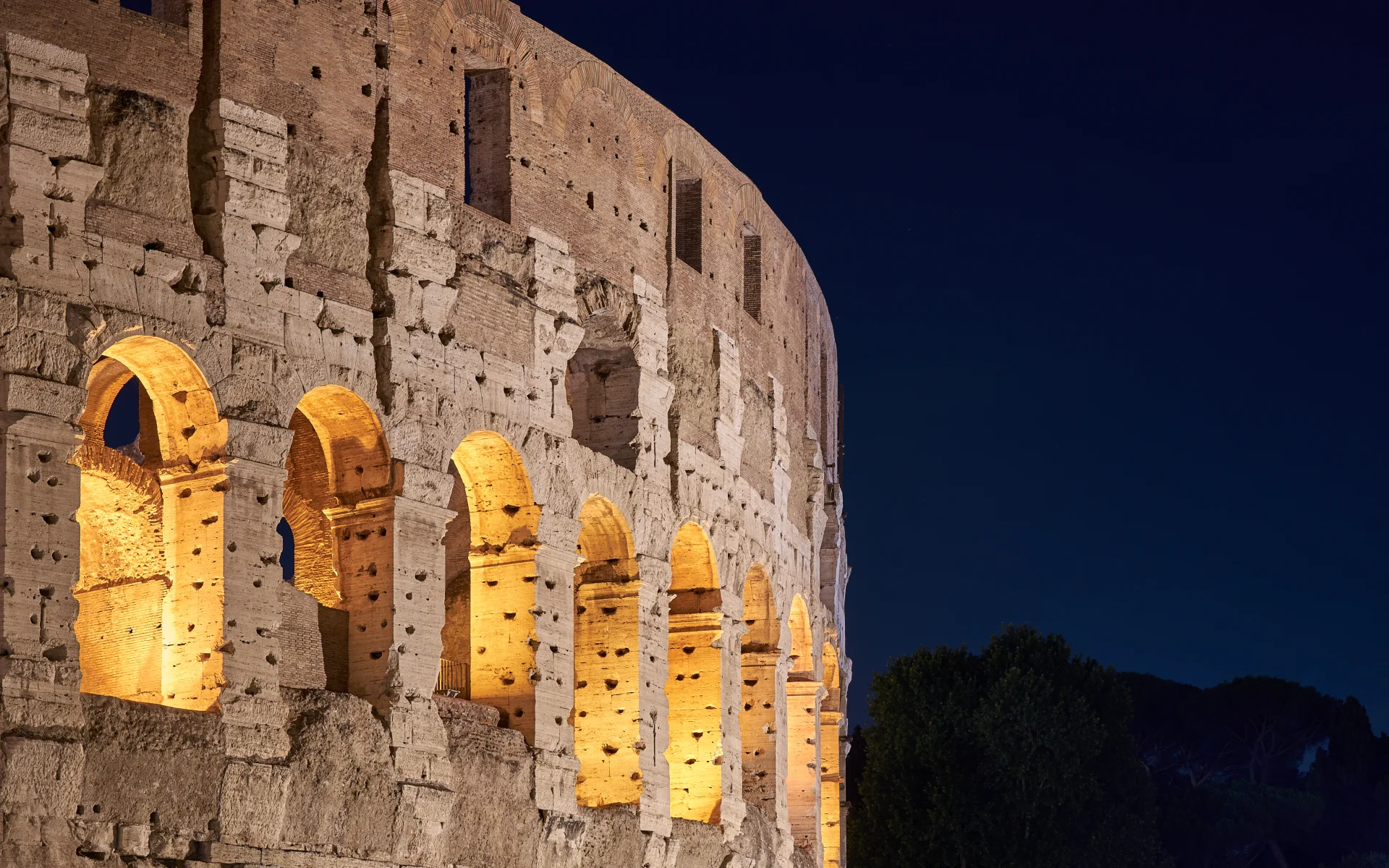
Cover photograph: the Colosseum illuminated at night, photographed in August 2024 by Anil Öztas / Wikimedia Commons, CC BY 4.0. Cropped and converted to WebP.
Where the Roman Empire still stands
The Colosseum was begun under Emperor Vespasian and opened under his son Titus in AD 80 with a festival of games that sources describe as lasting a hundred days. Its broken oval still dominates the valley below the Palatine Hill, where the remains of imperial palaces overlook the Roman Forum and its triumphal arches. The Historic Centre of Rome, with the Vatican's properties and the Basilica of San Paolo fuori le Mura, has been on UNESCO's World Heritage List since 1980.
The Appian Way, laid out for marching armies and nicknamed Regina Viarum, the queen of roads, joined the same list in July 2024, as Turismo Roma reports. Stretches on Rome's southern edge are still paved with stones that carried Roman traffic.
The dome that has not been surpassed
The Pantheon was rebuilt under Emperor Hadrian in the second century. Its dome remains the largest unreinforced concrete dome ever built, and its builders mixed lighter volcanic stone such as pumice into the upper layers to reduce the load. The oculus at the top is open to the sky, so sun and rain both enter. The building became a church in the early seventh century and has never closed since. Raphael, who died in 1520, is buried inside.
Michelangelo, Bernini and the Baroque city
Michelangelo painted the Sistine Chapel ceiling between 1508 and 1512 for Pope Julius II, and the Vatican Museums route ends beneath it. St Peter's holds his dome and his Pietà. Bernini and Borromini gave the city its Baroque face: Bernini's Fountain of the Four Rivers stands in Piazza Navona, and the Trevi Fountain, designed by Nicola Salvi and completed by Giuseppe Pannini in 1762, took thirty years to build.
The table Romans argue over
Roman cooking is direct and defended fiercely. Four pastas form the canon, carbonara, cacio e pepe, amatriciana and gricia, built on guanciale, pecorino romano and black pepper; cream in carbonara is treated as an insult. Supplì (fried rice balls with a molten centre), pizza al taglio, artichokes cooked the Jewish way in the old Ghetto and the offal dishes of Testaccio, once the slaughterhouse district, round out the table. The Italy destination hub and what makes Italy special place these traditions in the wider country.
Three reservations that shape the trip
The Colosseum Archaeological Park says timed Colosseum bookings open 30 days before a visit and tickets are issued in the holder's name. Carry the identification the named ticket requires, and read what the product includes: the standard 24-hour ticket and the two-day Full Experience cover different areas. The Colosseum, Forum and Palatine have separate entrances and security, and the Forum and Palatine involve long outdoor walks on uneven stone with limited shade. Refill a bottle at the park's drinking fountains.
The Vatican Museums warn that tickets.museivaticani.va is their only official online ticket portal. Its visitor guidance covers clothing and bag rules. St Peter's Basilica is a separate visit with its own queue and security, so plan it for another morning if the museums use up the day.
The Borghese Gallery's official guidance says booking is compulsory. A city pass is worth buying only after comparing its inclusions with the places you will enter; it does not automatically waive every reservation.
A four-day rhythm with one anchor per day
Day one belongs to the archaeological park. Afterwards walk to Monti or the Capitoline area for a quiet evening, because stone paths wear out legs and attention alike. Day two covers the Pantheon and Piazza Navona early, then quieter lanes toward Campo de' Fiori, whose market changes character through the day. Rome introduced a paid ticket for non-residents entering the Trevi Fountain's nearest basin area in February 2026; check current access before joining a queue. Never enter the water.
Day three is the Vatican and Prati, whose regular street grid suits lunch and a calm walk. Day four offers a choice: the Borghese Gallery and park for concentrated art, a single researched section of the Appian Way, or Testaccio and Ostiense for food and industrial history in districts where people live and work. A day trip to Pompeii or Tivoli should replace that choice, since each has its own transport and ticket needs. With one or two days only, pick the Colosseum–Forum area or the historic centre, not both plus the Vatican. Our Florence guide suits travellers continuing north.
Where to sleep, and how to move
Monti suits the Colosseum area and has good evening dining, Prati the Vatican day, Testaccio the food-minded; streets around Termini are convenient for trains but vary block by block. Check kerbs, entry steps and lift floors with the accommodation, since historic buildings can advertise a lift that starts above street level.
Use metro, buses and trams for distance and walking for clusters. ATAC says tickets must be activated or validated before boarding or passing the turnstiles; its ticket information and digital-ticket guide explain the bus, metro and urban-rail controls. Save routes offline. Take only official taxis or a verified booking method, and ignore unsolicited offers at Termini.
Heat, access and respect
From late spring to summer, schedule archaeological and open-square walks early, rest at midday and carry sun protection. Turismo Roma's accessibility directory lists entrances, toilets and wheelchair routes; confirm the day's lift status with each venue, since ancient surfaces stay uneven. Keep bags closed on crowded transport, step out of the pedestrian flow to check a phone, and know that Italy's Civil Protection guidance directs callers to the European emergency number, 112.
Do not sit on protected monuments or treat fountains as pools. Churches may close for worship and expect covered shoulders and knees. On the last evening confirm the airport or rail connection, allowing for platform changes and long terminal walks. More Rome-adjacent reading is in our Venice guide and the other practical country guides.
Questions and answers
How many days does a first Rome visit need?
Four days allow separate time for the archaeological park, historic centre, Vatican area and one interest-led district or museum day.
Can visitors explore Rome without a car?
Yes. Central routes combine walking with metro, tram and bus journeys. Driving adds restricted streets, parking and traffic without helping inside pedestrian archaeological areas.
What should be booked ahead in Rome?
Use official channels for the Colosseum Archaeological Park, Vatican Museums and Borghese Gallery. Check ticket names, identification rules and entrances before paying.
Sources
Rome · 41.9028° N, 12.4964° E
This story belongs to Rome, Italy. A country told city by city, where a craftsman solved a problem the rest of Europe copied and the city never forgot whose solution it was.