Florence First-Time Guide: Dome, Uffizi and a Three-Day Plan
The dome finished in 1436, the Medici offices that became the Uffizi, Michelangelo's David and the Oltrarno workshops, with the booking and crowd advice that supports a first visit.
Florence earns its reputation in a few hundred meters. Within the walkable center on the Arno, a dome, a gallery of offices, a marble giant and a covered bridge of workshops each mark a moment when this city of bankers and guilds changed how Europe built and painted. UNESCO inscribed the Historic Centre of Florence in 1982, recognizing the city that rose to cultural prominence under the Medici in the fifteenth and sixteenth centuries.
Use the Florence city page for a broader introduction; the story below comes first and the practical advice follows it.
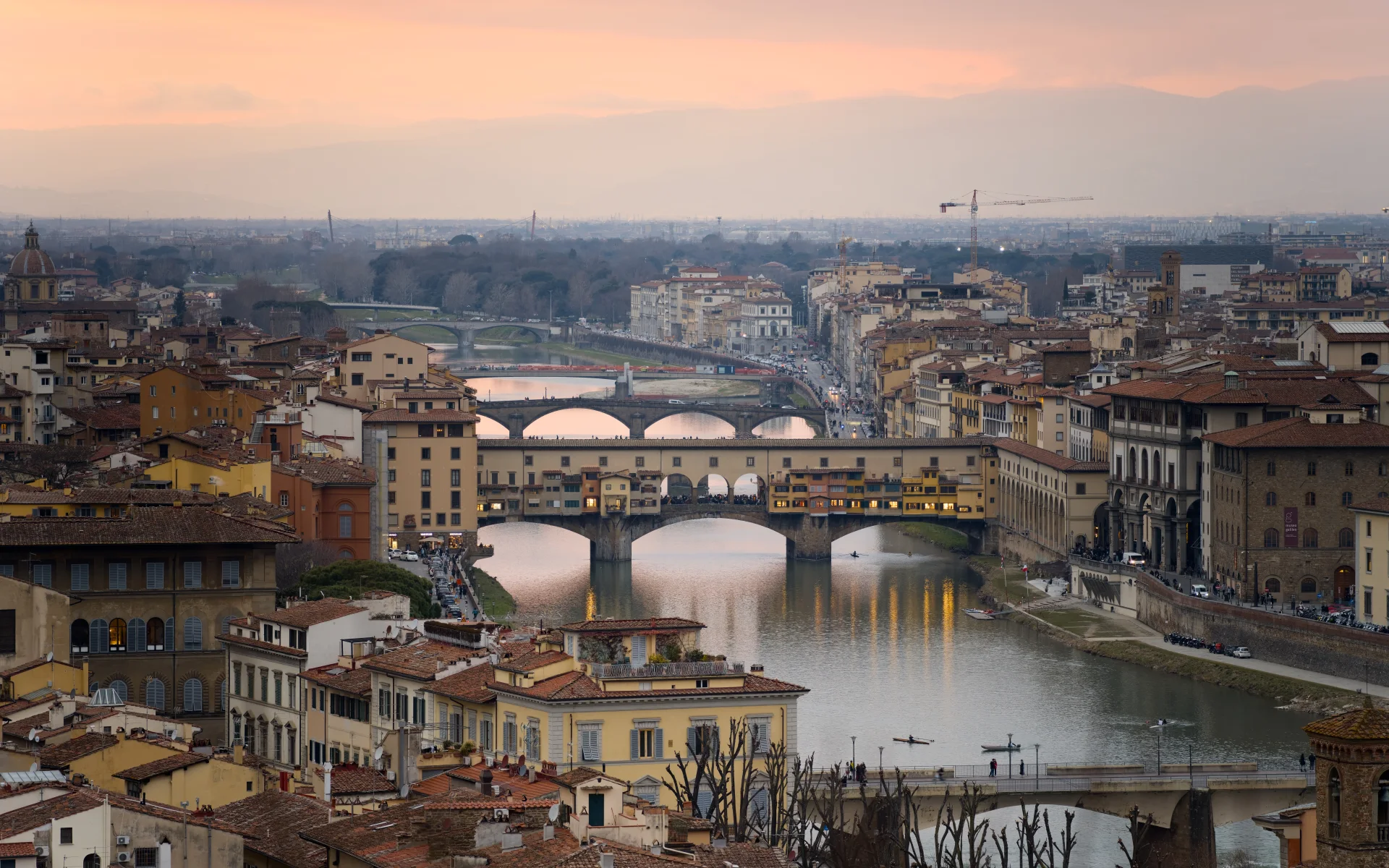
Cover photograph: Ponte Vecchio and the Arno seen from Piazzale Michelangelo at sunset, photographed on 17 February 2023 by Daniel Lu / Wikimedia Commons, CC BY-SA 4.0. Centre-cropped and converted to responsive WebP sizes; no building or landscape element was generated or removed.
The dome that finished in 1436
Work on Santa Maria del Fiore began in 1296 under Arnolfo di Cambio. In 1418 the wool guild announced a competition to cover the enormous crossing, and Filippo Brunelleschi beat Lorenzo Ghiberti to the commission. Construction of the dome began in 1420, and Pope Eugene IV consecrated the cathedral on 25 March 1436 with the dome complete. Brunelleschi used a herringbone brick pattern to carry the weight of fresh brickwork onto the nearest vertical ribs, and it is still described as the largest masonry dome ever built. Giotto designed the bell tower, begun before his death in 1337 and finished by Francesco Talenti.
The Uffizi and the Medici collection
Giorgio Vasari began the Uffizi in 1560 for Cosimo I de' Medici as offices for the state administration, which is what the word uffizi means; it was completed in 1581. When the Medici line ended, Anna Maria Luisa de' Medici negotiated the family pact that left the collections to Florence, and the gallery opened to the public in 1769. Botticelli's Primavera and Birth of Venus, Leonardo's Annunciation and Caravaggio's Medusa are among its best-known works. In 1565 Cosimo also had Vasari build a private passage linking Palazzo Vecchio to Palazzo Pitti, part of which runs above the Ponte Vecchio.
Michelangelo's David
The marble was a block of Carrara stone first shaped by Agostino di Duccio in 1465, abandoned after Donatello's death in 1466 and left in the cathedral workshop yard for about 25 years. Michelangelo began carving on 13 September 1501, and the statue, 5.17 meters tall, was unveiled on 8 September 1504. Commissioned for the cathedral roofline, it was instead placed in Piazza della Signoria and became a symbol of the Florentine Republic's independence. It moved indoors to the Galleria dell'Accademia in 1873; a replica has stood in the piazza since 1910.
Ponte Vecchio and the workshops of the Oltrarno
Florence's old bridge was swept away in 1333 except for two piers and rebuilt by about 1345. Butchers held its shops from 1442 until a 1565 decree left only goldsmiths and jewelers. Alone among the city's bridges, it survived the German retreat in August 1944. Across the river in the Oltrarno, artisans still bind books, gild frames, restore furniture and cut leather, which makes it the quarter where the craft story is easiest to follow. Every year around 24 June, the feast of St. John the Baptist, the four quarters (Santa Croce, Santa Maria Novella, Santo Spirito and San Giovanni) contest the Calcio Storico final in Piazza Santa Croce, a rough early form of football that was famously played during the siege of 1530.
Booking so the sights stay possible
The City of Florence warns visitors about imitation ticket sites, inflated commercial packages and scalpers. Start from FeelFlorence or the Uffizi Galleries' own ticket page, and confirm venue, date, entry time and booking charge before paying. The Uffizi, Accademia and popular Duomo components often need advance planning outside the quietest periods. The cathedral, dome, bell tower, baptistery, museum and crypt are separate components, so read what a pass includes and whether a timed slot is compulsory.
The dome climb involves many stairs, and city guidance notes that the dome, bell tower and some elevated areas are not accessible to people with motor disabilities. The Opera del Duomo Museum is a strong indoor alternative, with sculpture that gives context to the building.
Choose one, two or three days
For one day, choose either the Duomo complex or one major gallery, then walk Piazza della Signoria, the river and Oltrarno; trying to enter the Duomo, Uffizi and Accademia makes the day mostly queues. For two days, use the first two routes below. With three days, add David, Pitti and Boboli, or a ticket-light neighbourhood day according to your interests and mobility. Reserve only the timed entries that define the plan, then leave walking time unscheduled.
Three days that match the story
Day one: the cathedral quarter. Begin around Piazza del Duomo before the crowds, with a timed dome or monument entry as the anchor. Then walk to Piazza della Signoria, past Palazzo Vecchio, toward Santa Croce. Churches are active places of worship: cover shoulders and knees when asked and avoid interrupting a service.
Day two: the Uffizi and the Oltrarno. Arrive at the entrance named on the confirmation. Choose several rooms or artists beforehand and allow pauses. Afterward cross the Arno, avoid stopping in the narrowest part of the bridge, and spend the evening around Santo Spirito, where workshops are working businesses: ask before photographing and keep doorways clear. Piazzale Michelangelo and San Miniato make a good late climb in dry weather.
Day three: David, Pitti or a calmer route. The Accademia suits anyone for whom the statue is essential, followed by San Marco or a quiet lunch. The Pitti Palace and Boboli Gardens are a full day of slopes and sun exposure. A third option avoids another major ticket altogether: Sant'Ambrogio, a few civic buildings and an unhurried square.
Rooms, rails and road rules
The center puts the Duomo, Uffizi and main squares within walking distance, but older buildings may have stairs before a small lift. Santa Maria Novella suits rail arrivals, Santa Croce and Sant'Ambrogio evening dining, and Santo Spirito the Oltrarno. Ask for the exact floor, lift and luggage route; “accessible” alone is not enough information.
Driving into the center is rarely helpful. A camera-controlled restricted traffic zone, the ZTL, has schedules and access rules that can change, and a rental car can draw a fine even when following a navigation app. Check the city's current guidance before approaching the centre. Wear shoes with grip on slick stone, use LaMMA's regional forecast for heat or storm decisions, start outdoor routes early in summer and carry water. Write serious allergies down in Italian, keep phones and cards secure in station queues, and remember that Europe's emergency number is 112. Most journeys in the center are walkable; buses help with hills and tired returns.
Read what makes Italy special, continue into the countryside with our Tuscany guide, take the short rail hop to Bologna, continue with the Italy destination hub or explore other practical country guides.
Questions and answers
How many days should a first Florence visit have?
Three days allow the Duomo area, one major gallery day and a choice between the Accademia, Pitti Palace or a slower Oltrarno route.
Should visitors drive into Florence?
Usually not. Much of the historic centre is covered by a camera-controlled restricted traffic zone, and the central itinerary works mainly on foot.
Which Florence tickets need advance booking?
Reserve the Uffizi, Accademia and any Duomo component with mandatory timed access through the official channels linked by the city tourism office.
Sources
Rome · 41.9028° N, 12.4964° E
This story belongs to Florence, Italy. A country told city by city, where a craftsman solved a problem the rest of Europe copied and the city never forgot whose solution it was.