Edinburgh for First-Time Visitors: Castle, Festivals and a City of Literature
Edinburgh's volcanic castle rock, its two World Heritage towns, the festivals born in 1947 and its title as first City of Literature, plus the practical choices that make a first visit work.
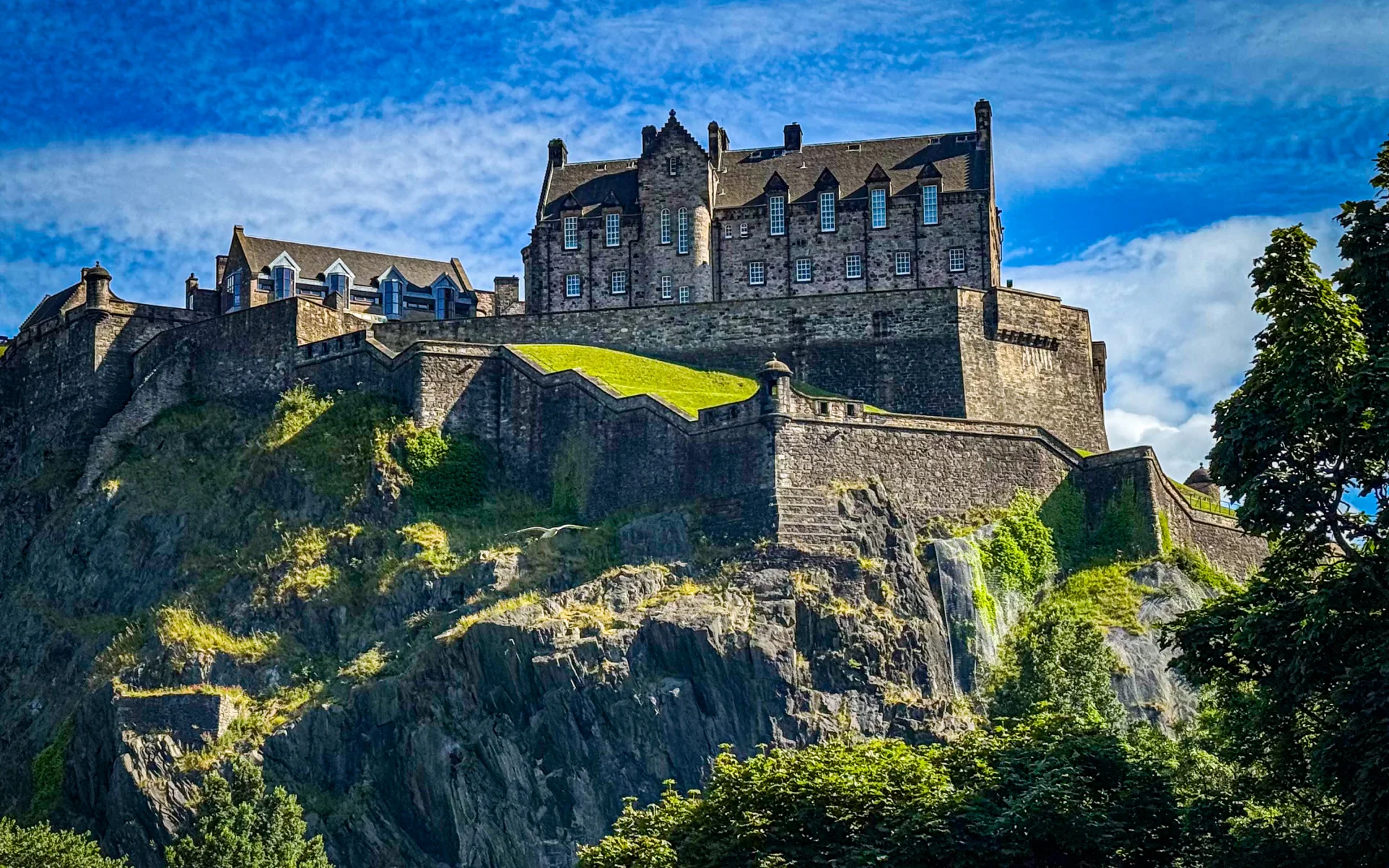
Edinburgh is built on the remains of a volcano. About 350 million years ago a plug of hard dolerite formed in an extinct vent, and when glaciers later scraped the softer land away, they left Castle Rock with a long tail of ridge trailing east. A fortress stood on the crag, a town gathered along the ridge, and the pair became the Royal Mile. Everything a visitor sees, from the castle to the closes, follows that geology.
Cover image: “Edinburgh Castle from Prince's Street” by Jdforrester, own work, licensed CC BY 4.0. Cropped to a 16:10 frame and converted to WebP; no generative alteration.
Castle Rock and the Honours of Scotland
St Margaret's Chapel, inside the castle, dates from the early twelfth century and is regarded as the oldest building in Edinburgh. In the Crown Room lie the Honours of Scotland, the country's crown jewels, which Sir Walter Scott helped bring back into view in 1818 when a sealed room was broken open and they were found. Beside them sits the Stone of Scone, taken to England seven centuries earlier and returned to Scotland in 1996, with a handover ceremony at the castle on St Andrew's Day. The castle is a working symbol of the nation, not a ruin.
Two towns, one World Heritage Site
UNESCO inscribed the Old and New Towns of Edinburgh together in 1995, because the contrast is the point. The medieval Old Town packed tenements ten and eleven storeys high along the ridge, with closes and wynds falling away on either side. In 1766 a competition for a new, orderly town to the north was won by James Craig, then 27, whose grid of streets drew on Enlightenment ideas of order. Robert Adam designed Charlotte Square at the western end of George Street. The Nor Loch that once lay between the two towns was drained by the 1820s, and the earth dug out for the New Town was tipped there to make The Mound. George Meikle Kemp's Gothic Scott Monument, finished in 1844, completes the Princes Street skyline.
August 1947 and the festivals that followed
Rudolf Bing, the Austrian-born impresario who became its first director, helped found the Edinburgh International Festival in 1947. The Fringe began as an offshoot in that very first year and is now widely described as the largest arts festival in the world. The British Army staged the first Military Tattoo in 1950. Every August the three run side by side, with thousands of shows in churches, cellars and lecture halls.
The first City of Literature
On 13 October 2004 Edinburgh was designated the world's first UNESCO City of Literature, an idea devised in the city itself, and the title launched UNESCO's wider Creative Cities Network. Scott, Robert Louis Stevenson, Arthur Conan Doyle and Muriel Spark are among the writers tied to its streets, and the Writers' Museum off the Royal Mile keeps their stories in one building.
Seeing it without fighting the hills
The Old Town sits on a ridge, many apparent shortcuts are stairways, and a dry morning can turn wet and windy by afternoon. Group places by level.
One day: book Edinburgh Castle in advance, since the operator says tickets often sell out, particularly in summer, and allow two to three hours. Walk down the Royal Mile and add either the National Museum of Scotland or a handful of closes. Two days: add the Palace of Holyroodhouse, the Scottish Parliament and the New Town's George Street and Charlotte Square, with the Scottish National Gallery as an indoor anchor. Three days: take a tram or bus to Leith's Shore and the Royal Yacht Britannia, or give the day to one deeper interest such as the Royal Botanic Garden or literary Edinburgh.
The castle approach is steep, exposed and cobbled, and it does not accept bags over its stated size limit or offer storage. Its official access guide covers a mobility vehicle to Crown Square, loan wheelchairs and sensory resources, though some historic rooms stay difficult. The National Museum lists its Tower Entrance as level access, with lifts and wheelchairs described in its accessibility guide.
Holyrood Park and a hill for each kind of weather
Arthur's Seat is an exposed hill walk, not a paved viewpoint. Wear shoes with grip, carry water, and check the Holyrood Park page for path or road restrictions before setting out. In clear, settled weather it is the best view of the volcanic landscape. Calton Hill offers a shorter climb with a broad outlook, and when visibility is poor, Dynamic Earth, the National Museum or the Parliament visitor experience are better uses of the hours.
Base, buses and trams
Old Town hotels put you on the Royal Mile but may mean stairs and no lift; New Town and the West End suit rail and airport links; Leith suits food and waterfront evenings. Check the real walking route from your bed to the nearest stop. Trams and airport buses link Edinburgh Airport with the centre, and trams run on to Leith and Newhaven. For contactless travel use the same physical card or device throughout, since a phone and its underlying card count as different methods; the TapTapCap explanation and the tram fare finder hold the current rules and the airport fare zone.
Food, weather and living in a capital
Reserve a special dinner for weekends and August, and try Scottish produce without assuming every meal needs whisky or a novelty dish. Tell venues about allergies before arrival. Several national museums and galleries have free general admission; castle, palace, yacht and festival tickets are the costs to check first, on official booking pages. Pack a waterproof layer in every season and look at the Met Office warnings map before a hill or day trip. Call 999 in an emergency and 101 for non-emergency police help; Police Scotland's contact page lists other options. People live in the closes, so keep voices low there and leave narrow pavements clear.
Continue through the United Kingdom destination hub, compare the capital with our London guide for first-time visitors, plan a different city break with our Manchester visitor guide, compare Scotland's largest city in what makes Glasgow special, or read what makes the United Kingdom special.
Questions and answers
How many days does a first visit to Edinburgh need?
One full day can cover a selective Old Town route. Two days add Holyrood and New Town without constant backtracking. Three days allow Leith, a specialist museum or a weather-dependent hill walk at a sensible pace.
Should I book Edinburgh Castle in advance?
Yes. The castle says tickets often sell out, particularly in summer, and advance online booking guarantees entry. Book on the official website and recheck access information before travelling.
Do visitors need a car in Edinburgh?
Not for this itinerary. Central districts are connected by walking, buses and trams, while restricted streets and parking make a car more burden than benefit for a city-only visit.
Can someone with limited mobility use this itinerary?
Yes with route changes. Use public transport between levels, treat Old Town and New Town as separate zones and confirm venue assistance. The castle remains steep and cobbled, while the National Museum publishes a level-access entrance and lift information.
Sources
London · 51.5074° N, 0.1278° W
This story belongs to Edinburgh, United Kingdom. Four nations with their own pride, from Neolithic monuments and Norman fortresses to the first steam passenger railway between cities.