Dublin: The Book of Kells, a City of Literature and Kilmainham Gaol
The Book of Kells at Trinity, Marsh's Library, the Abbey Theatre, Kilmainham Gaol and Guinness's 9,000-year lease: the dated story of Dublin, with practical advice.
Dublin is a city that tells its own story well, in manuscripts, plays, prison cells and pubs. A monastic gospel book made around 800 sits in a university founded in 1592, a theatre opened by two writers in 1904 became a national theatre, and a jail where the leaders of the 1916 Rising were executed is now one of Ireland's most visited museums. In 2010 UNESCO named it a City of Literature, which Dubliners treat as confirmation of something they already knew.
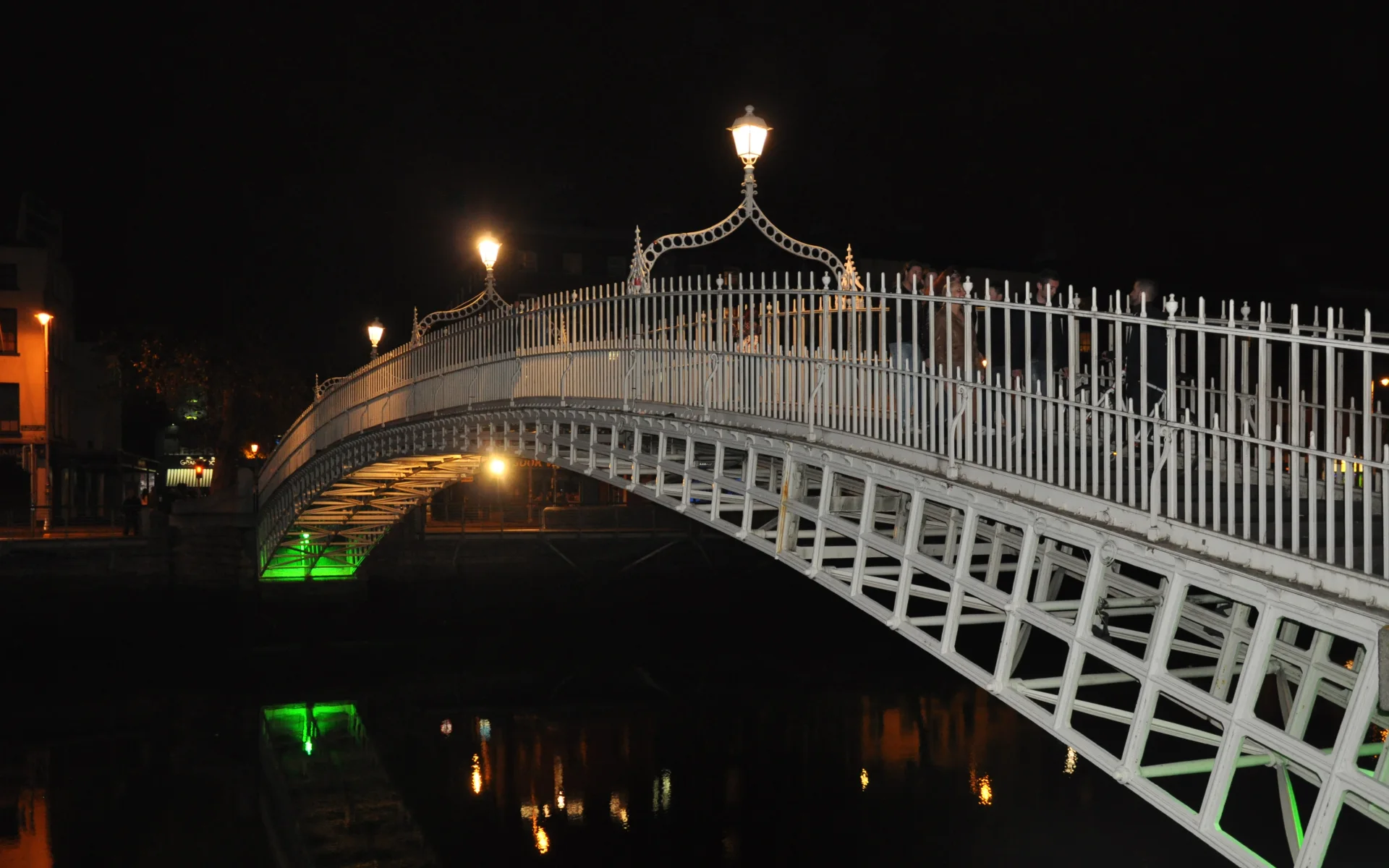
Cover photograph: Bob Collowan, “Ha'penny Bridge, Dublin, at night,” 19 November 2011, own work under CC BY-SA 4.0. Cropped to a 16:10 frame and converted to responsive WebP sizes; no landmarks were added or removed.
The Book of Kells and Trinity College
Queen Elizabeth I founded Trinity College by royal charter in 1592. The Book of Kells, a Latin manuscript of the four Gospels on 340 vellum leaves, is believed to date from about 800 and was probably begun at Iona and completed at Kells. It was sent to Dublin for safekeeping in 1654 when Cromwell's cavalry was quartered at Kells, and Henry Jones presented it to Trinity in 1661, where it has remained. It is known for ten full-page illustrations and many decorated initials. Two pages are shown at a time, rotated every six to eight weeks, and the display is in the Old Library, home of the Long Room.
A City of Literature
Dublin was named a UNESCO City of Literature on 26 July 2010, one of four in the world then, with Edinburgh, Melbourne and Iowa City. Swift, Wilde, Joyce, Yeats, Shaw and Beckett all belong to its story. Marsh's Library, founded by Archbishop Narcissus Marsh and opened in 1707, is described as the first public library in Ireland and keeps three wire reading cages added in the 1770s after thefts. It holds about 25,000 books, roughly 300 manuscripts and around 80 incunabula, and its oak bookcases still show bullet holes from the Easter Rising. The Abbey Theatre opened on 27 December 1904, with W. B. Yeats and Lady Gregory central to its founding, and from 1925 it received a subsidy from the Irish Free State, which the sources describe as making it the first state-subsidised theatre in the English-speaking world. Bloomsday on 16 June follows Leopold Bloom through Joyce's Ulysses.
Kilmainham Gaol and the Rising
Kilmainham Gaol was built in 1796 as the County of Dublin Gaol. Leaders of the 1916 Easter Rising, including Patrick Pearse, James Connolly and Tom Clarke, were imprisoned there and executed in the prison yard. Charles Stewart Parnell, Éamon de Valera and Robert Emmet were also held there. The Irish Free State decommissioned it as a prison in 1924, a restoration society of volunteers rescued it from 1958 to 1960, and it opened to the public as a museum in 1966.
Stout, pubs and music
Arthur Guinness signed a 9,000-year lease for the St James's Gate site in 1759, and a copy of the lease lies at the base of the atrium of the Guinness Storehouse, which opened on 2 December 2000. Most tickets include a pint at the Gravity Bar on the seventh floor. Pubs remain the social centre of the city, and a traditional session is musicians playing socially, so listen, buy a drink if you hold a table and keep conversation low.
Three days in a compact city
Day one: the National Museum of Ireland-Archaeology, Merrion Square's Georgian terraces, St Stephen's Green and Trinity College. Day two: Kilmainham Gaol, then the Liberties, with Christ Church or St Patrick's Cathedral and one stout or whiskey visit if it interests you. Day three: the DART along Dublin Bay to Howth, Dún Laoghaire or Dalkey, or, in poor weather, a museum and a neighbourhood such as Stoneybatter or Portobello. Many terraces are homes and offices, so admire them from the pavement. Kilmainham lies west of the main centre, so allow travel time, and check each museum's closing day because the weekly schedules differ.
Practical help: tickets, buses and rain
Booking. Heritage Ireland says advance online booking is essential for Kilmainham Gaol and third-party tickets are invalid; it asks wheelchair users to email before booking. Book the Book of Kells through the university's official site.
Getting around. Dublin Airport has no rail station, and TFI publishes current routes and ticket options for the buses to the centre. A Leap Card covers many bus, Luas, DART and commuter-rail trips, though some airport coaches have separate products. Heuston and Connolly are different stations, linked by Luas and bus rather than an internal railway passage, so read the station name on a rail ticket and allow a generous cross-city transfer on departure day. Save the journey result offline, but recheck live disruption notices before boarding.
Weather and the coast. Pack a waterproof layer in every season. On the Howth cliff paths, which can be muddy and exposed, wear proper shoes and turn back in strong wind; check Met Éireann's warnings. The National Museum offers venue-specific accessibility guidance.
Pubs and money. Joining a round means taking a turn buying for the group, though nobody has to drink alcohol. Choose a smaller pub with conversation or a real session over a venue selling only an idea of Irishness. Accommodation is usually the largest cost, and many national museums are free, so build the budget around lodging, transport, one reserved attraction and meals instead of buying a pass automatically. Cathedrals charge a visitor admission and remain places of worship, so check service closures and avoid photographing people at prayer.
Conduct and safety. Keep noise down near homes, and call 112 or 999 in an emergency; the Irish government says the free service can connect Gardaí, ambulance, fire or Coast Guard.
The rest of Ireland tells other chapters. Read what makes Ireland special for the wider story, spend a day in the hills with the Wicklow guide, or go west with the Galway guide. The Ireland destination hub lists the rest.
Questions and answers
How many days are enough for a first Dublin visit?
Two full days cover the historic centre and Kilmainham or another substantial museum route. A third day adds a weather-dependent DART coast trip or a slower neighbourhood day.
Do visitors need a car in Dublin?
No. Central Dublin is walkable, while buses, Luas trams and DART trains cover farther districts. A car adds parking and one-way-street complications.
Should you buy a Leap Visitor Card?
It can be convenient for frequent bus, Luas and DART trips, but compare its current duration and coverage with ordinary Leap fares for your itinerary. Airport coach products may have different rules.
Sources
Dublin · 53.3498° N, 6.2603° W
This story belongs to Dublin, Ireland. A country that runs on deep time, precise craft and stories told well, from a tomb older than the pyramids to a literature honoured four times.