Chicago: The Fire, the First Skyscraper and the Birthplace of Electric Blues
The 1871 fire, the 1885 Home Insurance Building, Wright's Robie House, the Art Institute and the birth of electric blues: the dated story of Chicago, with practical help.
Chicago is the city that burned down and rebuilt as the world's architecture laboratory. In October 1871 a fire destroyed more than 17,000 buildings, and within about fifteen years the city produced a building that is often cited as the world's first skyscraper. Add a lakefront blues scene that plugged in the Mississippi Delta, a museum with some of the most famous paintings in America and Frank Lloyd Wright's early houses, and the pride is easy to understand.
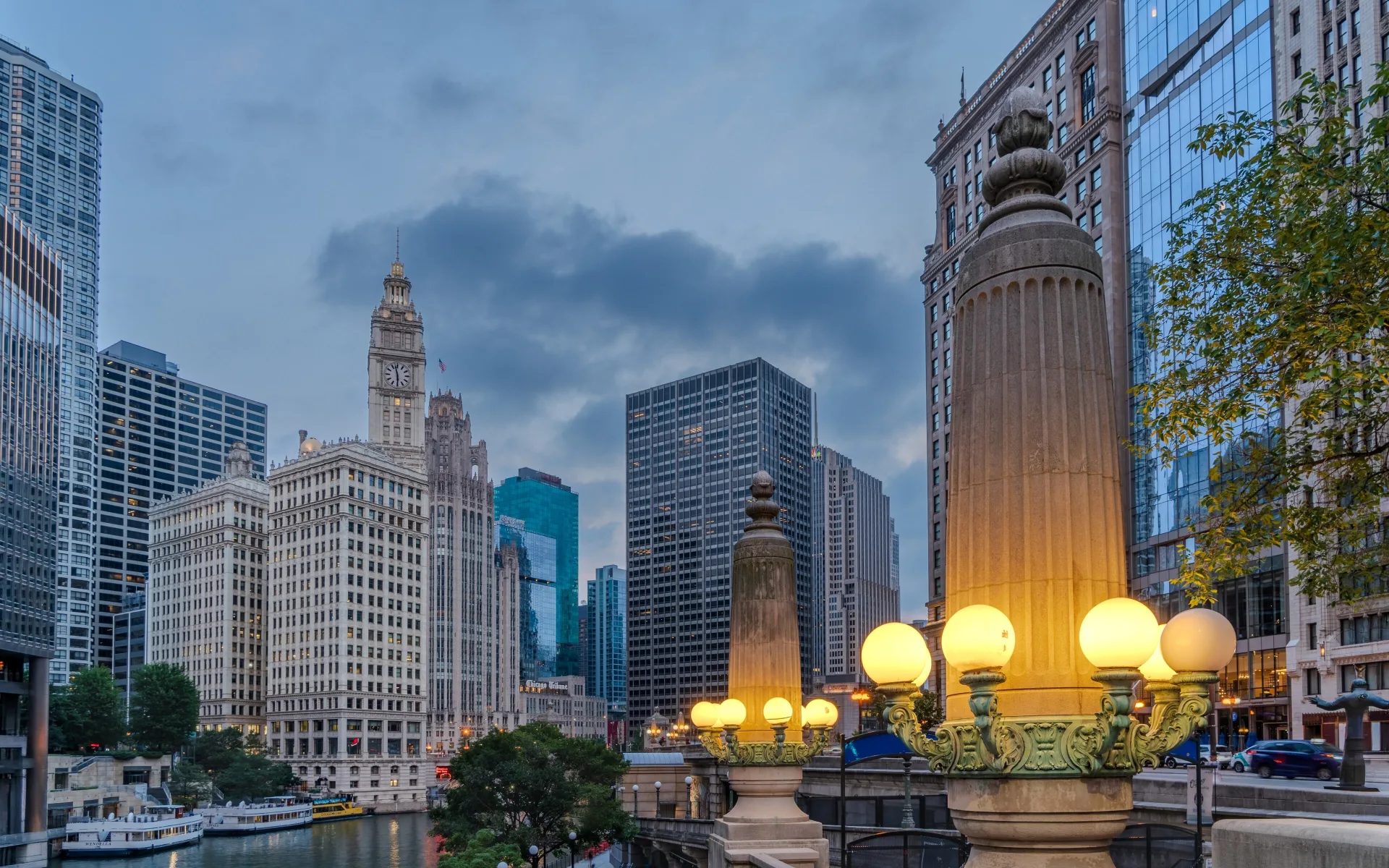
Cover photograph: the Chicago River, Wrigley Building and surrounding downtown architecture, photographed in August 2026 by NorbertNagel / Wikimedia Commons, CC BY-SA 4.0. Cropped and converted to WebP.
The fire and the first skyscraper
The Great Chicago Fire burned from 8 to 10 October 1871, covered about 2,112 acres and left roughly 90,000 to 100,000 people homeless, about 28 percent of the city's population. Wooden balloon-frame buildings and shingle roofs helped it spread, and critics such as Frederick Law Olmsted argued that brick walls would have limited the damage. Chicago revised its building and fire standards, and rebuilding began quickly, with lumber arriving the day the last fire was out. The Palmer House hotel, which burned 13 days after opening, was rebuilt across the street and advertised as the world's first fireproof building. Some structures survived: the Chicago Water Tower, built in 1869 by William W. Boyington, was the only public building in the burned zone to stand.
The Home Insurance Building, designed by William Le Baron Jenney and completed in 1885, was 138 feet tall and is often cited as the world's first skyscraper, the first tall building supported by a fireproof structural steel frame. It was demolished in 1931, but the Chicago School of architecture that followed turned the Loop into an open-air textbook of building.
Frank Lloyd Wright's Chicago
Wright's Prairie style took shape in the Chicago area. Frederick C. Robie signed the working drawings for the Robie House in Hyde Park in 1909, and the family moved into the long, low house in May 1910; it is regarded as one of Wright's best Prairie style buildings and helped popularize picture windows, protruding roofs and attached garages. It is one of the eight buildings on UNESCO's 2019 serial listing for the 20th-century architecture of Frank Lloyd Wright. Unity Temple in Oak Park is the other Illinois building on that list. The University of Chicago took ownership of the Robie House in 1963, the year it became a National Historic Landmark, and it opened to the public in 1965; the Frank Lloyd Wright Trust has run its tours since 1997, so book a slot before you travel.
Art, the blues and a Chicago voice
The Art Institute of Chicago was founded in 1879 and moved into its present building, put up for the 1893 World's Columbian Exposition, on 31 October 1893. Its collection of nearly 300,000 works includes Georges Seurat's A Sunday on La Grande Jatte, Edward Hopper's Nighthawks and Grant Wood's American Gothic.
Chicago blues grew out of the Delta blues as African Americans moved north from the South. Muddy Waters arrived in 1943 and became known as the father of the style, whose electric guitars and drums let it be heard in noisy clubs; it peaked in the late 1940s and early 1950s. The Chicago Blues Festival began in 1984, and clubs still play it every night; buy tickets from the venue, check minimum ages and cover charges, and listen as a guest in a living tradition, not a themed backdrop.
Neighborhoods and food with an argument
Chicago has 77 community areas, and each of the famous ones has its own food and history: Mexican cooking and murals in Pilsen, Black history and music in Bronzeville, Polish, Greek and South Asian kitchens elsewhere. Deep-dish pizza, the Italian beef sandwich and the Chicago-style hot dog are the dishes everyone argues about, and no single shop defines them, so a first visit is best spent sampling several neighbourhoods.
Seeing it in three days
Day one: the river and the Loop. Start at the Chicago Cultural Center, walk through Millennium Park and take an architecture cruise or walk, since a guided route gives the context that a skyline view cannot. Cruises are seasonal and weather-exposed, so reserve a reputable operator. Day two: the Art Institute and then the lakefront; do not schedule Museum Campus on the same day, and keep to the correct lane on the Lakefront Trail, which cyclists and pedestrians share. If the weather turns, the Cultural Center and a second indoor institution are easy substitutes. Day three: one neighborhood cluster, or Oak Park and Hyde Park for Wright. Pilsen suits murals and Mexican American food, Bronzeville suits Black history and music, and Hyde Park pairs the Robie House with the university, but choose one and give it time instead of photographing six. Book Robie House tours ahead, and spend money in the neighborhoods you visit. The Chicago city page connects them.
Practical help: the L, airports and weather
Transit. The CTA Blue Line links O'Hare with downtown around the clock, and the Orange Line links Midway, though it does not run all night; use the CTA airport guide before a late arrival. CTA accepts contactless bank cards and phone wallets, and the payment guide explains your options. Check the live alerts before each journey.
Access. Buses are generally accessible and many rail stations have elevators, but elevators can be out of service; see CTA's accessibility information.
Weather and safety. Wind off the lake makes cold feel colder and can make an exposed lakefront walk unsafe in ice. Spring swings quickly between rain and warmth, and summer brings heat, thunderstorms and festival crowds. The National Weather Service forecast and the Lake Michigan nearshore forecast are the best guides. Use normal urban awareness near train doors, call 911 for emergencies, and use CHI 311 for non-emergency city information.
Chicago's architecture makes the most sense beside other American cities. Philadelphia is the older, brick-built counterpart, Boston carries colonial and revolutionary history, and Portland shows a different regional character. Read what makes the United States special or go to the United States destination hub.
Questions and answers
How many days are enough for a first Chicago visit?
Three full days allow downtown architecture, one major museum area and a neighborhood day. With two days, keep the Loop and river together and choose either Museum Campus or one neighborhood rather than crossing the city repeatedly.
Do first-time visitors need a car in Chicago?
Usually not. CTA trains and buses, walking and occasional taxis cover this itinerary, while downtown parking adds expense and delay. A car can be useful only for a wider regional trip.
Which Chicago airport train goes downtown?
The CTA Blue Line links O'Hare with downtown and the Orange Line links Midway with downtown. Check the CTA for service changes, accessible stations and current fares before travel.
Sources
New York City · 40.7128° N, 74.0060° W
This story belongs to Chicago, United States. A country of home towns and large ideas, from Independence Hall and the first national park to jazz, skyscrapers and volcanic islands.