Brussels First-Time Guide: Grand-Place, Art Nouveau and Two Days
The Grand-Place rebuilt after 1695, Victor Horta's UNESCO-listed houses, Tintin, the 1958 Atomium and lambic beer: the dated story of Brussels, with practical advice.
Brussels is the capital of Belgium and of the European Union's main institutions, but its own character is stubbornly local: a medieval square rebuilt in four years, the birthplace of Art Nouveau, walls painted with comic-strip heroes, and a beer culture that UNESCO has recognized. It is officially bilingual in French and Dutch, and its pride has less to do with grandeur than with a sense of humor and an inventive streak.
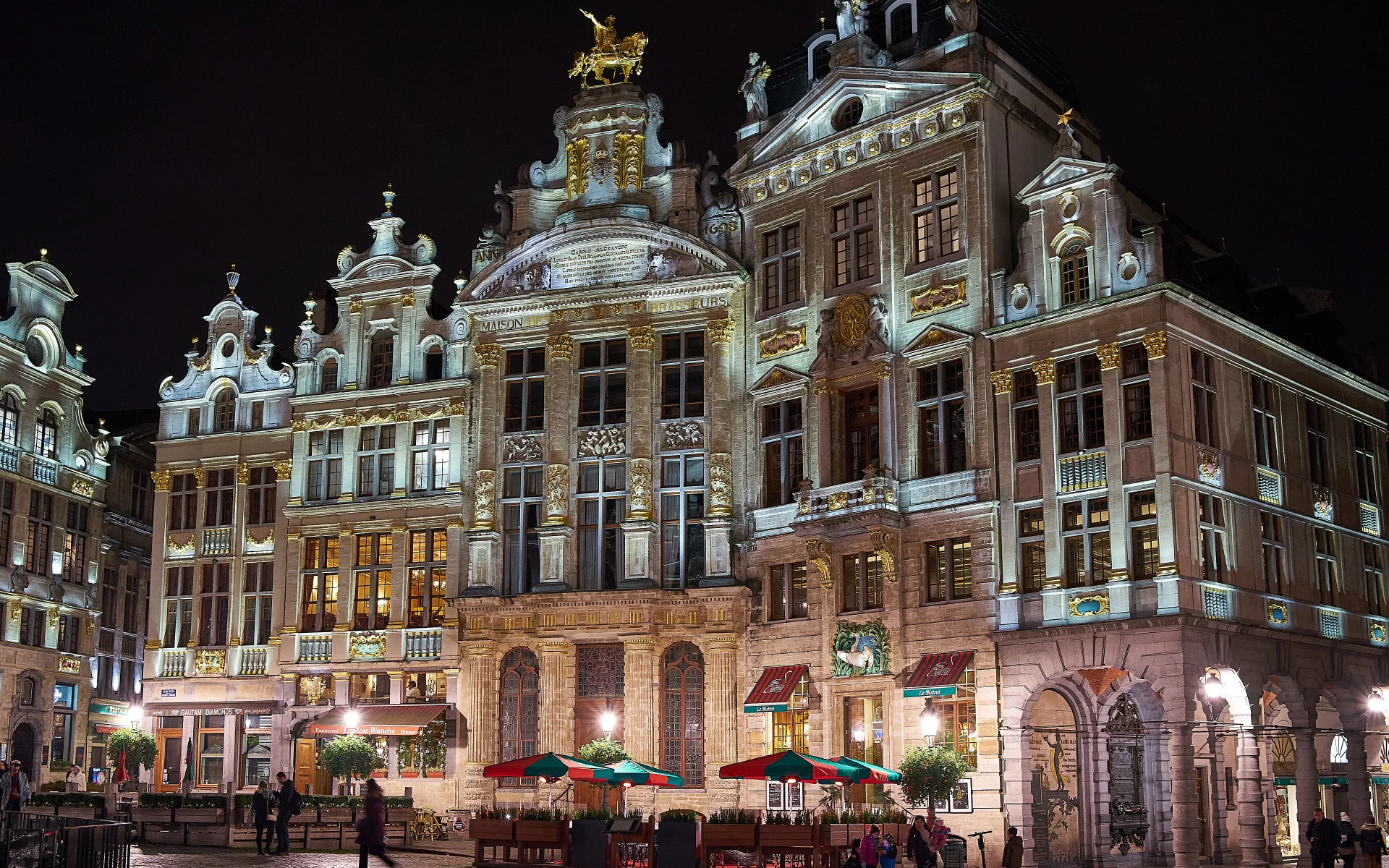
Cover photograph: illuminated guild houses on Brussels Grand-Place, photographed on 20 November 2018 by Radek Kucharski / Wikimedia Commons, CC BY 2.0. Centre-cropped and converted to responsive WebP sizes; no building or square element was generated or removed.
The square that came back in four years
On 13 August 1695, during the Nine Years' War, a French army under Marshal Villeroy bombarded Brussels and largely flattened the Grand-Place. Only the stone shell of the Town Hall and a few fragments of other buildings survived. The guilds and other owners rebuilt the surrounding houses within about four years, which is why the Italian Baroque and Flemish façades date mostly from after 1695. The Town Hall, built in stages between 1401 and 1455 and crowned by a 96-meter tower, is the square's only surviving medieval building. UNESCO inscribed the Grand-Place in 1998.
Victor Horta and the birth of Art Nouveau
The Hôtel Tassel, built in 1892 and 1893, is considered one of the first Art Nouveau buildings in the world. UNESCO credits Victor Horta with open floor plans, the use of natural light and the joining of curved decoration with structure. In 2000 it inscribed four of his Brussels houses: Hôtel Tassel, Hôtel Solvay, Hôtel van Eetvelde and Maison & Atelier Horta, now the Horta Museum in Saint-Gilles. Many other Art Nouveau façades in Ixelles and Saint-Gilles are private homes and best viewed from the opposite pavement.
Comic strips, an atom and a world's fair
Hergé launched The Adventures of Tintin in January 1929 in the supplement Le Petit Vingtième, and Belgian comics have been called an integral part of the country's culture. The Brussels Comic Strip Center opened in 1989 in a former fabric store designed by Horta. The Atomium was built for Expo 58, the 1958 Brussels World's Fair. It is 102 meters high, and its nine spheres represent iron atoms in a crystal unit cell, magnified about 165 billion times. It was designed by the architects André and Jean Polak from a concept by the engineer André Waterkeyn. A full renovation from 2004 to 2006 replaced its faded aluminium cladding with stainless steel.
Arcades, a small statue and René Magritte
The Galeries Royales Saint-Hubert opened on 20 June 1847, designed by Jean-Pierre Cluysenaar, and are described as the first truly public covered galleries in Europe. Nearby, the Manneken Pis was commissioned in 1619 from the sculptor Jérôme Duquesnoy the Elder and probably installed in 1620; the figure on the street is a 1965 replica, and the original is kept at the Brussels City Museum. He owns about a thousand costumes, which the Order of the Friends of Manneken Pis has managed since 1954. The Magritte Museum opened to the public on 2 June 2009 as part of the Royal Museums of Fine Arts and displays some 200 original paintings, drawings and sculptures by the Surrealist who lived in Brussels, along with his photographs and short films.
Lambic, chocolate and frites
Belgian beer culture was inscribed on UNESCO's intangible heritage list in 2016. Lambic, brewed by spontaneous fermentation with wild yeasts said to be native to the Zenne valley in which Brussels lies, is blended into gueuze, and it is found mainly in its production area and in a few cafés in and around the city. Chocolate makers cluster around the Sablon, frites come double-fried from friteries, and the city's tables also hold Congolese, Moroccan and Turkish cooking, a mark of its international population.
Choose one, two or three days
With one day, stay central: Grand-Place, the Galeries, one Mont des Arts museum and a nearby neighbourhood meal. With two days, add either the Atomium or the European Quarter and an Art Nouveau walk; each choice sits outside the central cluster. A third day supports an interior-focused Horta route, a second museum group or one Belgian rail day trip. Do not combine Atomium, the European Quarter and Saint-Gilles simply because each appears close on a small map.
Two days in the capital
Brussels works well in two days if you avoid crossing the city repeatedly. Day one: the Grand-Place before tour groups, the Galeries Royales Saint-Hubert, the Manneken Pis and one institution on the Mont des Arts, such as the Magritte Museum; Visit Brussels lists the Museum Mile and notes that opening days differ, with many closing on Monday. Day two: the Atomium, or the European Quarter with the Parlamentarium and House of European History, and the afternoon in Saint-Gilles for Art Nouveau streets. Bruges, Ghent, Antwerp and Leuven are on the national rail network, but each deserves a full day rather than a rushed add-on.
Practical help: stations, cards and quiet streets
Stations. Brussels has three major rail stations. Midi/Zuid handles many international services, Central is nearest the Grand-Place and Nord/Noord serves the north. Names appear in both French and Dutch, so learn both forms; confirm the station printed on your ticket. For airport journeys, the Belgian Rail operator notes an airport supplement that is usually built into the correct ticket.
Metro and access. STIB accepts a contactless card, phone or watch, and one device cannot validate for several people. Many metro stations and modern trams are accessible, but old streets are cobbled and some museums occupy historic buildings, so check lift outages on the day.
Seasons and passes. Winter is damp with short days, spring and autumn suit walking, and summer brings festivals and busy squares; carry a light waterproof year-round, and if rain sets in, the city's dense museum network is the obvious substitute. Compare the Brussels Card with the museums you will really enter, because two chosen tickets can cost less than a pass.
Language and manners. French is the language most widely spoken day to day, English is common in visitor settings and station names appear twice. Greet shopkeepers with bonjour or goedendag, keep bags closed around the Grand-Place and Midi, and view Art Nouveau houses from the pavement because they are homes.
More of Belgium
Brussels pairs naturally with the rest of Flanders. Bruges is a direct train away and keeps its medieval center intact, Ghent is its canal-lined rival, Antwerp has art and fashion, and Leuven is a university and beer town. What makes Belgium special ties them together, the Belgium destination hub lists the rest, and the Amsterdam guide covers a canal city across the border.
Questions and answers
Are two days enough for Brussels?
Yes for Grand-Place, one museum cluster, a neighborhood and either the European Quarter or Atomium. Add a third day for deeper Art Nouveau visits or a slower food-focused stay.
Can you use contactless payment on Brussels public transport?
STIB currently accepts a contactless bank card, phone or watch on its metro, tram and bus network. Use the same device for each validation and check current caps and airport rules.
Is Brussels-Midi the same station as Brussels-Central?
No. International trains commonly use Brussels-Midi/Zuid, while Brussels-Central is closer to Grand-Place. Local trains connect them frequently, but confirm the station printed on your ticket.
Sources
Brussels · 50.8503° N, 4.3517° E
This story belongs to Brussels, Belgium. Small, three-language and full of inventions the world knows without crediting Belgium: oil painting at its finest, the saxophone and lambic beer.