Bruges: The Medieval City That Trade Built and Time Preserved
The Belfry and canals of a World Heritage city, Van Eyck's Madonna, Michelangelo's marble and the Holy Blood procession: the dated story of Bruges, with practical advice.
Cover: AI-generated illustration. © ANUSHKA DAHANAYAKE (PVT) LTD.
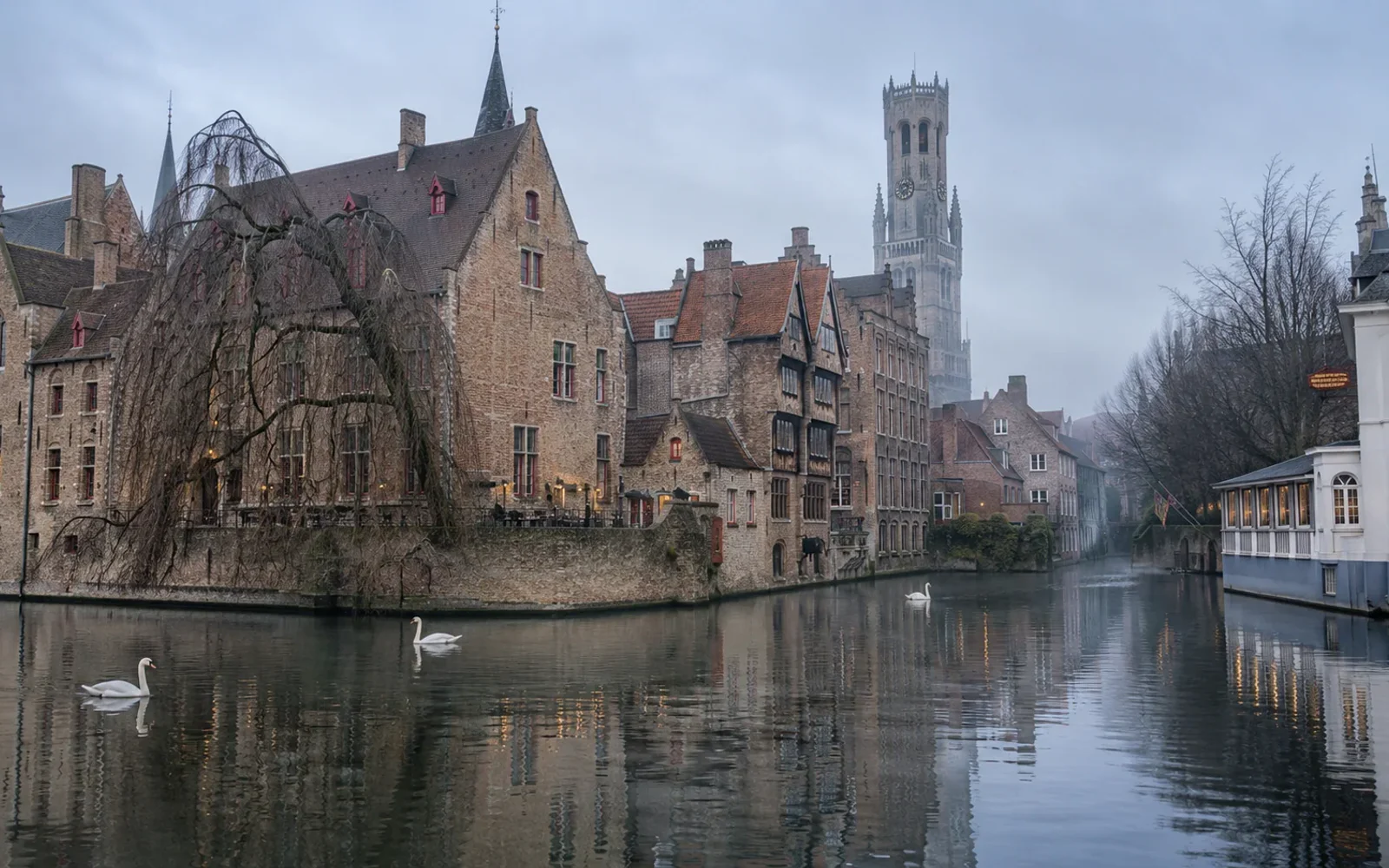
Bruges grew rich as a medieval trading port, then fell quiet when its sea channel silted up and commerce moved to Antwerp. Almost nothing was rebuilt, and from the second half of the nineteenth century British and French visitors made it one of the world's first tourist destinations; a restoration that began in 1965 renewed the medieval center. That is why the brick houses, canals and Gothic towers survive as a single readable medieval city. UNESCO inscribed the historic center in 2000, and the pride Bruges people take in it is the pride of a place that kept its own past.
A trading capital on the Zwin
Bruges became capital of the County of Flanders in 1089 and received its city charter on 27 July 1128. A storm in 1134 opened a natural channel at the Zwin that reached the town of Damme, which became its commercial outpost, and the Hanseatic League kept a trading office, a kontor, in the city. The Bourse opened in 1309 and is described as most likely the first stock exchange in the world. Bruges weavers were among the best in Europe, and by about 1350 the population had reached at least 46,000. In the fifteenth century Duke Philip the Good set up his court here, drawing artists and bankers from across the continent. Silting of the Zwin from around 1500 ended the golden age, and Antwerp took over as the region's commercial leader.
A Gothic skyline built on cloth and trade
The Belfry has stood on the Markt since about 1240. Fire destroyed the upper half in 1280, an octagonal stage was added between 1483 and 1487, and lightning wrecked the spire in 1493. It stands 83 meters tall today, 19 meters shorter than before the wooden spire burned in 1741 and was never replaced. A staircase of 366 steps climbs to a carillon of 47 bells. The tower is part of the Belfries of Belgium and France World Heritage property as well as of the historic center. The Gothic town hall on the Burg was begun in 1376 and finished in 1421, and is one of the oldest city halls in the former Burgundian Netherlands. Beside it, the Basilica of the Holy Blood houses the relic carried through the streets every Ascension Day; the Procession of the Holy Blood had emerged as a civic ceremony by the late thirteenth century, and UNESCO listed it as intangible heritage in 2009.
Van Eyck, Memling and the Flemish Primitives
Painters worked for Bruges merchants and the court of Burgundy, and the results still hang in the city. Jan van Eyck completed the Madonna with Canon van der Paele between about 1434 and 1436, and it is held in the Groeninge Museum. Hans Memling's works are shown in the medieval Old St John's Hospital. In the Church of Our Lady stands Michelangelo's marble Madonna and Child, carved between 1503 and 1505 and bought in 1504 by the Bruges cloth merchants Giovanni and Alessandro Moscheroni. In 1944 German soldiers retreating from Belgium took it away hidden in mattresses on a Red Cross truck, and it was found a year later in a salt mine at Altaussee in Austria and returned to Bruges.
Beguines, lace and beer
The Ten Wijngaerde Beguinage was built in the thirteenth century for lay religious women, a walled enclave of white houses around a lawn, and it is one of the Flemish Béguinages on the World Heritage List. Benedictine nuns live there now and ask for silence. Lace is still made on bobbins in Bruges, and the Lace Centre shows how. The De Halve Maan brewery still makes Brugse Zot and Brugse Straffe Hendrik in the center, and Flemish stews cooked with beer, mussels in season and fine chocolate make up the table.
Two days for a city that rewards slowing down
Bruges is small, crowded in the middle of the day and quiet before ten and after five, so an overnight stay is the best advice the city can give. Day one: the Markt before the day-trippers arrive, the Belfry climb, then the Burg and the Basilica. Choose the Groeninge Museum for the Flemish masters, and see the canals from a boat or on foot along the Rozenhoedkaai. Both are better late in the day. Visit Bruges notes that canal-boat tickets are bought on the spot and that sailing depends on season and weather. Day two: the Beguinage and Minnewater, then the eastern ramparts and windmills. Old St John's Hospital or the Folklore Museum suit rain.
Pairing one painting museum with the Hospital, where Memling's work hangs in a medieval infirmary, teaches more than four rushed entrances. Cycling to Damme works only if wind and daylight allow a safe return. Check conservation closures with Musea Brugge directly.
Practical help: trains, cobbles and crowds
Getting there. Belgian Rail lists direct trains from Brussels averaging about one hour. The station is a walk of roughly twenty minutes from the Markt, and local buses shorten it. Wheeled cases on cobbles are noisy at night, so a short bus or taxi ride is kinder to residents.
Cobbles and access. Cobbles are the main barrier for wheels and tired feet. The Belfry has narrow stairs and is not accessible to every visitor, and boat boarding can involve steps, so ask before booking. Visit Bruges publishes accessible routes and facilities.
Crowds and conduct. Midday brings cruise passengers and day-trippers, so keep lunch and booked interiors for the middle of the day and walk the canals early or late. Keep groups narrow, never block bridges and keep quiet in the Beguinage. Sint-Anna and the eastern center feel more residential than the Markt. Avoid photographing residents, and enter only courtyards that are open to visitors.
Bruges is half of a medieval pair. Compare it with its rival in what makes Ghent special, then continue to the capital in the Brussels first-time guide. Another canal city, with a very different history, is described in the Amsterdam guide. For the whole country, read what makes Belgium special or go to the Belgium destination hub.
Questions and answers
Is Bruges worth staying overnight?
Yes. An overnight stay gives you quieter early and late hours, time for museums and neighborhood walks, and reduces the pressure to compress the city into a few crowded hours.
How long is the train from Brussels to Bruges?
Belgian Rail currently lists the average direct journey at about one hour. Use its journey planner for your date, platform and any engineering work.
Do you need to book a Bruges canal boat?
According to [Visit Bruges](https://www.visitbruges.be/en/things-to-do/sightseeing/bruges-boat), regular canal-boat tickets are bought on the spot from the boat companies; sailing depends on season, weather and demand. Ask about boarding steps and seating if accessibility matters.
Sources
Brussels · 50.8503° N, 4.3517° E
This story belongs to Bruges, Belgium. Small, three-language and full of inventions the world knows without crediting Belgium: oil painting at its finest, the saxophone and lambic beer.