Ella for First-Time Visitors: The Viaduct, the Gap and the Hill Railway
Ella's Nine Arch Bridge, its gap in the mountains and the Main Line railway that climbs to it, followed by the practical choices that make two days there work.
Ella sits at about 1,041 meters on the southern lip of Sri Lanka's hill country, where the mountains split into the Ella Gap and the view drops away across the southern plains. Around it are cloud forest and tea estates; beneath it runs one of the best-known railway journeys in Sri Lanka. The town is small, but three things have made it known worldwide: a stone viaduct, a mountain gap and the hill railway that serves both.
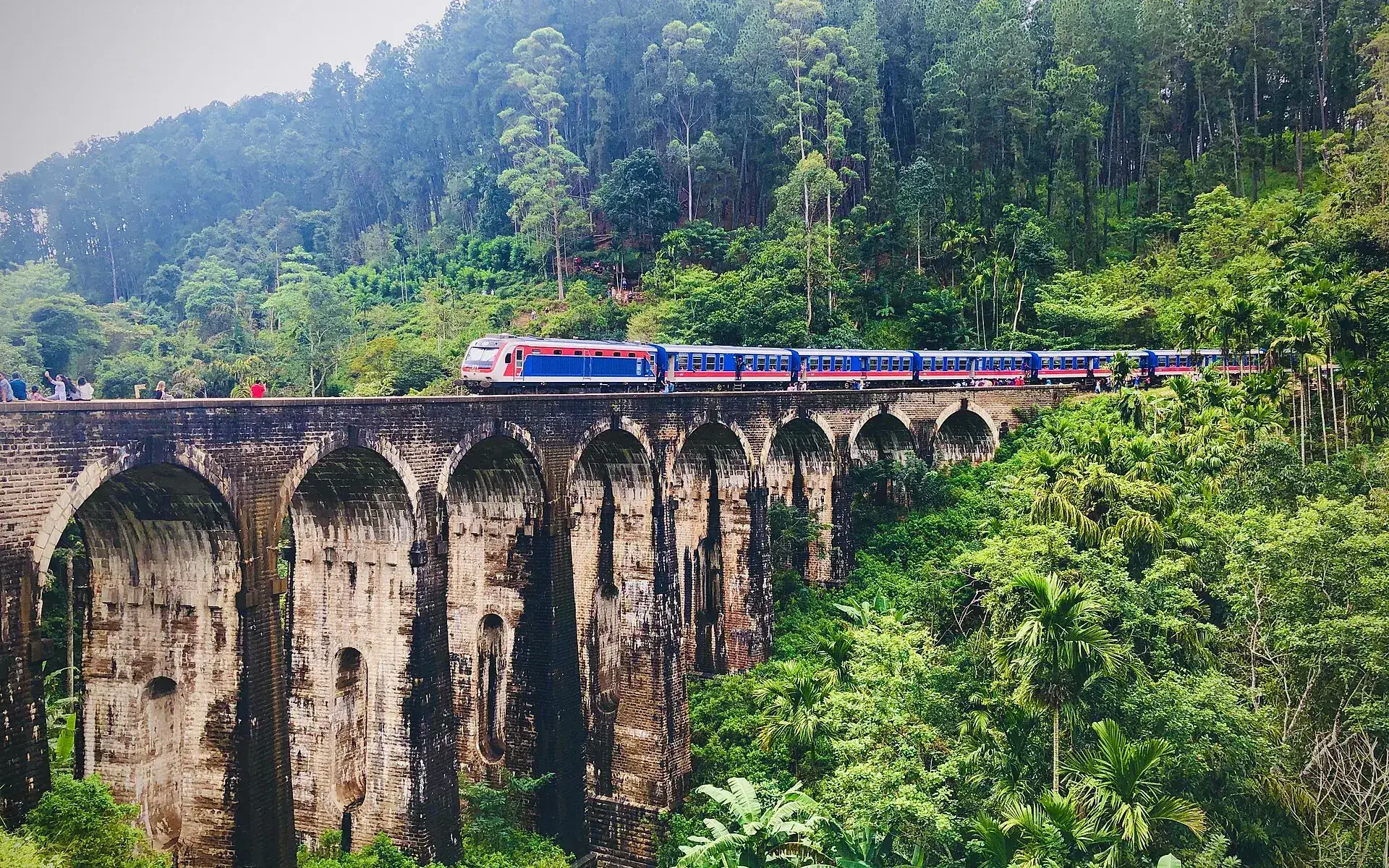
Cover photograph: the Denuwara Manike passenger train crossing Nine Arch Bridge, photographed in December 2019 by Dilshan255 / Wikimedia Commons, CC BY-SA 4.0. Cropped and converted to WebP. The image documents one train on that date, not a current crossing timetable.
A railway that climbed for sixty years
The Main Line began in the lowlands: the first train ran from Colombo on 27 December 1864, and the line reached Kandy in 1867. It then climbed, reaching Nanu Oya in 1885, Bandarawela in 1894 and Badulla in 1924, with Ella's own station opening in 1918 as the 75th on the line, 271 kilometers from Colombo. Each extension pushed the track higher into tea country that the colonial economy was built on. Its summit is at Pattipola, 1,898 meters above sea level. For the passenger, the result is a slow ride through tea gardens, tunnels and waterfalls; the stretch past Haputale into Ella is the one people remember. The town begins at the end of the platform, which is why many visitors treat the train as the first sight rather than the transport.
Nine Arch Bridge and the story told about it
The viaduct at Demodara, between Ella and Demodara stations, carries a single track across a jungle valley on nine arches, 91 meters long and 24 meters above the ground. Harold Cuthbert Marwood, the railway engineer in charge of that section, is credited with the design, and local labor built it under British supervision from stone, brick and cement, with steel used only for the rails and their fastenings. Sources date its completion to between 1919 and 1921. A popular tale says the steel meant for it was diverted to the First World War and villagers finished it in masonry; the same tale names a local builder, P. K. Appuhami, yet no document confirms his role. What the record does show is a structure designed for a steep gradient and a sharp curve, and it is a protected archaeological monument.
The Gap, the peaks and Ravana
Ella Gap lets the eye run across the southern plains. Little Adam's Peak, a pyramid-shaped hill of 1,141 meters also called Punchi Sri Padaya, is named after the larger Adam's Peak and is the easier climb. Ella Rock, across the valley, is longer and rougher. Ravana Falls, a drop of about 25 meters beside the Ella-Wellawaya road, carries the name of the demon king of the Ramayana, and a cave nearby is also named for him. Dhowa rock temple, with an unfinished 12-meter Buddha figure carved into the stone, is described as around 2,000 years old and lies a short ride away.
Booking the train, not the photograph
Sri Lanka Railways publishes an official schedule search and an online seat-reservation platform. Its reservation FAQ lists Colombo Fort-Badulla and Kandy-Ella services and says booking opens 30 days ahead; popular hill-country seats can disappear well before departure. Use the official service, not an unknown social-media seller. Enter every passenger's NIC or passport details exactly, carry matching identification, and remember that tickets are non-transferable and a 5% convenience fee applies. No ticket guarantees an open doorway: keep your body inside and never lean out to photograph.
Two days around the gap
Day one. Walk Little Adam's Peak early, before heat and crowds. Sri Lanka Tourism identifies it as the smaller Ella summit and recommends a morning walk with water; the final viewpoints have exposed edges, so stay behind barriers. After a rest, see Nine Arch Bridge in the afternoon. It is an active railway bridge: use a public approach, stay clear of the track, avoid tunnels, and treat a train crossing as a bonus, not a reason to wait for hours.
Day two. Choose one substantial outing. Ella Rock needs daylight, extra water and, if the route is unfamiliar, a reputable local guide; turn back in thunderstorms or poor visibility. A tea estate visit works better when the operator says whether the factory is running that day. Ravana Falls sits on a busy road and swells in rain, so view it from permitted areas and keep out of wet rocks and fast water.
Where to stay, what to eat, and what to watch
Central Ella is convenient but noisy; a hillside guesthouse offers quiet and a view, though it may mean steep lanes or a tuk-tuk each time. Ask for the walking time from the road and for stair counts, and save the location offline. Family-run rice-and-curry places reward a walk away from the main street; say clearly how spicy you want a dish and mention coconut, fish or nut allergies. Carry cash for small vendors and agree tuk-tuk fares before setting off.
Weather changes quickly in the hills. Check the Department of Meteorology's forecasts before a ridge or waterfall, pack a rain layer, sun protection and closed shoes (leeches appear on wet vegetation), and start walks early because mist often fills the gap by mid-morning. Steep roads and uneven paths make Ella difficult for limited mobility; ask accommodation and drivers about gradients and steps in advance.
Save 119 for police emergencies, 1990 for the Suwa Seriya ambulance service and 1912 for Sri Lanka Tourism help, as listed in the regulator's short-code register, the 1990 service page and the SLTDA hotline page. Ella's popularity strains water and waste systems, so refill bottles where safe, avoid single-use plastic and keep noise down near homes.
Continue with our Sri Lanka destination hub, connect the railway journey to Kandy without the rush, explore more hill country in what makes Nuwara Eliya special, or plan the coast with the Galle Fort visitor guide.
Questions and answers
How many days do you need in Ella?
Two full days cover Nine Arch Bridge, one moderate hill walk and time in town without rushing. Add a third day for a waterfall, tea-focused visit or a weather buffer during wetter periods.
Do you need to reserve the train to Ella?
Reserved seats on popular hill-country services can sell out, so book through Sri Lanka Railways when your date opens. Unreserved carriages may still be available, but boarding and comfort are not guaranteed. Always check the current official timetable.
Is Ella suitable for travelers with limited mobility?
The town has steep roads and many attractions use uneven paths or stairs. The railway station and road viewpoints may still be manageable with planning; ask accommodation and transport providers for exact gradients, steps and vehicle access.
Sources
Colombo · 6.9271° N, 79.8612° E
This story belongs to Ella, Sri Lanka. An island of ancient capitals, irrigation tanks, hill-country tea and colonial harbours, where continuity runs unbroken across two thousand years.