Bologna for First-Time Visitors: Porticoes, Food and Three Calm Days
The world's oldest continuously operating university, UNESCO-listed porticoes, a sanctuary reached by a covered walk and food rules written into a civic record.
Cover: AI-generated illustration. © ANUSHKA DAHANAYAKE (PVT) LTD.
The Etruscan city of Felsina stood here by the end of the sixth century BCE, and in 196 BCE the town became a Roman colony named Bonōnia. The University of Bologna was established in 1088 and has operated continuously since, which is why it is widely described as the oldest university in the world still teaching. The Peace of Constance in 1183 gave the city effective autonomy. Medieval towers rose in the twelfth and thirteenth centuries. San Petronio, begun in 1388 and never finished, dominates Piazza Maggiore. Bologna was declared European Capital of Culture in 2000, and UNESCO named it a City of Music on 26 May 2006. It rewards visitors who prefer depth to spectacle.
A city built under cover
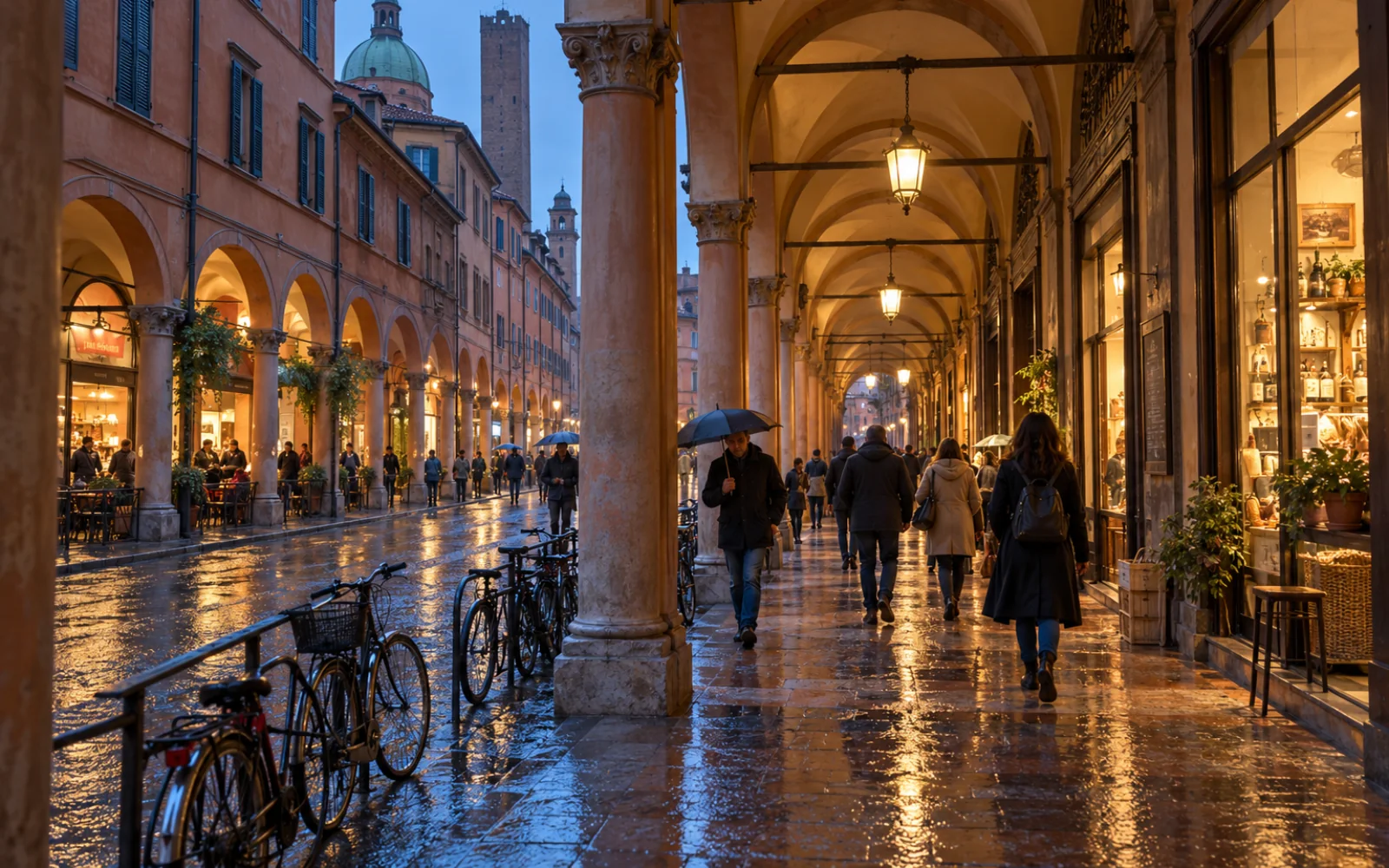
The most distinctive thing about Bologna is architectural: continuous arcades, or porticoes, line the streets. About 38 kilometres of them stand in the historic centre, and the larger network exceeds 45 kilometres. UNESCO recognised the porticoes of Bologna as a World Heritage Site in 2021. They began partly to house a growing population, including students, and they now shelter shoppers, cyclists and conversation in rain or summer sun. The portico to the Sanctuary of San Luca climbs for several kilometres on steps and gradients to a sanctuary whose construction began in 1723.
Bologna's central buildings tell the same story of civic pride. The Piazza del Nettuno, the Palazzo dei Banchi and the Archiginnasio, the university's historic home, were built in 1564, and the arcaded square they frame is still the city's living room. In 1506 Pope Julius II deposed the Bentivoglio family, and in 1530 Charles V was crowned here.
A table with written rules
Bologna's food culture is tied to a productive region. Tagliatelle al ragù, the dish that tourists call spaghetti bolognese, is not served with spaghetti; the ragù recipe was filed with the Bologna Chamber of Commerce in October 1982, with beef, pancetta and whole milk, and without garlic. Tortellini, mortadella and fresh pasta come from the same logic of making food well from local materials. The Quadrilatero market streets and the Mercato delle Erbe keep the trade visible. Buy edible souvenirs only when you can keep them safely, ask before photographing vendors and keep narrow aisles clear.
Lunch can focus on tagliatelle al ragù, tortellini or a seasonal dish. Ask what is made in-house rather than demanding every classic at one restaurant, and treat a menu designed around the region as more convincing than one advertising dozens of national dishes.
Wounds and renewal
Allied bombing damaged much of the city on 24 July and 25 September 1943, and Resistance forces entered Bologna on 21 April 1945. On 2 August 1980 a terrorist bombing at the central railway station killed 85 people, and the city marks the date every year with remembrance. The station memorial and the annual commemoration are part of the city's civic life, and visitors are asked to treat them with the same respect as any other memorial.
One city day and one wider day
City day. Begin in Piazza Maggiore with the Basilica of San Petronio, a working church where dress, service restrictions and photography rules apply. Walk Piazza del Nettuno and the Quadrilatero, continue to the Archiginnasio, then end with a slow portico walk through Santo Stefano. Courtyards and apartment entrances are private unless explicitly open. Bologna Welcome currently lists Asinelli Tower closed during area maintenance and suggests the Clock Tower as a panoramic alternative, so recheck before paying for a view.
Wider day. Take one rail trip: Modena offers the cathedral and food traditions, Parma has art and its own food culture, and Ravenna's mosaics deserve a full day. Count station-to-sight time and the final return, not only the fastest advertised train. Florence is close by high-speed rail, but adding it to a short Bologna visit can turn both cities into platforms.
Where to stay and what to reserve
The area between Bologna Centrale and Piazza Maggiore is practical for a first visit. Near the station suits early trains, the Quadrilatero places sights and food outside the door but can be noisy, and Santo Stefano feels calmer. Ask about lifts, traffic noise and the exact entrance, since arcaded addresses can be less obvious after dark. Reserve one important experience, not every meal: one market visit, one substantial traditional meal and ordinary bar breakfasts reveal more than a marathon of tastings. Major temporary exhibitions may use timed admission, and trade fairs push accommodation prices up, so book early.
Practical notes for Bologna
Bologna Centrale is large, with high-speed and regional areas at different levels, so arrive early to find the platform. The Marconi Express links the airport with the station, with step-free design according to the airport; check operating notices and keep a bus or official taxi alternative. TPER operates buses. A car creates restricted-zone and parking problems, because the central traffic zone is camera-enforced and hotel access rules need confirming in advance.
Porticoes shelter walks in rain but paving can be slick near the edges, and cyclists move quickly. The San Luca route is not an accessible substitute merely because it is covered, so contact venues for the exact step-free entrance. Summer is humid, so move climbs to early hours. Close bags in station crowds, use authorised taxis and tell staff about serious allergies in clear Italian, since vegetarian does not automatically mean a dish is made without meat stock. Coffee is often taken quickly at the counter and a listed cover charge is normal.
Budget from real accommodation dates, local tax, airport transfer, one paid visit per day and meals. Bologna is no longer a cheap secret, particularly during trade fairs, but lunch menus, markets used sensibly and free civic spaces keep costs under control. At aperitivo, establish whether food is included, and lower your voice under residential porticoes late at night.
Read what makes Italy special, continue through the Italy destination hub, or compare Florence for first-time visitors and responsible visiting in Venice.
Questions and answers
How many days do you need in Bologna?
Two days cover the historic core at a steady pace; three allow a portico walk, food experience and museum without rushing. Add a separate day for Modena, Parma or Ravenna.
Can Bologna be visited without a car?
Yes. The centre is walkable, buses cover outer districts and Bologna Centrale has excellent rail connections. A car is more likely to create restricted-zone and parking problems.
Do you need to book Bologna's towers?
Access can change because of conservation work. Check Bologna Welcome for the current official panoramic option and reserve if timed entry is required.
Is Bologna suitable in rainy weather?
Yes. Its extensive porticoes shelter many central walks, although paving can still be slippery. Museums, markets and churches provide good alternatives during heavier rain.
Sources
Rome · 41.9028° N, 12.4964° E
This story belongs to Bologna, Italy. A country told city by city, where a craftsman solved a problem the rest of Europe copied and the city never forgot whose solution it was.