Niagara Falls: Ice-Age Cataract, Daredevils and Power
Carved about 10,000 years ago, Niagara Falls has hosted tightrope walkers, barrel riders and a pioneering hydroelectric industry. This guide tells that story first, then how to see it.
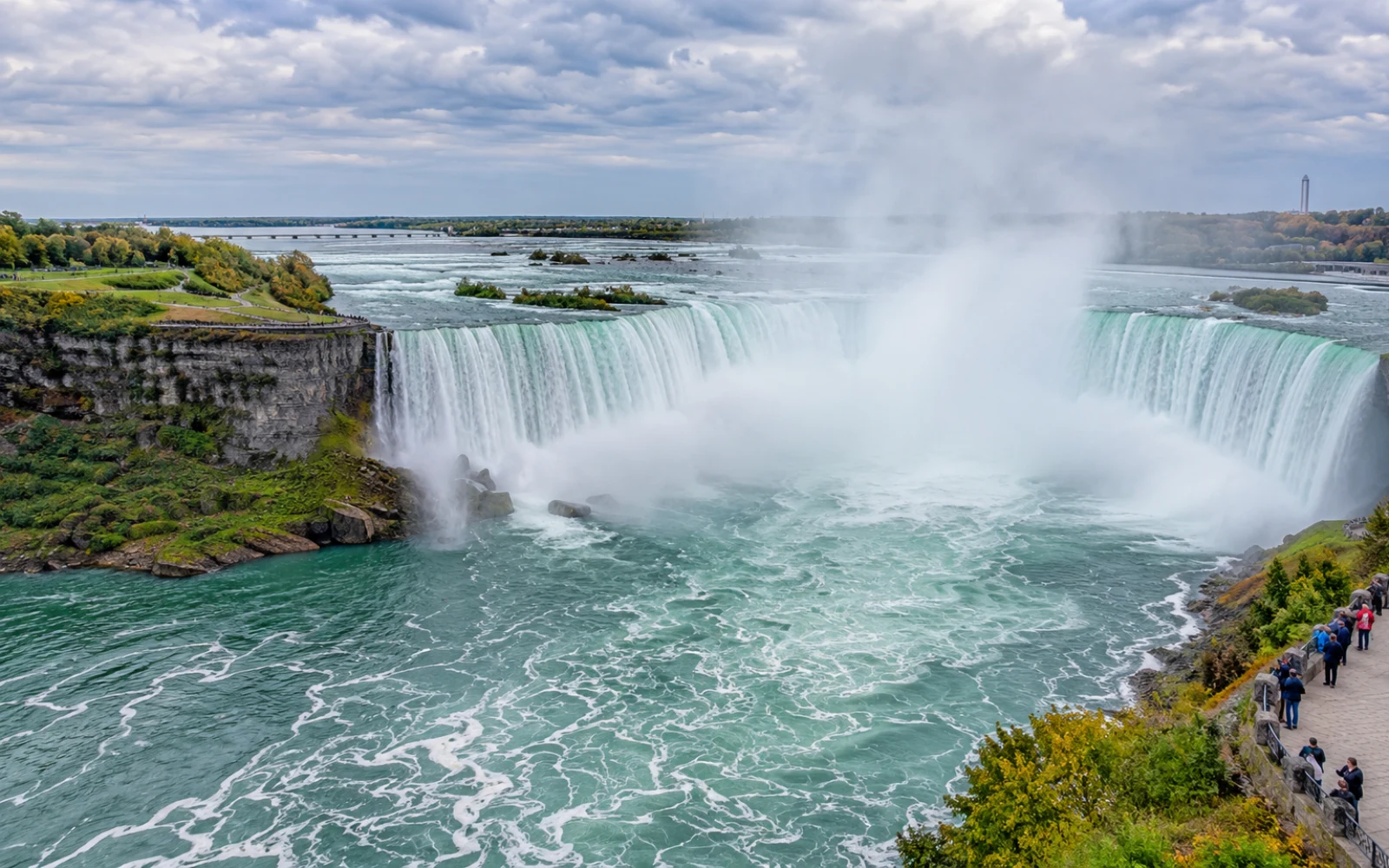
Cover: AI-generated illustration. © ANUSHKA DAHANAYAKE (PVT) LTD.
Niagara Falls is a geological accident with a long human biography. The Wisconsin glaciation retreated about 10,000 years ago and left meltwater to carve a path between Lake Erie and Lake Ontario. About 10,900 years ago the falls stood between Queenston and Lewiston, and since then erosion has pushed them roughly 10.9 kilometres upstream. The Horseshoe Falls on the Canadian side is about 57 metres high and about 790 metres wide, and on average some 2,400 cubic metres of water pass over the edge every second. The name is usually traced to an Indigenous word, Ongiara, which has been glossed as "thundering water".
Three falls share the river, and each has its own character. The American Falls drop between 21 and 30 metres and are about 320 metres wide, with a rock-strewn base that gives them a fractured look. The small Bridal Veil Falls are separated from the others by islands. The Horseshoe Falls carries the great majority of the water, and its recorded peak flow, measured by Ontario Hydro, reached 6,370 cubic metres per second. Because the Canadian side faces the American Falls across the gorge, it also offers the best panorama of all three at once, which is why the promenade and its viewpoints have drawn crowds for more than a century.
Showmen, ferries and the first tourists
Niagara has been drawing visitors since the nineteenth century, and the visitor industry grew around spectacle. A small steamer called Maid of the Mist was christened in 1846, first as a river ferry, and boat trips below the falls have operated in one form or another ever since. On 30 June 1859 the French acrobat Charles Blondin became the first person to cross the gorge on a tightrope, and he repeated the feat for large crowds. On 24 October 1901 a schoolteacher named Annie Edson Taylor became the first person to go over the falls in a barrel, and she survived. Both feats are still recounted in museums and plaques along the river, and the lesson from both is the same: the water is not a stage, and nobody should try to copy them.
Public land mattered as much as private showmanship. In 1885 Ontario created Queen Victoria Niagara Falls Park to protect public access to the view, and the Niagara Parks Commission now maintains the waterfront gardens, promenade and heritage sites. The gardens and open frontage that visitors treat as normal are a result of that early decision.
Power from the gorge
Niagara is also an engineering story. The first generating station on the river was built in 1881, and a large-scale alternating-current system was switched on in August 1895, helping establish electricity as a public service. In 1906 the Ontario government brought power transmission under public control, and the Sir Adam Beck stations on the Canadian side remain a central part of the province's power system. A new tunnel for the Beck stations, begun in August 2005, entered service in March 2013 and added 150 megawatts of capacity. The practical effect is that the flow visitors see is regulated, and part of the river is diverted for generation before it reaches the falls.
Culture around the cataract
The falls have inspired poets, painters and honeymooners for two centuries, and that reputation still shapes the Canadian side. Clifton Hill's arcades and wax museums sit next to quiet gardens and vineyard country in the surrounding Niagara region. The Illumination of the falls each evening has become a local ritual, and the fireworks on summer nights gather crowds on the promenade. Visitors who walk a little beyond the main viewing area often find the story more convincing. The gorge walls expose layers of ancient rock, the river below the falls runs in a hard, fast channel, and the gardens along the parkway show how seriously Ontario took the idea of a public landscape. Local pride rests less on the commercial strip than on the park, the gorge, the wine country and a sense that an ordinary river carries remarkable energy.
A first walk along the promenade
Start at the Horseshoe Falls viewpoints beside Table Rock, where the volume is easiest to understand. Continue north along the Niagara River promenade toward the American Falls viewpoints. The route is simple but can be congested, so keep to one side, do not stop across the full path for photographs and leave room for wheelchair users and families. The seasonal visitor transport system returns tired walkers if fatigue or weather intervenes.
The Skylon Tower, zipline and other attractions offer different angles, but none is required. Ask whether each purchase provides a genuinely new experience or another elevated photograph, because one paid anchor plus the public promenade is enough for many first visits. Boat trips and the tunnel walks behind the falls are the most distinctive paid options; both operate seasonally, so check opening dates and weather before travel.
Getting there, weather and cost
Within the visitor area, walking and local or visitor transit are often easier than repeatedly moving a car. The Niagara Region Transit network and GO Transit's seasonal services to Niagara Falls make a car-free day from Toronto practical. Parking price and availability vary by lot, so photograph the lot identifier and payment terms, and never stop in an unauthorised roadside space for a quick view.
Spray soaks nearby paths, so bring a waterproof layer even on a sunny day, and expect ice on pavements in winter. The falls remain impressive in every season, and winter sometimes adds ice formations and fewer crowds. Hold railings, stay behind barriers and keep children close, because the current above the falls is faster than it looks. Photography is welcome, but tripods should not block the promenade. Accommodation prices rise on weekends and in summer, and attractions sell combined passes with varying coverage, so compare what each pass includes before buying.
Visitors continuing through Ontario can pair Niagara with the capital in our Ottawa first-time guide or with Toronto in three days. For the national picture, read what makes Canada special and browse the Canada destination hub.
Questions and answers
How long do you need at Niagara Falls?
One full day covers the Canadian viewpoints and one paid close-up experience. Stay overnight for evening illumination, slower walks or a separate Niagara-on-the-Lake day.
Do you need a passport to see Niagara Falls from Canada?
You need documents appropriate to enter Canada, and additional border documents if crossing to the United States. You do not cross a border simply to walk the Canadian viewpoints.
Which Niagara Falls attraction should a first visitor book?
Choose either a seasonal boat trip for a water-level experience or Journey Behind the Falls for tunnels and observation decks. Booking both is optional, not essential to understand the falls.
Sources
Toronto · 43.6532° N, 79.3832° W
This story belongs to Niagara Falls, Canada. The second-largest country by area, shaped by Indigenous nations, two official languages, newcomers from every continent and a national park system begun at Banff.