What Makes Lyon Special: Two Rivers, Secret Passageways and the Capital of French Food
A city between two rivers with a Roman past, a Renaissance old town on the World Heritage List, hidden passageways, a silk-weaving heritage, the birth of cinema and a reputation as France's food capital. A guide to what makes Lyon special.
Cover: AI-generated illustration. © ANUSHKA DAHANAYAKE (PVT) LTD.
Few French cities have shaped as many everyday things as Lyon. The punched-card loom, the first films of the Lumière brothers, the puppet Guignol, a school of cooking led by women and a chef who became a household name all came from this city where the Rhône meets the Saône. Its historic centre, from the Roman hill of Fourvière to the weavers' slopes of the Croix-Rousse, has been on the World Heritage List since 1998. For the Lyonnais, pride rests less on monuments than on work done well: a length of silk, a quenelle, a reel of film.
Lugdunum, the Roman capital of Gaul
Lyon was founded in 43 BC as Lugdunum and became a leading city of Roman Gaul. On the Fourvière hill, two Roman theatres still host summer performances during the Nuits de Fourvière festival, and the Gallo-Roman museum is built into the slope beside them. The ridge has stayed the city's spiritual high point: the white basilica of Notre-Dame de Fourvière, completed in the late nineteenth century, looks down on both rivers, and the older chapel beside it carries the gilded Virgin at the centre of Lyon's most loved festival.
Silk, the canuts and a loom that changed industry
From the sixteenth to the nineteenth century Lyon was Europe's capital of silk weaving. The loom developed by Joseph Marie Jacquard in the early 1800s used chains of punched cards to control the pattern, so a single weaver could produce brocades that had needed several hands. The idea of storing instructions on punched cards later influenced early computing. To fit the tall machines, weavers known as canuts moved up the Croix-Rousse hill into buildings with high ceilings and large windows that still define the district.
The canuts also gave Lyon a place in labour history. In 1831, when silk prices fell and merchants cut piece rates, the weavers rose up and briefly held the city; a second revolt in 1834 lasted six days before troops suppressed it. These are counted among the first workers' uprisings of the industrial age. The Maison des Canuts keeps working looms, and a few workshops still weave and restore silk for historic interiors.
Traboules: a city with private shortcuts
Vieux Lyon is one of the largest Renaissance districts in Europe, built by bankers and merchants drawn by Lyon's trade fairs. Its traboules, covered passages that cut through buildings and courtyards from one street to the next, let goods and people move under cover. On the Croix-Rousse they carried bolts of silk down the hill, sheltered from the rain. Most are private homes, so the tourist office's list of open traboules is the route to follow.
Guignol, the weaver who talks back
Around 1808 Laurent Mourguet, a former silk worker who pulled teeth in the street and used puppets to draw a crowd, created Guignol. He dressed the glove puppet as a canut, with a Lyon accent and a habit of mocking authority, alongside his drinking friend Gnafron and his wife Madelon. Guignol became the most famous puppet in France, and small theatres in Lyon still stage his shows for children and adults.
The Mères and the making of a food capital
Lyon's reputation at the table was built by women. The "Mères lyonnaises" were cooks who opened their own restaurants and served precise, generous home cooking. The best known, Eugénie Brazier, became in 1933 the first chef to hold three Michelin stars at two restaurants at once, one on the rue Royale and one at the Col de la Luère, a record of six stars that stood for decades.
Bocuse took his family's restaurant at Collonges-au-Mont-d'Or, just north of the city, to three Michelin stars in 1965 and became one of the most famous chefs of the twentieth century. In 1987 he founded the Bocuse d'Or, the international cooking competition still held in Lyon, and the covered market Les Halles de Lyon Paul Bocuse carries his name. The bouchons keep the older tradition: quenelles in Nantua sauce, andouillette, salade lyonnaise with a poached egg, cervelle de canut (a fresh cheese with herbs whose name teases the silk workers) and pink praline tart. Wine comes in the heavy-bottomed Lyon pot, filled with Beaujolais or Côtes du Rhône. For the wider French food map, our guide to what makes Bordeaux special follows the other great wine city.
The Lumière brothers and the first film
Louis and Auguste Lumière ran a photographic plate factory in the Monplaisir district. In March 1895 Louis filmed the workers leaving it at the end of the day; La Sortie de l'usine Lumière is counted among the first motion pictures ever made. Their cinematograph could film, print and project, and the public screenings that followed launched cinema as a public entertainment. The Institut Lumière now occupies the family villa in Monplaisir, with a museum of their inventions and a cinema.
A writer, a pilot and a city of the night sky
Antoine de Saint-Exupéry, the aviator and author of The Little Prince, was born in Lyon on 29 June 1900 and took his first flight at the age of twelve. The city counts him among its proudest sons, and his love of flying and the night sky sits well with Lyon's own celebration of light. Like the Lumière brothers, he belongs to Lyon's long story of light, flight and invention.
8 December: candles in every window
The Fête des Lumières began on 8 December 1852. A gilded statue of the Virgin was to be placed on the Fourvière chapel; when it was finally inaugurated that December, residents spontaneously set small candles, called lumignons, on their windowsills. Families still do it every 8 December, and since the late twentieth century the city has added light installations on its façades over several nights. The Fourvière sanctuary tells the story, and the festival remains a local tradition before it is a tourist event.
Seeing Lyon by hill, river and neighbourhood
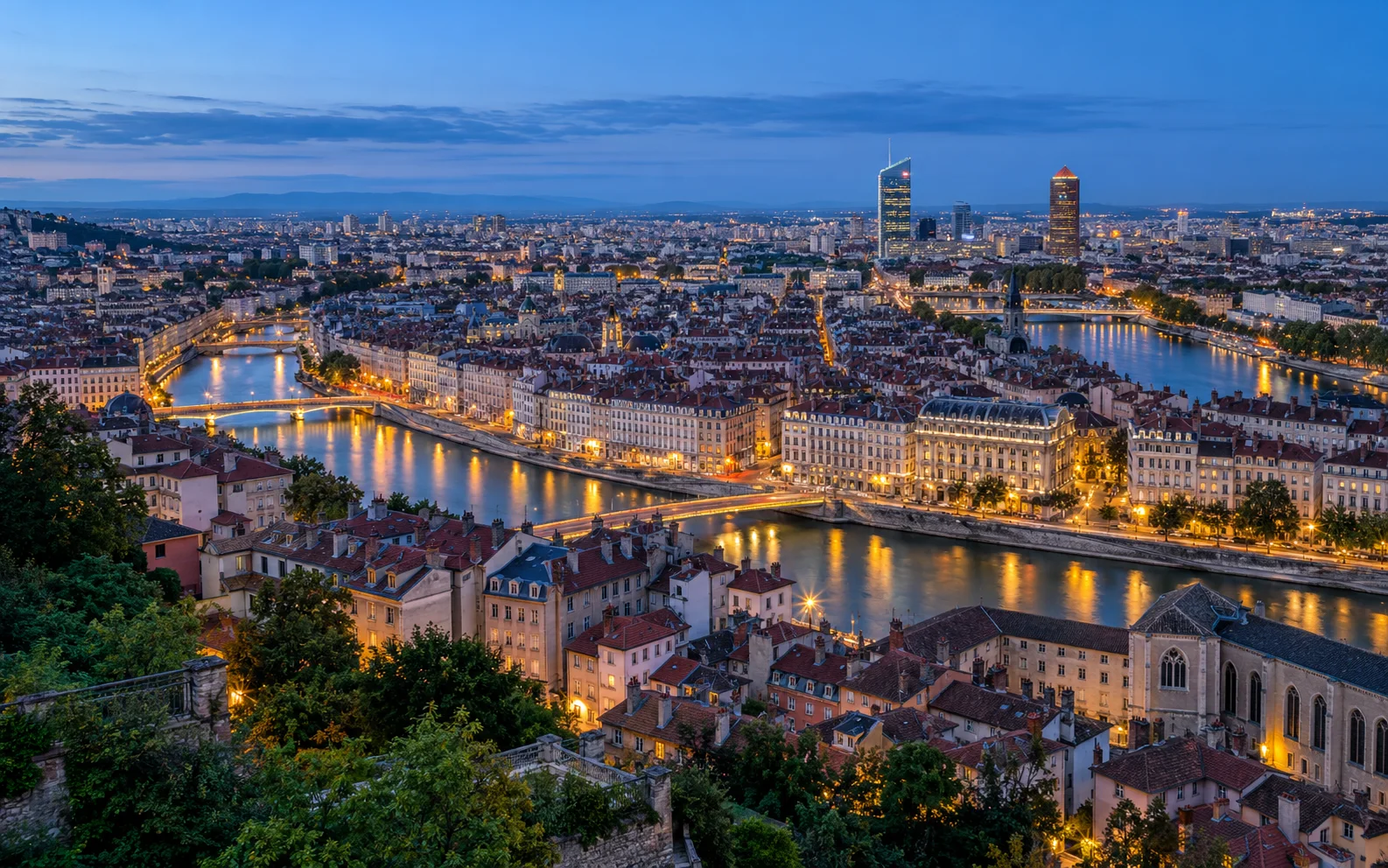
Lyon is best understood as three levels. Fourvière and Vieux Lyon sit on the west bank of the Saône; the Presqu'île, with Place Bellecour, the opera and the Musée des Beaux-Arts, fills the tongue of land between the rivers; and the Croix-Rousse rises to the north. Two funiculars climb Fourvière and Saint-Just from Vieux Lyon, and the TCL network of metro, trams and buses covers the city on one ticket. The Rhônexpress tram links the airport, and SNCF's high-speed trains reach Paris in about two hours; confirm whether the train uses Part-Dieu or Perrache.
A sensible three-day shape is Fourvière and Vieux Lyon on the first day, the Presqu'île and Les Halles on the second, and the Croix-Rousse with the Maison des Canuts or the Institut Lumière on the third. The short-stay Lyon City Card includes TCL transport and participating museums; check which version you are buying.
Eating and moving with care
Book well-known bouchons ahead at weekends and read the current menu; offal and rich sauces are central to the tradition, and vegetarian travellers should choose places that publish suitable dishes. A set lunch is usually better value than dinner. Fourvière and the Croix-Rousse are steep, Vieux Lyon is cobbled and many traboules have steps, so travellers who need step-free routes should ask the tourist office for an accessible itinerary. In early December the Festival of Lights changes crowd flows and security, so follow the city's published plan and book a room well in advance.
Beyond the city
Lyon is the natural base for the Alps and the south. Annecy's lake and old town lie to the east, and the Rhône valley leads south to Provence. The France country page gathers every French city we cover, so a Lyon stay can serve as a base as well as a destination, and what makes France special sets Lyon's silk, film and cooking inside the national story.
Questions and answers
What is a traboule?
A traboule is a covered passageway running through buildings and courtyards from one street to the next, found in Vieux Lyon and on the Croix-Rousse hill. Silk workers used them to carry fabric; several hundred exist and some are open to the public during the day.
What is a bouchon?
A bouchon is a traditional Lyon restaurant serving hearty local dishes such as quenelles, andouillette and salade lyonnaise, usually with checked tablecloths and pots of local wine. Some carry an official 'Bouchon Lyonnais' label.
Why does Lyon light candles on 8 December?
The custom goes back to 8 December 1852, when a gilded statue of the Virgin was inaugurated on the Fourvière chapel and residents placed small candles in their windows. The modern Fête des Lumières grew from that tradition.
Sources
Paris · 48.8566° N, 2.3522° E
This story belongs to Lyon, France. A country that sends people to the baker twice a day, protects a cheese by law and refuses to be averaged into one postcard.