Provence First-Time Visitor Guide: Bases, Markets and Day Trips
Greeks, Romans, popes and painters each left a layer in Provence. Their dates and places, then a practical plan for markets, villages and summer heat.
Cover: AI-generated illustration. © ANUSHKA DAHANAYAKE (PVT) LTD.
Provence is a region where each century left something solid. Greek colonists founded Marseille around 600 BC, Romans built aqueducts and amphitheatres, popes moved their court to Avignon, and in 1888 a restless Dutch painter began a year of intense work in Arles. The lavender and market stalls are the popular image, but the better reason to come is that you can walk through these layers in a single compact area. Locals are proud of that depth and of the Provençal language revival that won a Nobel Prize.
Greeks and Romans in the south
Greek colonists from Phocaea founded Massalia, the site of modern Marseille, around 600 BC. In 122 BC the Romans founded Aquae Sextiae, later Aix-en-Provence, and the name Provence traces back to the Roman Provincia Romana. In Arles, the Romans took the town in 123 BC and built a canal to the Mediterranean in 104 BC. Constantine I made Arles a favourite city and built baths there, parts of which still stand, and Constantine III made it his capital in 408. In 1981 UNESCO listed Arles's Roman and Romanesque monuments; the amphitheatre was later converted into a fortress, and bullfights, including Provençal-style events where the bull is not killed, are still held there.
The Pont du Gard, built in the first century AD, rises 48.8 metres above the river at low water and carried water about 50 kilometres to Nîmes. Its gradient is astonishingly gentle: the Pont du Gard section drops 2.5 centimetres over 456 metres. It may have been in use as late as the sixth century, and UNESCO listed it in 1985. A team led by Guilhem Fabre dates its completion to around the middle of the first century.
Popes in Avignon
Pope Clement V moved the papal court to Avignon in 1309, beginning the Avignon Papacy; seven successive popes lived here until 1377. The Palais des Papes was built in two parts: the older Palais Vieux, begun in earnest under Benedict XII (1334-1342), and the Palais Neuf, expanded under Clement VI, Innocent VI and Urban V. Six papal conclaves were held there, electing popes between 1334 and 1394. After the popes returned to Rome the palace declined, was damaged during the Revolution, served as barracks, prison and stables, and opened as a national museum in 1906. It draws about 650,000 visitors a year and has been a UNESCO World Heritage Site since 1995. The Festival d'Avignon has its starting point in an exhibition organised by René Char in 1947.
Painters, poets and the Provençal language
Vincent van Gogh arrived in Arles on 21 February 1888 and left for the Saint-Paul asylum in May 1889. In that time he produced more than 300 paintings and drawings, among them The Night Café, the Yellow Room (Bedroom in Arles), Starry Night Over the Rhône and L'Arlésienne. Arles is also the home of the Rencontres d'Arles photography festival, held annually since 1970, and the LUMA Arles arts centre, centred on a 56-metre tower.
Frédéric Mistral, a leader of the Félibrige revival of the Provençal language, received the Nobel Prize in Literature in 1904. After Good King René's death the title passed to Louis XI in 1481, and Provence was legally incorporated into the French royal domain in 1486, yet the language and the region's identity survived.
Camargue and Luberon
The Rhône forks just upstream of Arles to form the Camargue delta. Much of the Camargue, France's largest wetland, lies within the commune of Arles, which is the largest in metropolitan France by area. The Camargue has wetlands, wildlife and mosquitoes; the Verdon involves mountain roads and water safety, and the Luberon has hill villages. They are not interchangeable. Use protected-area guidance, stay on marked routes and keep distance from animals.
Markets, villages and a plan
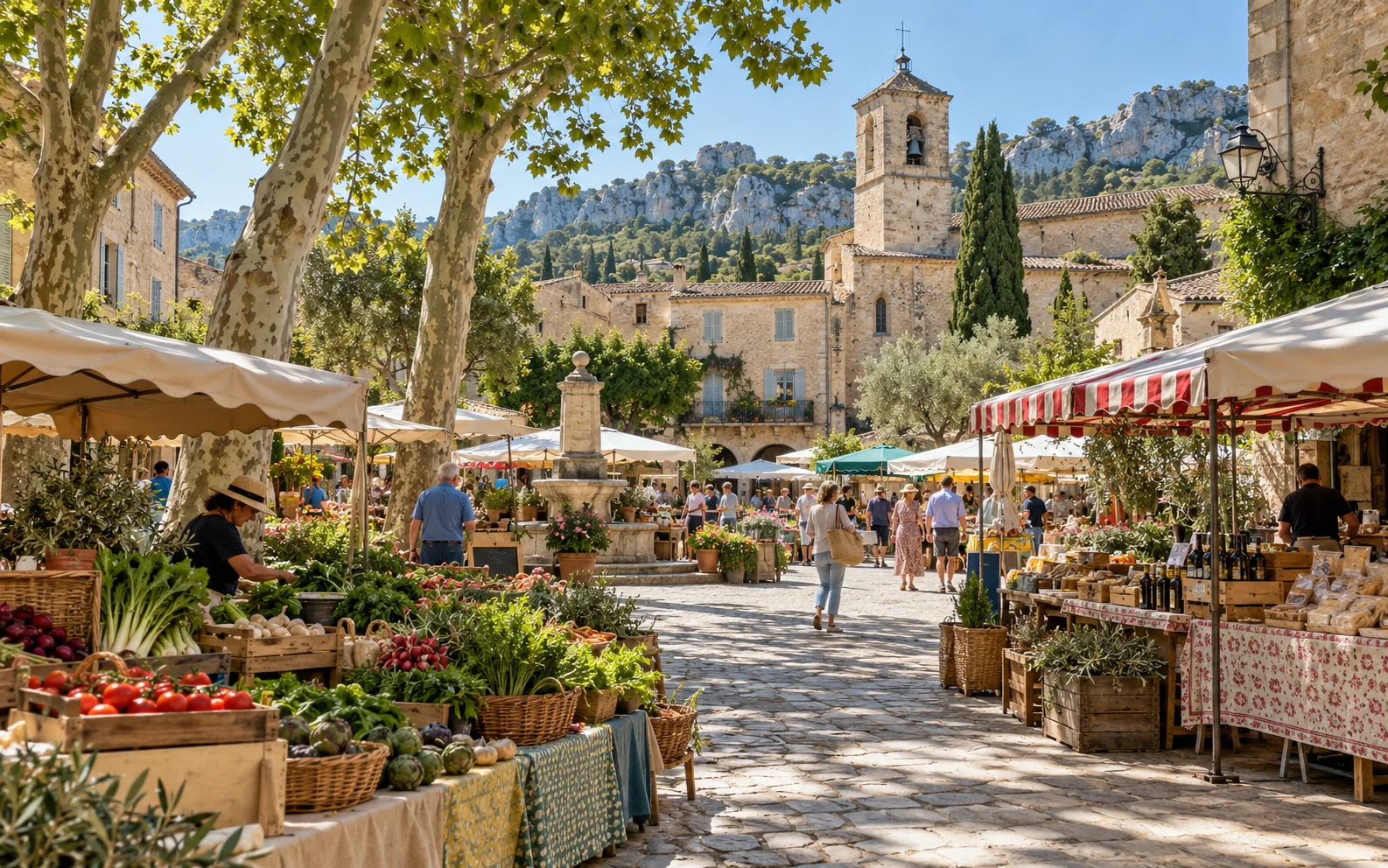
Markets are working places. Arrive before the closing rush, keep aisles clear, greet traders with "Bonjour" and ask before photographing a person or stall. Bring a reusable bag and small payment options.
For a first trip, choose a base: Avignon for high-speed rail and the papal palace, remembering that the TGV station and central station are separate; Arles for Roman sites and the Camargue. Group villages by geography. In the Luberon, two villages plus lunch and a short walk can fill a day. Parking outside historic centres is often intentional because lanes are narrow and residential. With a rental car, designate a sober driver, photograph existing damage and understand tolls and fuel rules. For Roman history, link places that transport supports, such as Arles and Nîmes on separate days.
Lavender is an agricultural crop, not a public studio. Bloom dates vary and harvesting begins when farms need it to begin. Stop only in legal parking, remain on public paths and never pick stems or enter fields. Valensole and higher plateaux can require long driving from western Provence, so stay near your chosen area if lavender is central.
Heat, wind and fire: practical notes
July and August can be extremely hot. Begin exposed walks early, carry water and sun protection, and never leave anyone in a parked vehicle. The mistral can make cycling, boating and picnics uncomfortable or dangerous. The regional tourism authority advises checking fire-related access restrictions before entering forests, especially in summer; follow local barriers immediately. Spring and autumn often suit walking, but heavy rain can cause flash flooding, so do not enter a flooded road or dry-looking river channel during warnings.
Service is included in French restaurant prices, and a small extra tip is optional. Budget for regional transport or a car, parking, one paid heritage site and one considered meal; picnics reduce costs if you use designated areas and take everything away. Historic villages can be steep, cobbled and partly vehicle-free, so ask tourist offices about accessible parking, toilets and step-free viewpoints. Forty-eight hours before arrival, confirm the first transfer, market day, restaurant opening, weather and fire access, and keep an indoor alternative for the hottest hours.
Explore more through the France destination hub, read what makes France special, pair the region with the Marseille guide, or continue east along the coast with the Nice first-time visitor guide.
Questions and answers
How many days do you need in Provence?
Five to seven days allow one main base, two village or landscape days and time in a larger town without changing hotels constantly. A long weekend should focus on one compact area.
Can you visit Provence without a car?
Yes if you base in Avignon, Aix-en-Provence, Arles or Marseille and use trains, regional buses and selected tours. A car is more useful for dispersed villages, but should not be treated as essential for every day.
When does lavender bloom in Provence?
Timing varies by altitude, weather and harvest, broadly from mid-June into July in many areas. Confirm local conditions shortly before travel and never enter working fields without permission.
Sources
Paris · 48.8566° N, 2.3522° E
This story belongs to Provence, France. A country that sends people to the baker twice a day, protects a cheese by law and refuses to be averaged into one postcard.