Normandy First-Time Visitor Guide: Coast, History and Bases
Normandy gave England a conqueror, France a duchy and the world the landing beaches of 1944. Its sites, cheese and abbey, with a plan for seeing them.
Cover: AI-generated illustration. © ANUSHKA DAHANAYAKE (PVT) LTD.
Normandy is the part of France that changed English history in 1066 and French history in 1944. The same coast holds a medieval duchy's capital, a tapestry that tells the story of the Norman Conquest, an island abbey and the beaches of the largest amphibious invasion ever launched. Locals are proud of that sequence and of a food culture that gave the world Camembert. The region is wide, so each of these stories is best seen as its own chapter.
Rouen: capital of a duchy
From 912 Rouen was the capital of the Duchy of Normandy. Rouen surrendered to Henry V of England on 19 January 1419 after a long siege, and on 30 May 1431 Joan of Arc was burned at the stake in the city. Philip II Augustus entered Rouen on 24 June 1204 and annexed Normandy to the French kingdom. The city received a founding charter allowing self-government in 1150, and its medieval centre includes the Gros-Horloge, which dates back to the fourteenth century.
Claude Monet painted a series of views of Rouen Cathedral's façade in the 1890s, including Rouen Cathedral, Full Sunlight in 1894. The city was severely damaged by bombing in 1944 during Operation Overlord, and its rebuilt streets show both the medieval plan and the postwar repairs. Rouen also has a place in sporting history: the 1894 Paris-Rouen run is regarded as the first competitive motor race.
Bayeux and the tapestry of 1066
The Bayeux Tapestry is nearly 70 metres long and narrates events from 1064 to the Battle of Hastings on 14 October 1066. Most scholars attribute its commission to Bishop Odo of Bayeux, and it was probably made in England in the decades after the conquest, possibly completed by 1077 for the dedication of Bayeux Cathedral. It now has 58 scenes, and its final scenes are missing. The earliest written reference is a 1476 inventory of Bayeux Cathedral. In 1792 revolutionary authorities confiscated it to cover military wagons, and a local lawyer rescued it. The Gestapo took it to the Louvre in 1944, and it returned to Bayeux in March 1945. UNESCO added it to the Memory of the World Register in 2007.
Check before travelling: according to Wikipedia, the tapestry was removed from its Bayeux museum in September 2025 for a loan to the British Museum, where an exhibition opened on 10 September 2026, with a return to France expected by July 2027. Confirm with the Bayeux museum what is on display during your dates.
Mont-Saint-Michel
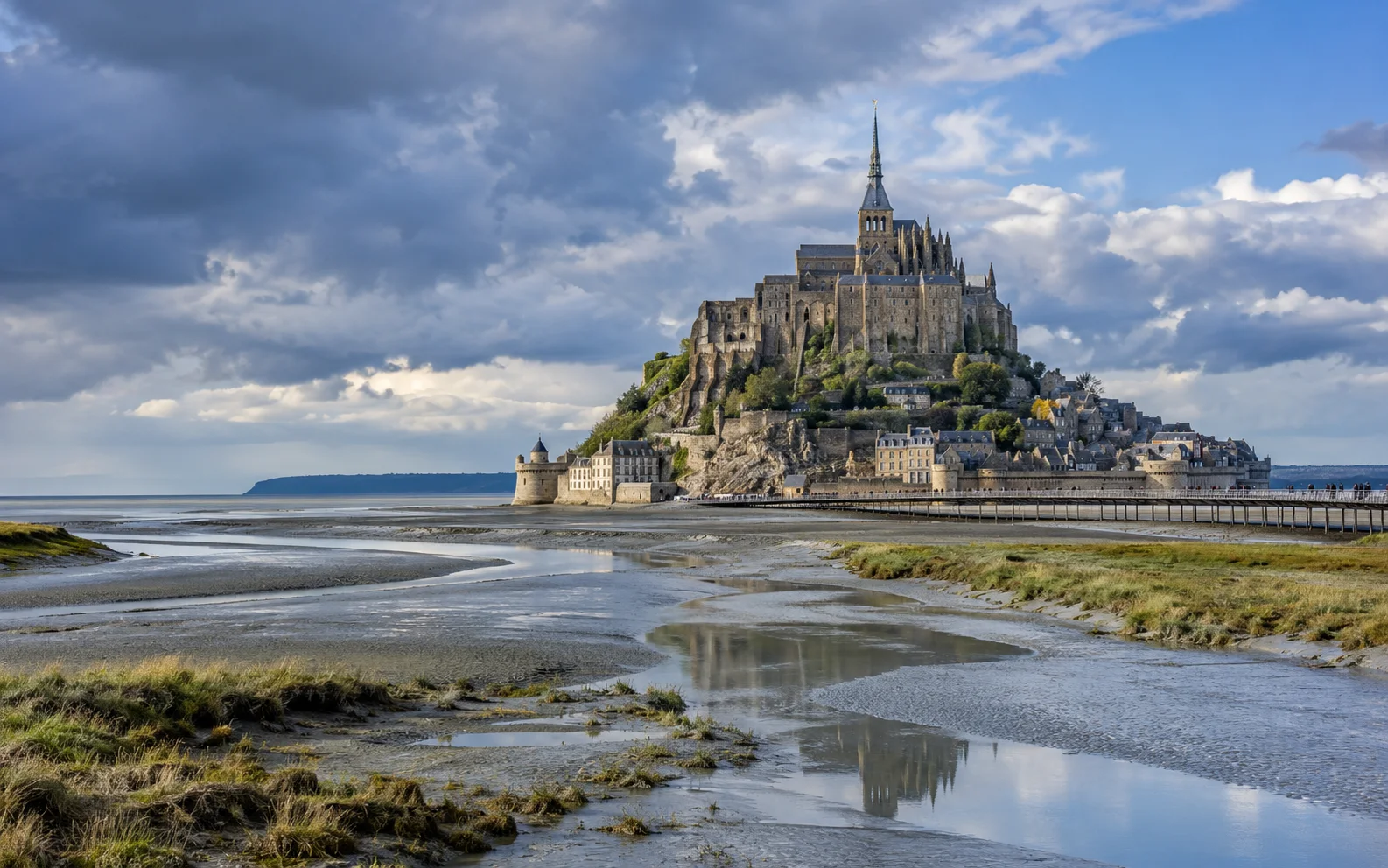
Legend says the archangel Michael appeared to Aubert of Avranches in 708 and told him to build a church on the islet, and a first monastic establishment followed in the eighth century. The abbey withstood sieges in 1423 and 1433 during the Hundred Years' War and was never taken. After the French Revolution it became a prison from 1793 until 1863. The tidal causeway was converted into a raised causeway in 1879, Benedictine monks returned in 1966, and UNESCO inscribed the Mont and its bay in 1979. The Monastic Fraternities of Jerusalem began living on the Mont in 2001. A new mainland car park opened in April 2012, 2.5 kilometres from the island, and a new bridge opened in July 2014. The population of the Mont was 23 in 2023.
Arrive early or stay later than the largest day-trip groups, and confirm shuttle operation and abbey admission. Steep lanes and many steps slow movement. Tidal range is about 14 metres between high and low water: do not walk onto mudflats alone. The destination office directs bay crossings to certified guides. Book one for any crossing and obey weather cancellations.
D-Day: remembering with context
The Allied invasion began shortly after midnight on 6 June 1944 as Operation Neptune, the first phase of Operation Overlord. Utah and Omaha were American beaches, Gold and Sword British, and Juno Canadian. About 156,115 Allied soldiers landed, supported by roughly 5,000 ships. Omaha Beach suffered the highest casualties because of its high cliffs, and at least 10,000 Allied casualties were recorded that day, with 4,414 confirmed killed.
Choose one sector or a guided tour with a clear historical focus rather than rushing a circuit; Pointe du Hoc, Omaha Beach, the American Cemetery, Gold Beach and Pegasus Bridge cannot all be understood in a day. Normandy American Cemetery has a separate visitor approach from Omaha Beach; the direct pathway to the beach has been closed since 2016. Cemeteries are places of remembrance. Keep voices low, supervise children, avoid celebratory poses and do not remove sand, stones or artefacts from fields.
Camembert and the orchard table
Camembert was first made in the village of Camembert in the late eighteenth century. Legend credits Marie Harel with first making it in 1791 after advice from the Abbot Charles-Jean Bonvoust; historians note that its modern origins lie more in nineteenth-century industrialisation. The engineer M. Ridel devised the wooden box used to ship it in 1890, the cheese was issued to French troops in the First World War and Camembert de Normandie received AOC status in 1983 and protected designation of origin in 1992. Cider and Calvados come from the region's orchards, which are part of a working economy; reserve producer visits and do not enter fields uninvited.
Practical notes: bases, trains and weather
Rouen suits medieval architecture and the Seine valley; Caen provides transport and museums; Bayeux is smaller and convenient for organised landing-beach tours; Honfleur has a harbour but no railway station. Two well-chosen bases are better than four one-night stops, and a room "in Normandy" may be hours from tomorrow's goal. Trains link Paris with Rouen, Caen and Bayeux, though the final leg may be a bus or taxi, and Sunday rural services can be sparse. Without a car, compare tours from Bayeux or Caen by group size, walking demands and included admissions. Drivers should expect narrow roads and tractors, and cider tastings require a sober driver.
Rain, wind and sun can occur in one day. Carry a waterproof layer, build one indoor alternative into each coastal day, and at cliff sites such as Étretat stay behind barriers. A focused paid tour can offer better value than several disconnected admissions. Ask sites for the accessible entrance, surface and toilet details, because bunkers, beaches and the Mont present different barriers. Adults should review museum themes before bringing young children; some collections include graphic testimony.
Forty-eight hours ahead, reconfirm the first train, tour meeting point, abbey ticket, tides and weather. Continue with the France destination hub, read what makes France special, return to the capital with the Paris first-time visitor guide, or use the Bordeaux guide for a contrasting western-France city trip.
Questions and answers
How many days do you need in Normandy?
Four to six days allow one eastern and one western base. A weekend should focus on a single area such as Rouen and the Seine, Bayeux and the landing beaches, or Mont-Saint-Michel.
Can you visit Normandy without a car?
Major towns are reachable by train, but beaches, memorials and rural villages have limited connections. Guided tours from Bayeux or Caen make a history-focused car-free visit practical.
Can you walk on the tidal flats at Mont-Saint-Michel alone?
No. Tides, channels and quicksand create serious hazards. Cross the bay only with an authorised guide and follow current local instructions.
Sources
Paris · 48.8566° N, 2.3522° E
This story belongs to Normandy, France. A country that sends people to the baker twice a day, protects a cheese by law and refuses to be averaged into one postcard.