Heidelberg for First-Time Visitors: Castle, Old Town and River
A 1386 university, a Renaissance castle blown up in 1689 and 1693 and an old town the war missed: why Heidelberg inspired Germany's Romantics.
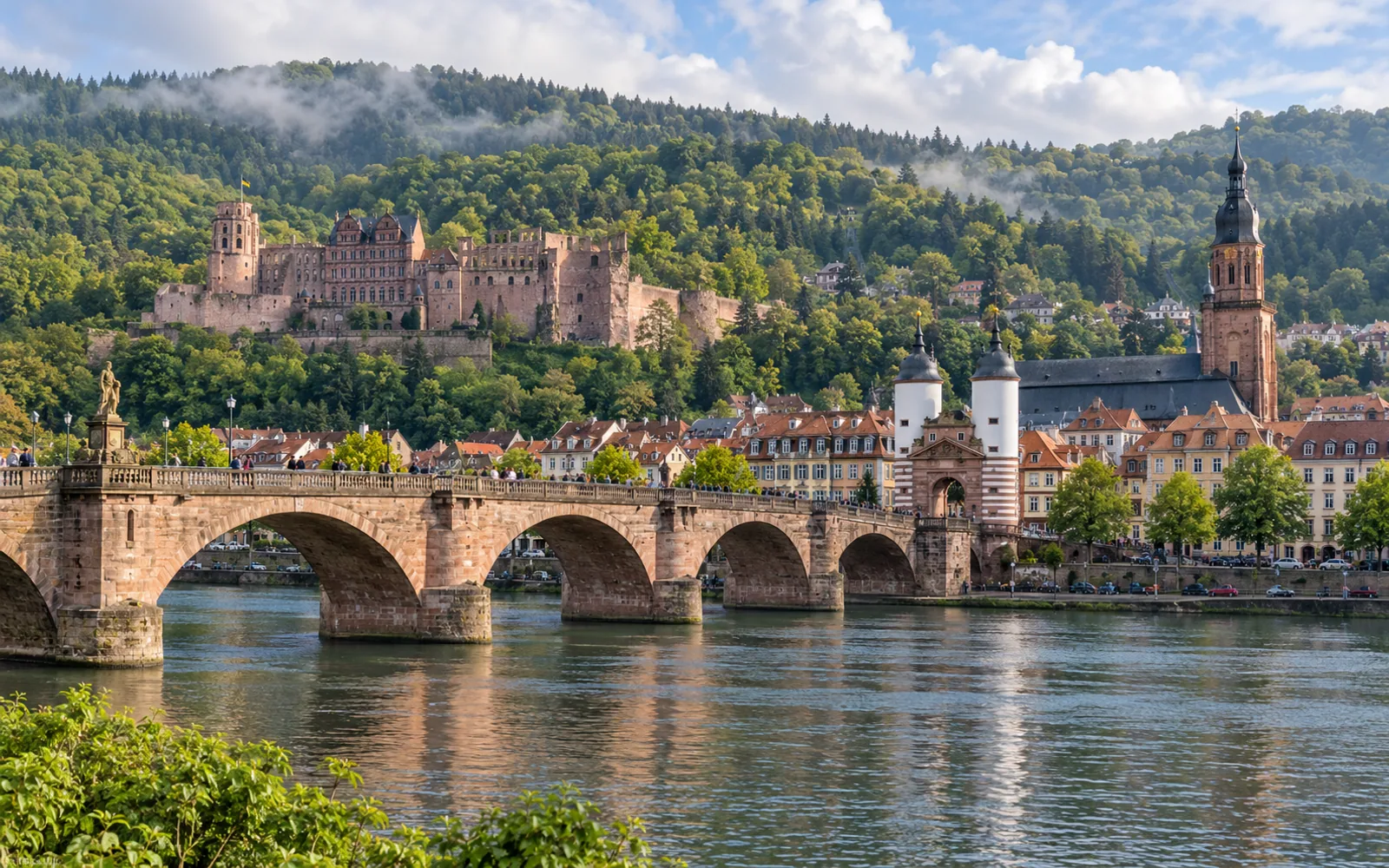
Cover: AI-generated illustration. © ANUSHKA DAHANAYAKE (PVT) LTD.
Heidelberg is the German town that Romantic painters and writers made into an idea. The ruined castle above the Neckar, the oldest university in the country and an old town that survived the Second World War unbombed give it a continuity few German cities can match. The academic and literary history is the key to almost everything a first-time visitor sees.
Germany's oldest university
Heidelberg University was founded in 1386 by Elector Ruprecht I with papal permission and is the oldest in Germany. The city is also home to the European Molecular Biology Laboratory and four Max Planck Institutes, and UNESCO has named Heidelberg a City of Literature. The population is roughly 156,000 to 163,000, and about a quarter are students, so students shape daily life in the old town. The Student Prison, a compact attraction with controlled hours, records a part of that student culture, and the university museum explains how the institution shaped the town.
A castle that became a ruin
The castle is a partly rebuilt ruin on the Königstuhl hillside above the town, and Heidelberg was a seat of the Electorate of the Palatinate. A castle was first mentioned in 1214. By 1303, an upper and lower castle are recorded, and the upper one was destroyed by lightning in 1537. Under the Electors Palatine the castle grew into a palace, one of the most important Renaissance structures north of the Alps. Frederick V, the "Winter King", married Elizabeth Stuart, and his court commissioned the Hortus Palatinus gardens. The Catholic League captured Heidelberg in 1622 during the Thirty Years' War.
The destruction came later. French troops set fires and blew up parts of the castle in 1689 and again in 1693, during the Nine Years' War. The court moved to Mannheim in 1720, and locals took stone from the ruins. A lightning strike in 1764 caused another major fire, which is why the castle survives as a ruin rather than a restored palace. The enormous wine barrel, the Great Tun, was built in 1751, and the German Apothecary Museum is housed in the complex.
Charles de Graimberg led efforts to preserve the ruins in the early 1800s. Restoration of the Friedrichsbau took place from 1897 to 1900. Romantic painters and writers such as Turner, Victor Hugo and Mark Twain popularised the ruins, and the Philosophers' Walk on the opposite hillside offers a view across the river to them.
The old town the war missed
Baden annexed Heidelberg in 1803. The city was not bombed during the Second World War: in March 1945, U.S. Army artillery commander William Beiderlinden helped persuade German troops to withdraw, which spared the city from shelling. Germans did destroy three arches of the Old Bridge before leaving. The university reopened in 1945, and the city's population passed 100,000 in 1946. U.S. Army General George S. Patton died in a Heidelberg hospital in December 1945. The city's wartime record was not only one of survival: the Nazi party was strong in Heidelberg, and in 1940 local Jews were deported to Camp Gurs in France, a chapter that belongs in any honest account of the town. This unusual survival of the buildings is why the Baroque old town feels more unbroken than in most German cities.
Two days that follow the story
Day one. Begin at Kornmarkt and reach the castle by funicular or the steep walking route. The official Palace Ticket includes the funicular, courtyard, Great Tun and German Apothecary Museum; castle interiors require a guided tour with an additional charge, so check the official ticket description and tour times. Descend to the Marktplatz and Heiliggeistkirche, then continue along the lanes parallel to Hauptstrasse, where university buildings and smaller squares interrupt the retail corridor.
Day two. Walk the Philosophenweg only if footwear, heat and mobility make sense; the classic access via the Schlangenweg is steep, stepped and can be slippery. Back in town, choose the Kurpfälzisches Museum, the university museum or a river activity according to the weather, and use the evening for a meal away from the busiest Marktplatz frontage. With a third day, consider Schwetzingen Palace gardens or the monastery ruins on the Heiligenberg.
Practical notes for a hillside town
The Altstadt places you near the sights but can be noisy around Hauptstrasse. Bergheim offers easier access to the main station, and Neuenheim is calmer across the river. Heidelberg Hauptbahnhof is west of the old town, not beside it, so count the transfer when planning a day trip from Frankfurt or Stuttgart. The regional VRN network covers local transport, but ticket validity and zones depend on the journey; do not board an ICE with a local ticket. A car adds little in a town designed for walking, and limited central parking makes it a burden.
Spring and autumn offer good walking temperatures. Summer can be hot on exposed climbs and thunderstorms develop quickly, so start the castle early and move museums into midday. Winter is quieter, but ice makes steep stone routes hazardous. The old town is largely car-free but contains cobbles, thresholds and crowded lanes; the flat riverbank and main shopping axis are easier than the castle or the Philosophenweg. VRN provides accessible journey information, though lift outages can change a route.
Accommodation is usually the largest cost, many of the best experiences, such as the bridge, riverbanks and squares, are free, and restaurant prices rise on the most visible corners, so walk a street or two away. The main risks are traffic interactions, slippery paths, heat and routine theft in crowds; call 112 for medical or fire emergencies and 110 for police. Churches remain places of worship, so keep voices down and avoid touring during services, and ask before close photography of students, traders or diners.
Two days before arrival, check the castle, funicular, museum and VRN sites. Heidelberg is best when there is room to pause: read what makes Germany special, compare it with other destinations on our Germany hub, see the Frankfurt guide for the nearest major airport city, then use the Munich guide or Berlin guide to continue planning.
Questions and answers
Is Heidelberg a day trip or an overnight stay?
A day trip covers the castle and old town, but one or two nights allow the river, museums and hillside walks before and after excursion crowds.
Can you visit Heidelberg without a car?
Yes. Trains, trams and buses serve the city, and the old town is best explored on foot. A car is unnecessary for the central sights.
How do you reach Heidelberg Castle?
Walk uphill or use the funicular from Kornmarkt. Check official operating notices, ticket inclusions and accessibility before relying on it.
Sources
Berlin · 52.5200° N, 13.4050° E
This story belongs to Heidelberg, Germany. A country whose contributions to the world each belong to a particular town, and whose regions still keep their own dialects, bakeries and festivals.