Nuremberg for First-Time Visitors: History, Old Town and Food
The imperial city of Dürer and Henlein, rebuilt after 1945, and the documentation of the Nazi years that it chose to keep in view.
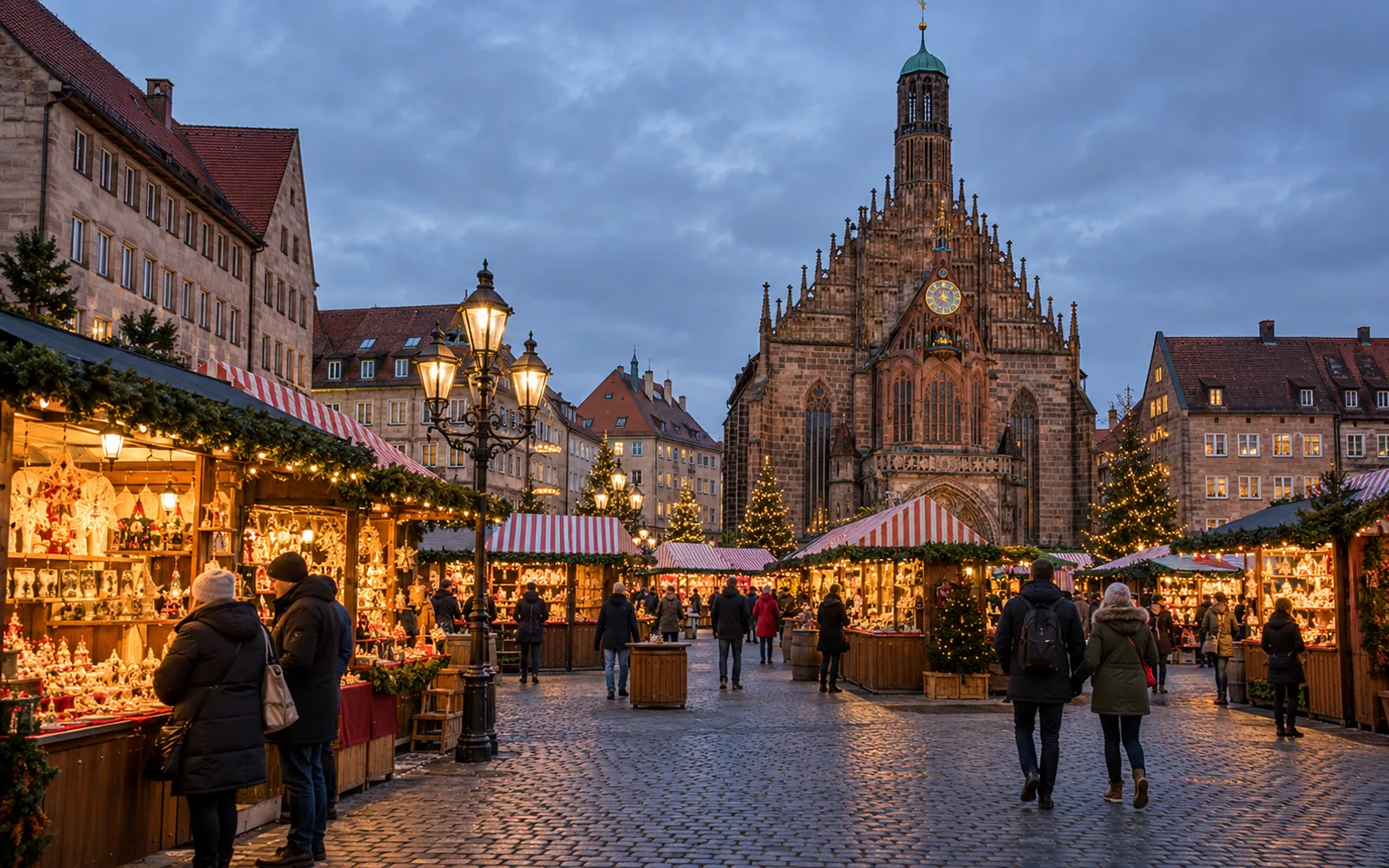
Cover: AI-generated illustration. © ANUSHKA DAHANAYAKE (PVT) LTD.
Nuremberg first appears in a document of 1050, as the site of an imperial castle, and for the next five centuries it behaved like a capital without being one. Imperial Diets met here between 1211 and 1543. The Golden Bull of 1356 required every newly elected German king to hold his first Diet in the city. The imperial regalia were kept in Nuremberg from the early fifteenth century until 1796. That history of power, trade and craft explains why the city is both a celebrated medieval showcase and the place where Germany decided to document its worst years in plain view.
The city of makers and firsts
Skill, not only politics, built Nuremberg's reputation. Albrecht Dürer bought the half-timbered house below the castle in 1509, built around 1420, and worked there until his death in 1528. In 1515 he produced woodcuts of the first printed star charts. Anton Koberger opened a print shop in 1470 and published the Nuremberg Chronicle in 1493, one of the most lavishly illustrated books of the century. The locksmith Peter Henlein is credited with the small portable clocks known as "Nuremberg eggs" in the sixteenth century, and the poet-cobbler Hans Sachs, a master singer of the same age, later inspired Wagner's opera on the guild singers.
The city kept inventing into the industrial age. Germany's first railway, the Ludwigsbahn, ran between Nuremberg and neighbouring Fürth in 1835, and the DB Museum now tells that story near the old walls. Toy-making, still honoured by the Toy Museum and the international toy fair billed as the largest of its kind in the world, grew from the same workshop culture. Dürer's printmaking, Koberger's presses, Henlein's clockwork and the toy workshops all share one thread: a city of guilds where precision was a point of civic pride, and where visitors can still meet makers who explain their materials and origin.
Rebuilt in 1949, and why it matters
On 2 January 1945 Allied bombing destroyed roughly 80 per cent of the medieval centre in about an hour. Dürer's house was already damaged in October 1944 and was rebuilt by 1949. Much of what visitors now call the old town is therefore reconstruction, and the churches, houses and castle buildings around the Hauptmarkt were rebuilt or restored in the decades after the war. The result keeps the medieval street pattern and the red-roofed skyline that Dürer's contemporaries would recognise. Locals take real pride in this: the restored centre is an act of memory as much as of architecture, and a walk along the surviving city walls shows how much of the outline was saved.
Food Nuremberg is proud of
Nürnberger Rostbratwürste are small, thin sausages grilled over an open flame and usually served in multiples, with sauerkraut or potato salad. The classic order, Drei im Weggla, is three in a crisp roll with mustard. Lebkuchen, the soft spiced gingerbread associated with the city, is a honey-and-spice bake that fits a city built on trade, and specialist bakeries sell many versions, so ask makers to explain ingredients and seasonal availability. The Christkindlesmarkt, according to the official market history, dates to the mid-sixteenth century and still fills the Hauptmarkt each Advent, beneath the Frauenkirche. Franconian wine and local beer sit beside the menus; alcohol is always optional.
The Nazi years, documented
The same city that Hitler's regime chose for its party rallies also became the setting for the trials of 1945 to 1946, where the main Nazi leaders were tried at the Palace of Justice. The Documentation Center at the former Rally Grounds explains how propaganda, architecture and mass spectacle worked, and the Memorium Nuremberg Trials covers the courtroom and what followed. For Nuremberg today these are acts of responsibility, not attractions, and the city also awards an international human rights prize established in 1995.
A two-day route that follows the story
Day one, imperial and craft Nuremberg. Enter through Königstor, then walk north via St Lorenz, the Hauptmarkt and the Frauenkirche toward the Imperial Castle. The route climbs, so travellers needing an easier approach should check bus options and the castle's accessible entrance first. The castle has courtyards, museum rooms, a tower and a deep well with separate conditions, so choose what interests you. Descend past the Albrecht Dürer House and finish with the Germanisches Nationalmuseum or the DB Museum, not both.
Day two, the twentieth century. Take a tram to the former Rally Grounds and the Documentation Center. Its official project page says the redesigned permanent exhibition opened for a first look in May 2026, so check current entry and construction access rather than relying on an older floor plan. The grounds are a large, exposed outdoor area, so wear sturdy shoes and treat the site with restraint: do not climb on structures or pose theatrically. The Memorium sits at the Palace of Justice on the other side of the city, so give it a separate half-day or swap it in.
Practical notes for Nuremberg
Hauptbahnhof lies just outside the old walls, and the airport connects by U-Bahn. VGN runs local transport with zone-based tickets, and a local pass does not cover long-distance trains. The NÜRNBERG CARD bundles participating museums with local transport in zone A, including Fürth and Stein, so compare its price with what you will actually use.
Cobbles and slopes are the main access challenge; U-Bahn stations are often step-free but lifts break, so confirm with VGN. Each museum lists its own access details. At the Christmas market, set a meeting point, avoid large luggage and watch belongings near the station and in crowds. Emergency numbers are 112 for ambulance or fire and 110 for police. Serious allergies need a written German explanation, and reusable market mug deposits are refunded when you return the cup.
Where to go next
Continue through the Germany destination hub, read what makes Germany special, compare another city rebuilt from ruins in our Dresden article, or pair Nuremberg with the Munich guide on a longer trip through Bavaria. Buy food and souvenirs in commercial areas, not while moving through documentation exhibits, and favour makers who explain materials and origin. The city rewards a slow second visit, so leave the neighbouring cities for a later trip instead of compressing everything into one.
Questions and answers
How many days do you need in Nuremberg?
Two full days allow the castle and old town plus one substantial museum or documentation site. Add a third for more museums or a nearby Franconian town.
Is Nuremberg walkable?
The old town is compact but slopes toward the castle and has cobbles. Trams and U-Bahn help with the station, Documentation Center and longer distances.
When is the Nuremberg Christmas market?
The Christkindlesmarkt normally operates during Advent, but dates and hours change annually. Use the official tourism and market information before booking.
Sources
Berlin · 52.5200° N, 13.4050° E
This story belongs to Nuremberg, Germany. A country whose contributions to the world each belong to a particular town, and whose regions still keep their own dialects, bakeries and festivals.