Melbourne for First-Time Visitors: Exhibition Hall, Espresso and the MCG
Melbourne through its World Heritage exhibition hall, espresso bars, laneways and sporting ground, with a three-day plan around the Free Tram Zone.
Melbourne stands on the land of the Kulin Nation, and its nineteenth-century grid of arcades and lanes grew from a gold-rush boom that left the city a Victorian exhibition hall, a vast cricket ground and a habit of taking coffee, sport and argument seriously. The pride Melburnians take in the place rests on specifics: a building the world agreed to protect, an espresso culture that arrived with Italian migrants in the 1950s, and a stadium that has hosted both an Olympic Games and the first Test match.
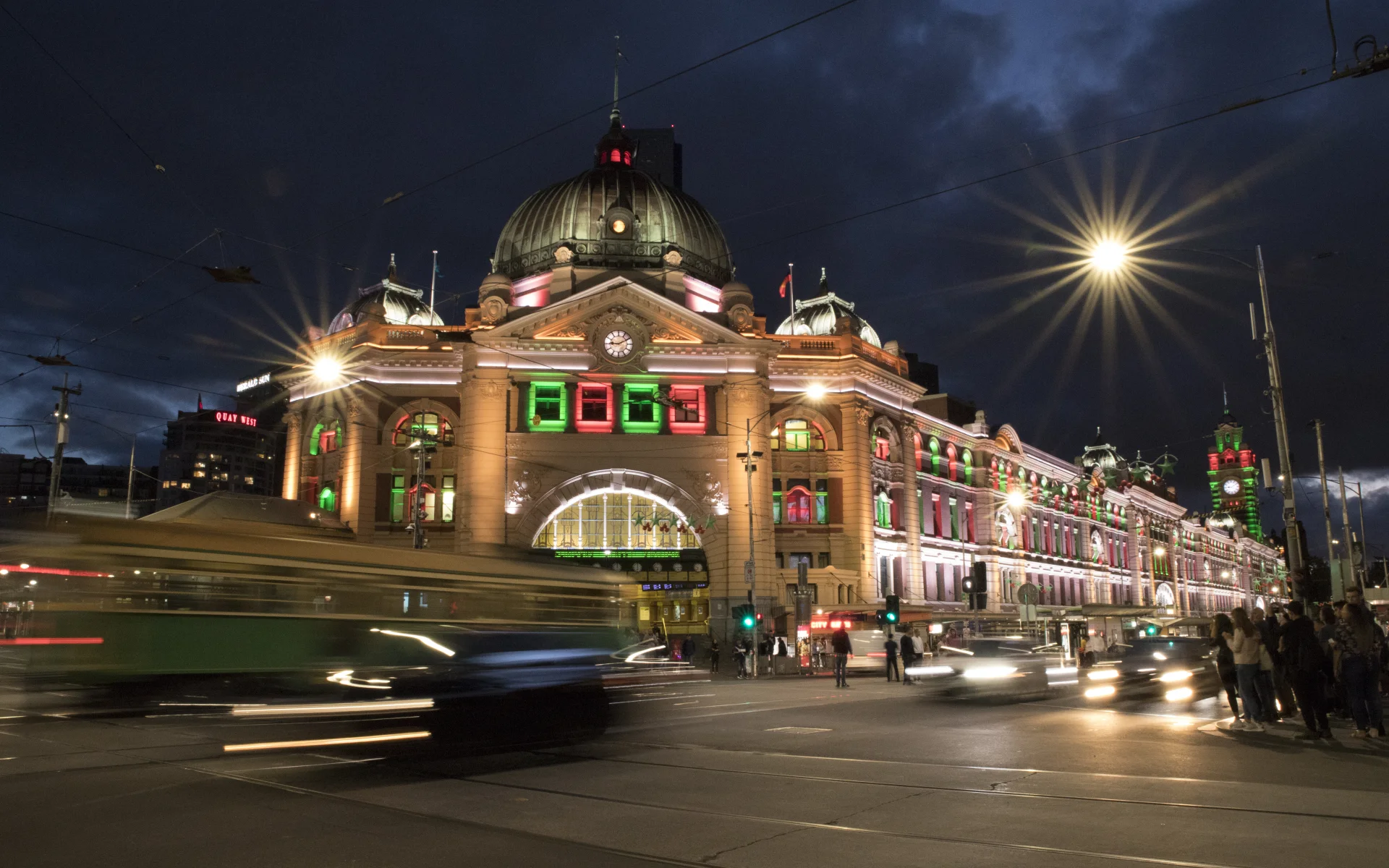
Cover photograph: Flinders Street Station at night by Cazz/Wikimedia Commons, dedicated to the public domain under CC0 1.0; cropped for this page. The 2018 photograph does not show current services or traffic conditions.
The Royal Exhibition Building
Joseph Reed designed the Royal Exhibition Building in 1878 for the Melbourne International Exhibition of 1880-81, and the hall hosted a second great exhibition in 1888. Together with Carlton Gardens it was inscribed on the World Heritage List on 1 July 2004, making it the first built heritage place in Australia to be listed. UNESCO's decision rested partly on its continuing use; the hall still hosts events, and Melbourne Museum stands alongside in the gardens. Tours of the dome are the best way to understand the ambition of a young colonial city that wanted to show itself to the world. The Museums Victoria site explains the building's role in the exhibitions and in its later life as a venue.
The MCG and the sporting calendar
The Melbourne Cricket Ground has an official capacity of 100,024, and it was the main stadium of the 1956 Olympic Games. Its grandstand was built in time for the first Test match in March 1877, and it still hosts the Boxing Day Test and the AFL Grand Final. The Melbourne Cup has been run at Flemington since 1861, and the Australian Open fills Melbourne Park each January. The ground's record attendance, 1.153 million across the fifteen days of the 1956 Games, is a figure Melburnians quote. Few cities have a calendar so firmly tied to their identity; the MCG offers tours on days without matches, and the sports museum inside its stands tells the story of the ground.
Espresso, laneways and migration
Italian migrants brought espresso machines to Melbourne in the early 1950s, and Pellegrini's on Bourke Street is often credited as one of the first true espresso bars; historians also point to the Bancroft family's café, which opened with a commercial machine in May 1954. Carlton became the centre of the Italian community, and Greek and Vietnamese cooks later gave Lonsdale Street, Richmond and Footscray their own food. That history is why the standard of an ordinary Melbourne coffee is so high, and why Hosier Lane's street art, Degraves Street's cafés and the nineteenth-century Block and Royal Arcades are worth exploring slowly. The Koorie Heritage Trust is a reminder that Melbourne's story does not begin with its Victorian lanes.
Federation Square and the river
Federation Square and Flinders Street Station form the city's meeting point on the Yarra, and the National Gallery of Victoria sits a short walk away. The Block and Royal Arcades, off Collins Street and Bourke Street, preserve the look of the nineteenth-century city, and their mosaic floors and glass roofs make a quiet counterpoint to the street art of the laneways.
Beyond the grid
Melbourne's reach extends well past the tram network. The Great Ocean Road, with the Twelve Apostles rock stacks, starts roughly an hour and a half from the city, and the Yarra Valley's wineries are closer still. St Kilda has its pier and bay, Fitzroy and Collingwood its music venues and vintage shops, and Queen Victoria Market is the city's larder. These make a day trip or an evening worth planning, but none needs to be squeezed into the same day as the heritage sights.
Three days in the grid and beyond
If you have one day, keep the grid, river and one collection together. A second day is best spent in Carlton/Fitzroy or at the MCG and gardens, depending on interests. Use day three for St Kilda or another inner neighbourhood; do not treat a Great Ocean Road trip as part of a city day.
Day one: grid and river. Start at Federation Square and Flinders Street Station to read the relation between the grid and the Yarra, then walk selected arcades and lanes. They contain deliveries, offices and residents, so keep doorways clear and avoid long photo sessions. Continue to the State Library or Queen Victoria Market, which trades on specific days; ask before photographing stallholders. Leave St Kilda for another day, since it is outside the free zone.
Day two: one collection and one neighbourhood. The National Gallery of Victoria suits an arts day south of the river, with the Arts Centre and gardens close by. For the heritage story, choose the Royal Exhibition Building and Melbourne Museum in Carlton and continue to Carlton and Fitzroy for food. Keep two lunch alternatives, because Melbourne's dining strength is spread across many districts. Confirm ingredients directly if you have a serious allergy.
Day three: gardens and bay, or a local day. Begin at the Royal Botanic Gardens when the weather is good, then ride a tram to St Kilda. Check swimming conditions and lifeguard warnings, and keep away from wildlife. In poor weather, replace the foreshore with Footscray for food or Richmond for streets beyond the stadiums. The Great Ocean Road and Phillip Island each need a separate day. Compare a tour's actual stops, group size and return time before booking. Other Australian cities reward a similar approach, as the Sydney guide and Adelaide guide show.
Free trams, weather and getting around
Public Transport Victoria states that tram journeys wholly inside the signed Free Tram Zone do not require myki. The zone covers trams only, not trains or buses. If you travel only within it, do not touch on, because doing so may charge a fare; a journey that starts or ends outside the zone needs a valid myki. St Kilda and Fitzroy are outside it. Trams share the road and approach quietly, so cross only at safe points and take care on wet tracks.
Weather can shift quickly. Check the hourly forecast, carry a light waterproof layer and sun protection, and plan the most exposed activity for the best window. Heat can build on platforms, at stadiums and along the bay, and fire-danger advice matters on regional trips. In an emergency call 000. Many central venues are accessible, but a tram stop, old platform or building entrance can be the weak link, so use PTV accessibility information and ask the venue about lifts and seating. Allow rests: arcades, museum floors and station interchanges add distance that the compact grid hides.
Melbourne Airport is not on the suburban rail network. Compare the airport's current transport options against your arrival time and accommodation; late arrivals and large groups can change the sensible choice. For step-free planning, use PTV's accessibility guidance and confirm the exact stop, not only the route.
For more, see the Australia overview, what makes Australia special and the Melbourne section of the country page.
Questions and answers
How many days are useful for a first Melbourne visit?
Three days allow a central-city orientation, one museum and inner-north day, and a gardens or bayside day. Add at least one separate day for a regional excursion.
When is Melbourne tram travel free?
Tram journeys wholly inside the signed Free Tram Zone do not require myki. A journey starting or ending outside that zone requires valid payment under current PTV rules.
What should visitors book in Melbourne?
Reserve major exhibitions, theatre, concerts and sporting events that matter to you. Book regional tours separately rather than attaching one to a full city day.
Sources
Melbourne · 37.8136° S, 144.9631° E
This story belongs to Melbourne, Australia. A continent of the world's oldest continuing cultures, a World Heritage reef and cities that each began for different reasons.