Vienna First-Time Visitor Guide: Ringstrasse, Music, Coffee
A boulevard built where city walls stood, Klimt's The Kiss, the State Opera and coffee houses honoured by UNESCO: Vienna's story and how to visit it well.
Vienna can overwhelm through abundance: imperial apartments, art collections, churches, concert halls and cafés all compete for limited attention. Behind that abundance lies a clear story of an empire that rebuilt its capital, nurtured a musical tradition and invented a way of sitting in a café.
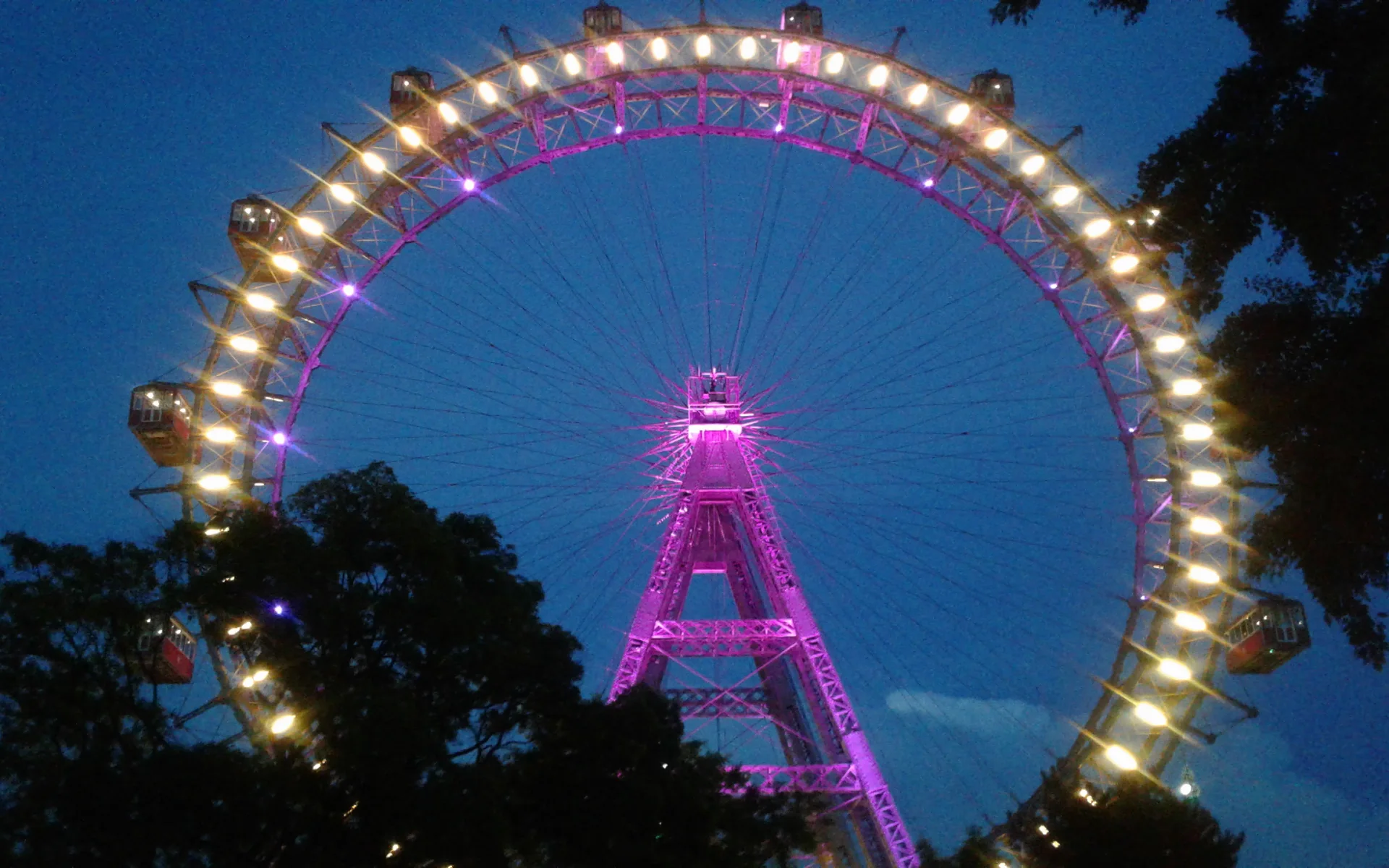
Cover photograph: Ulke0004, “Das Wiener Riesenrad bei Nacht,” 2 October 2018, own work under CC BY-SA 4.0. Centre-cropped to a 16:10 frame and converted to responsive WebP sizes; no landmarks were added or removed.
A boulevard where the walls stood
Emperor Franz Joseph signed the decree ordering Vienna's city walls demolished on 20 December 1857, and from 1858 the city became a vast construction site. In their place grew the Ringstrasse, lined with the State Opera, Parliament, City Hall, the university and the museums of art and natural history; the Habsburg history portal describes the era. Inside the ring, the Hofburg held the imperial court, and St Stephen's Cathedral marks the centre. Trams 1, 2 and D pass important sections but are ordinary public transport, so check the direction and get off where the next stop in your plan begins.
Opera, music and the coffee house
The Vienna State Opera opened on 25 May 1869 with Mozart's Don Giovanni in the presence of Franz Joseph and Empress Elisabeth, according to the opera house's history; neither architect, August Sicard von Sicardsburg or Eduard van der Nüll, lived to see it finished. The house was damaged in the Second World War and reopened on 5 November 1955. If a concert or opera matters, book from the official venue and check programme, performers, duration and seat visibility; tourist medleys and serious opera are different products.
Viennese coffee house culture was added to Austria's national inventory of intangible cultural heritage in 2011, and the Austrian UNESCO commission's entry treats the practice, not the buildings, as the heritage. You do not need to queue for the most photographed address: order clearly and allow time, since service may be deliberate rather than rushed. Travellers with serious allergies should carry a clear German explanation.
Klimt and the Belvedere
Klimt's The Kiss hangs in the Upper Belvedere. The Austrian state bought it in 1908 for the Moderne Galerie, then housed in the Lower Belvedere, though sources date the painting itself to 1907 to 1909. The Belvedere's official FAQ requires an entry time for both locations and explains that a time slot controls admission, not the length of the visit. Choose the collection that matters and verify the entrance printed on the ticket.
Palaces and the choice of interiors
Schönbrunn is the Habsburg summer palace. Its official FAQ warns about fake ticket sites and identifies its authorised channel; the palace tour, gardens, zoo and other attractions are separate decisions. The Gloriette stands uphill: in heat, frost or limited mobility, use the formal gardens and treat the climb as optional. Schönbrunn's barrier-free guidance says the palace display areas use ramps or lifts, while the Gloriette terrace and several viewpoints require stairs, and it lists accessible toilets, loan wheelchairs and assistance-dog access. In the Hofburg, choose one attraction, whether the apartments and Sisi Museum, the Treasury or a scheduled Spanish Riding School programme, instead of assuming a single ticket.
Wine taverns and the table
Vienna is one of the few capitals with vineyards inside its boundaries. Heurigen, wine taverns in districts such as Grinzing, Nussdorf and Stammersdorf, serve the latest vintage, often a Gemischter Satz field blend, with a cold buffet. Wiener Schnitzel, a thin breaded veal cutlet, shares the table with Tafelspitz, boiled beef, while the Naschmarkt and a Würstelstand show the everyday city. Reserve only the restaurant central to your trip and leave the rest flexible.
One, two or three days
With one day, stay central: Stephansplatz, the Graben and Kohlmarkt toward the Hofburg, one imperial interior or major museum, then part of the Ring. With two days, give Schönbrunn its own half-day and return through a lived-in district such as Wieden or Mariahilf; at the Naschmarkt keep aisles open and ask before photographing workers. With three days, add one collection, whether Belvedere, MuseumsQuartier with the Leopold Museum, or the Wien Museum, and a slower area such as Leopoldstadt and the Prater, where the Giant Ferris Wheel is a separate ticketed attraction. A day trip replaces the third day.
The Innere Stadt puts monuments outside the door but costs more, Neubau and Josefstadt are near MuseumsQuartier, Wieden suits Belvedere and Hauptbahnhof. Ask about steps before the lift, since historic buildings can have half-landings even when described as accessible.
Choosing the season
April to June and September to October are mild and suit long walks along the Ring and in palace gardens. December brings Christmas markets, and the winter ball season fills halls with dancers in evening dress, though the cold makes gardens and viewpoints less comfortable. High summer is warm and the State Opera takes a break, so concerts need checking by date. Free churches, parks and architecture walks balance the costlier interiors in any season, and one reserved palace, performance or exhibition per trip is usually enough.
Transport, heat and emergencies
Vienna Airport lists current rail connections; the S7 serves Wien Mitte while other rail services may suit Hauptbahnhof. The official visitor guide says paper tickets marked for validation must be validated before the journey, while digital tickets begin at their selected start time; do not stamp an already-valid ticket again, and note that normal Wiener Linien products cover the core zone, not the airport. Check lift status for the exact station on the day.
Start exposed routes early in summer heat and see the City of Vienna's heat guidance when a warning is active. In winter, daylight is short, and on Sundays and public holidays many shops limit hours. Palace gravel, slopes and thresholds can stay difficult even where the interior is step-free. For urgent help call 112; the City of Vienna lists it as the 24-hour European emergency number. Before departure, distinguish Hauptbahnhof, Wien Mitte and Westbahnhof on the ticket.
Continue through the Austria destination hub, read what makes Austria special, compare another central European city with the Prague visitor guide, or plan a northern city break with the Helsinki first-time visitor guide.
Questions and answers
How many days do first-time visitors need in Vienna?
Two full days cover a focused historic-centre route and Schönbrunn. A third day adds one major collection and either the Prater or a neighbourhood route without turning the visit into a museum marathon.
Do you need a car in Vienna?
No. U-Bahn, trams, buses and walking cover the main visitor areas efficiently. Driving usually adds parking and restricted-zone complications.
Should Schönbrunn Palace be booked in advance?
Book through the official channel when a particular palace tour matters. Confirm the named product, entrance time and accessible route instead of assuming every ticket includes the same rooms or gardens.
How do you choose a Vienna concert?
Check the programme, venue, performers, duration and seat category on an established venue or ensemble's official site. Choose music you want to hear instead of buying an unverified package from a street seller.
Sources
Vienna · 48.2082° N, 16.3738° E
This story belongs to Vienna, Austria. A country whose best-known exports are carried in the head: a carol, a waltz rhythm, Mozart and an hour over one coffee.