Dempsey and Tanglin: Barracks History, Gardens and Slow Transfers
A slower Dempsey–Tanglin plan that explains adaptive reuse, avoids unsafe road walking and pairs heritage with the Botanic Gardens’ Tanglin entrance.
Dempsey is often shown as a green collection of restaurants, but its low buildings and winding roads come from a longer story of plantation land, Tanglin Barracks and later military use. Tanglin and the Botanic Gardens add different histories nearby. The challenge is not a lack of places; it is connecting dispersed clusters without walking on hostile road edges or spending the whole afternoon in tropical heat.
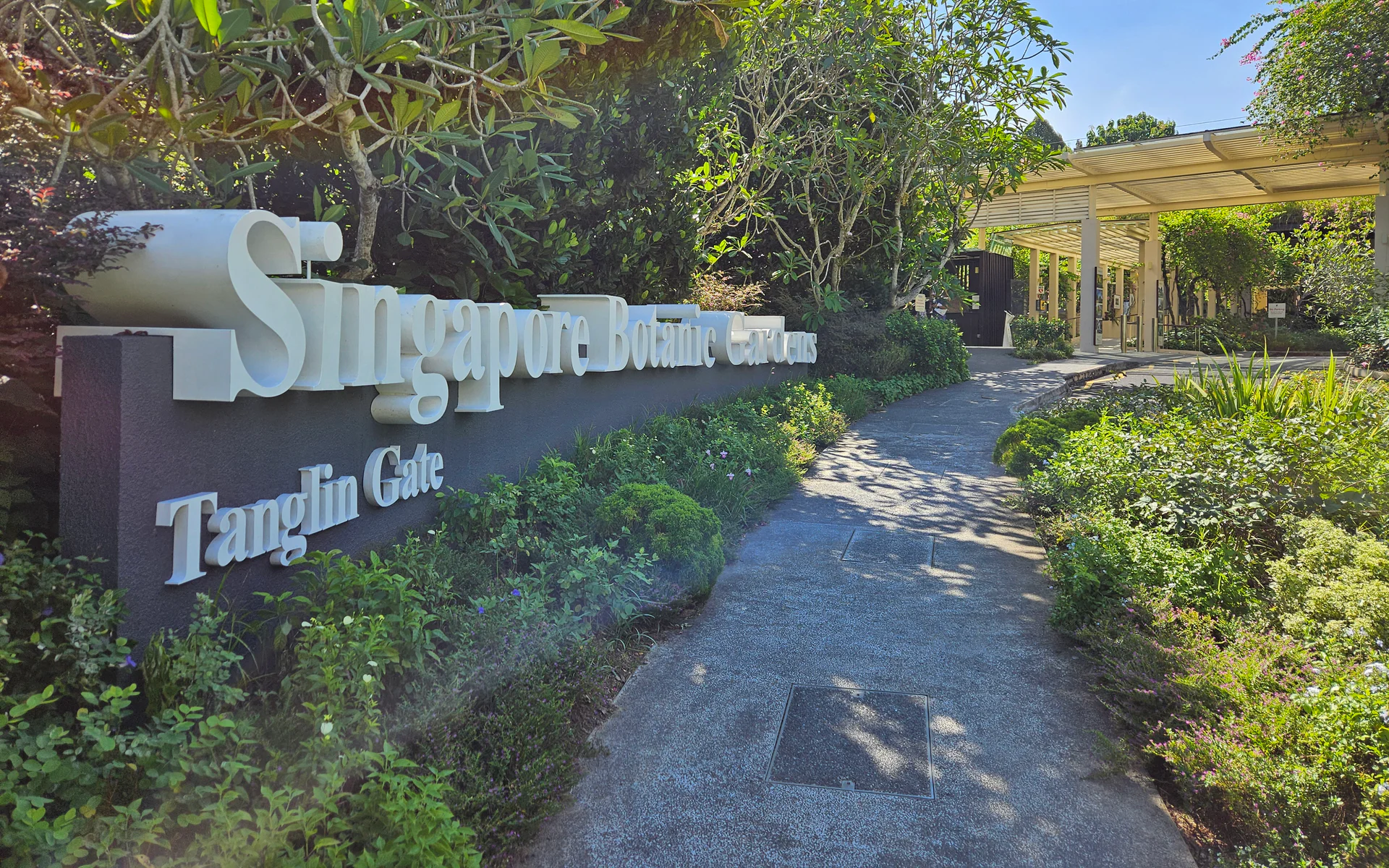
Cover photograph: “6. Tanglin Gate” by NoPhysicist, dedicated to the public domain under CC0 1.0. Cropped and resized for this guide.
Why Dempsey and Tanglin matter: barracks, plantations and a garden that changed an economy
Tanglin's green, low-rise character is the product of two long histories that sit side by side. The first is military. According to the National Heritage Board's Roots collection, in 1868 the Colonial Engineer, Colonel George Chancellor Collyer, built ten attap-roofed structures here to house British infantry, and the first occupants were the 80th Foot, the Staffordshire Volunteers. A year later their commander had the jungle cleared and turfed to make a cricket pitch. The land had been a nutmeg estate known as Mount Harriet in the 1850s. The barracks grew into a camp whose Officers' Mess was built in 1934, and after the Singapore government took over in 1971, the Ministry of Defence and the Central Manpower Base occupied the site from 1972 to 1989.
The second history is scientific. In 1859 an Agri-Horticultural Society formed by public-spirited citizens started a garden at Tanglin on 23 hectares of former plantation land. The government took over its management in the 1870s and brought in Kew-trained botanists. From 1896, Henry Nicholas Ridley, the Gardens' first Director, pioneered Malaya's rubber industry with such persistence that he was nicknamed "Mad Ridley"; by 1920, Malaya produced over half the world's rubber. In 1928 Richard Eric Holttum set up laboratories and began the first orchid breeding and hybridisation experiments, the foundation of the region's cut-flower industry.
In 2015 the Singapore Botanic Gardens were inscribed as a UNESCO World Heritage Site, the country's first. For Singaporeans the Gardens are both a point of national pride and an everyday public place for morning walks and picnics.
Today the barracks hold restaurants, galleries and shops, while the Ministry of Foreign Affairs has used the old Officers' Mess since 2001. Seeing both well comes down to how you move between their separate clusters in tropical heat.
Think in clusters, not a continuous street
The Singapore Land Authority describes Dempsey as an enclave made up of Dempsey, Minden and Loewen clusters. They are linked historically and commercially but not arranged like a compact high street. Entrances, car parks, slopes and vegetation make a direct-looking route slower than expected.
Select one Dempsey cluster, one Tanglin or garden segment and a meal. Place them on a live map, then inspect the walking line as well as the distance. If the route lacks a continuous pavement or requires an uncertain crossing, use a bus or licensed taxi/private-hire service.
Save the exact building number. “Dempsey Hill” is not precise enough for a driver or meeting point. People travelling separately should agree on a named entrance, not a restaurant that may have several doors.
In rain, road edges and car parks can flood briefly or become slippery. At night, visibility around bends is reduced. Reflective clothing does not make an unsafe pedestrian link suitable.
Read the landscape before adaptive reuse
Official heritage accounts connect the area to nutmeg plantations and Tanglin Barracks. Plantation history should include land, labour and colonial commerce, not only picturesque greenery. Military use shaped the building forms, road layout and separation from the surrounding city.
Use the Singapore Land Authority’s Dempsey history and National Heritage Board records to identify what survives and how it changed. Not every low building is original, and not every decorative object is a military artefact.
Adaptive reuse keeps structures occupied, but most interiors are now businesses. Enter only during opening hours and as a customer or invited visitor. Staff areas, loading spaces and private events are off limits, however interesting the architecture. Ask before photographing employees or diners.
There is no need to romanticise former barracks. Military sites are connected to discipline, empire and conflict as well as architectural style. A useful caption identifies the building and its transformation instead of calling the whole district “hidden colonial charm”.
Let the meal solve the middle of the day
Dempsey’s restaurants make an indoor lunch a practical heat break, but current tenants and hours change. Reserve directly when a particular venue matters and confirm cancellation terms. A map listing can remain visible after a business moves.
Menus vary widely in price and cuisine. Check service charges, taxes, dietary needs and children’s options before arrival. For severe allergies, contact the restaurant; shared kitchens cannot always prevent cross-contact. Plant-based labelling does not automatically mean allergen-free.
Dress codes are usually venue-specific, not district-wide. Special clothing bought on the strength of an old review is rarely needed. A clean, comfortable outfit and rain-ready footwear suit the wider route.
A meal purchase is not permission to photograph every interior. Some artworks and designs remain copyrighted. Ask before using tripods, flash or images for commercial purposes.
Enter the Botanic Gardens through the right gate
Singapore Botanic Gardens has several entrances. Tanglin Gate serves the southern historic core, while other gates suit different transport and attractions. Use the Gardens’ current visitor information and map to choose the entrance nearest the intended feature.
The Gardens are not merely a park break. Their history includes colonial plant exchange, economic botany and later conservation and public use. Read interpretation around the heritage landscape, and remember that introduced ornamental planting differs from untouched rainforest.
Stay on open paths, do not pick seeds or flowers and never feed wildlife. Monitor children beside ponds and roads. Joggers, wheelchairs, maintenance vehicles and pedestrians share parts of the network, so groups should not occupy the full path for photographs.
General grounds and individual attractions can have different hours, tickets and last admissions. Verify the exact facility. A garden gate being open does not prove that an orchid collection, library or café is accepting visitors.
Wheelchair loans, accessible toilets and route information are described on official pages, but availability and surfaces still need checking. Tropical downpours can alter the easiest route. Ask staff for the nearest sheltered, step-free option rather than following a stair-heavy scenic path.
Use Tanglin for context, not filler shopping
Tanglin includes diplomatic, residential, retail and garden areas. Decide whether the remaining time is for heritage, a practical shopping stop or transport onward. There is little value in walking through a mall simply because it is air-conditioned unless it provides the needed rest, meal or service.
Embassies and residences require privacy. Do not photograph security arrangements, peer through gates or fly drones. Follow pavement diversions and keep clear of vehicle entrances.
If visiting a gallery in the wider area, verify opening and appointment requirements. Small spaces may close between exhibitions. Place the gallery before a reserved meal only when the walking connection and opening are confirmed.
Build the day in one of two directions
Garden first: enter the Botanic Gardens at Tanglin Gate near opening, explore a selected heritage loop and exit before the strongest heat. Take transport to a named Dempsey building, eat lunch and visit one adaptive-reuse cluster. This is the safer pattern for visitors who value plants and outdoor walking.
Dempsey first: arrive for a specific gallery, heritage walk or early meal, then transfer to Tanglin Gate for a shorter late-afternoon garden circuit. This suits a confirmed booking but needs a storm alternative.
Reversing direction only to capture better light usually means midday walking. Singapore’s Meteorological Service provides live warnings. When thunder is heard, stop the outdoor route and seek a substantial building or enclosed vehicle; do not shelter beneath a tall tree or rely on a small open structure. Resume only after current official advice and local conditions indicate it is safe.
If heavy rain persists, keep the meal and one indoor venue, then leave. Gardens remain valuable on another morning. Heat illness signs such as headache, nausea, confusion or unusual weakness require cooling, rest and medical help when severe.
For another heritage district with a more continuous walking grid, use Katong and Joo Chiat or Tiong Bahru. Singapore’s Little India requires different market and worship etiquette. The Singapore hub contains currently published district guides.
Leave with the transformation visible
At the end, identify one feature inherited from barracks use, one sign of contemporary adaptation and one part of the garden landscape shaped by plant science or public policy. That exercise prevents the day becoming only restaurant names and greenery.
Dempsey and Tanglin feel premium when they are given space, not when every venue is purchased. Safe transfers, careful historical language and one well-read garden route produce a more distinctive visit than chasing a list of fashionable addresses.
Questions and answers
Why are the Singapore Botanic Gardens a World Heritage Site?
Founded at Tanglin in 1859, the Gardens shaped the region's economy and science: Henry Ridley pioneered Malaya's rubber industry from 1896, Eric Holttum began orchid hybridisation in 1928, and in 2015 they became Singapore's first UNESCO World Heritage Site.
Is Dempsey Hill a historic district or a shopping area?
It is both: former plantation and military land has been adaptively reused for contemporary businesses. The present use should not erase the site’s earlier labour and military histories.
Is this route suitable in midday heat?
Not as one continuous outdoor walk. Use an early garden period, indoor meal or gallery break and transport between clusters during the hottest or stormiest hours.
Sources
Singapore · 1.3521° N, 103.8198° E
This story belongs to Singapore. An island city of Malay, Chinese, Indian, Peranakan and global communities, where dense neighbourhoods and protected nature keep distinct identities.