Hakone Loop Guide: Luggage, Weather, Onsen Etiquette and Transport Choices
A transport-first Hakone guide for linking mountain railway, cable car, ropeway, Lake Ashi cruise and buses without letting luggage or closures control the day.
Hakone's famous “loop” is a chain of different transport systems, not a single sightseeing ride. The mountain railway, cable car, ropeway, Lake Ashi cruise and buses can form a satisfying circuit, but only when luggage, weather and closures are checked first. Build the day around the weakest connection and one meaningful stop, not around collecting every vehicle.
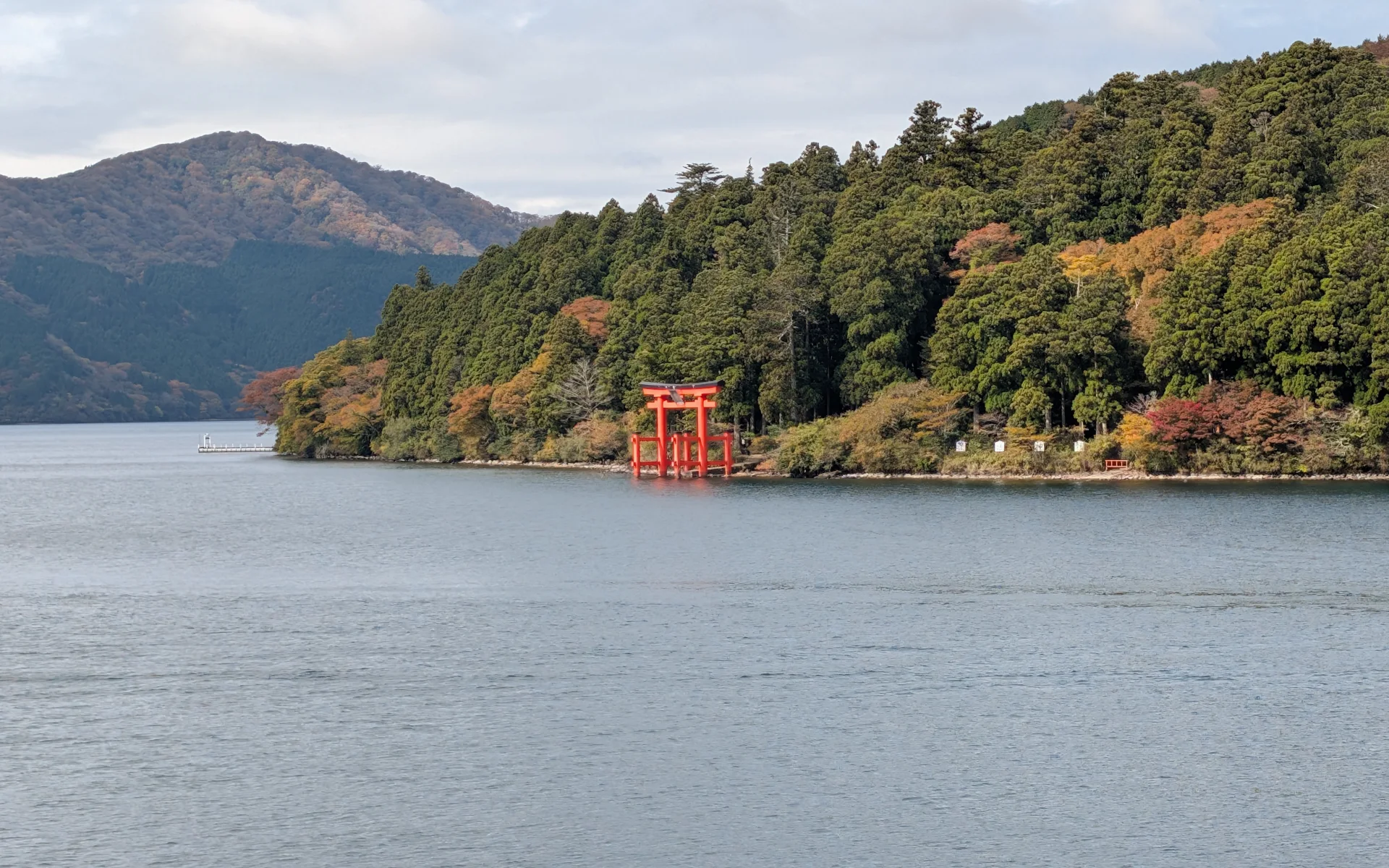
Cover photograph: Lake Ashi and the Peace Torii of Hakone Shrine by Joli Rumi / Wikimedia Commons, licensed CC BY-SA 4.0. Cropped and converted to WebP.
Why Hakone matters: a mountain pass, hot springs and four centuries of travellers
Hakone sits in the mountains on the old Tokaido, the road between Edo, today's Tokyo, and Kyoto, and for centuries travellers on that road had to cross it. In 1619 the Tokugawa shogunate placed the Hakone Checkpoint on its present site beside Lake Ashi. Its officials enforced a rule remembered as "incoming guns and outgoing women": weapons were stopped from entering Edo, and the wives and children of feudal lords, kept in the capital as a guarantee of loyalty, were stopped from leaving. The checkpoint was dissolved when the shogunate fell. The buildings seen today were rebuilt from a restoration report dated 1865 that came to light in 1983, and the reconstruction has been open to the public since April 2007.
The landscape that made the crossing hard is also what makes Hakone loved. This is volcanic country. Owakudani still steams, hot springs feed the bathing towns along the valley, and Lake Ashi lies among forested ridges with Mount Fuji beyond them on a clear day. On 1 February 1936 the area became part of Fuji-Hakone-Izu National Park.
Hakone's best-known craft is yosegi-zaiku, a wood marquetry that began in the Edo period and is centred on the mountain village of Hatajuku. Makers fit small pieces of different woods together so that their natural colours form geometric patterns, and the puzzle box is the most popular form. The craft is still made in and around Hatajuku today.
For people in Hakone, the pride lies in that continuity: a road station that once guarded the nation's main highway, an onsen culture that still draws visitors up the valley, and a craft still made in the village where it started. Seeing even part of it depends on a chain of mountain transport, so the practical checks come first.
First check: is the chain operating today?
Open the Hakone transport status page before leaving and again at Hakone-Yumoto. Wind, lightning, volcanic gas, maintenance, road congestion or fog can interrupt one link while the others continue. A replacement bus preserves transport, not necessarily the views or time assumed in an itinerary.
The classic sequence from the Tokyo side is Hakone-Yumoto to Gora by mountain railway, cable car to Sounzan, ropeway through Owakudani to Togendai, cruise across Lake Ashi, then bus back through Moto-Hakone or Hakone-machi. It can also run in reverse. Hakone's official English transport map is the useful planning document because it shows the network, not one idealised route.
Do not begin the ropeway side when a fixed ryokan dinner, museum booking or Tokyo train leaves no recovery margin. Put the non-refundable commitment first and let the circuit change around it.
Second check: remove large luggage from the route
Suitcases are poor companions on the mountain railway, cable car and crowded buses. Day visitors should use an appropriate locker and confirm closing or collection time. Overnight guests can ask whether their accommodation participates in the Hakone luggage transport service and confirm same-day deadlines, eligible areas, dimensions and current fees.
Never send medicine, passports, valuables or the only warm layer. Carry a compact bag containing documents, weather protection, water and anything needed before the luggage is reunited. Photograph the receipt and accommodation details in Japanese.
If luggage delivery is unavailable, travel directly to the accommodation, leave bags only with permission, then begin a shorter section. Completing fewer modes without a suitcase is better than forcing a full circuit while blocking aisles.
Third check: choose the arrival that suits the route
From Shinjuku, Odakyu services connect towards Hakone-Yumoto, with some journeys requiring a change at Odawara. Travellers arriving by shinkansen from elsewhere may use Odawara as the gateway. JNTO's Fuji-Hakone-Izu access guide outlines the main approaches, but current operator timetables and the exact ticket conditions decide the journey.
An area pass can be good value when its covered transport matches the final route. Compare it with individual fares after deciding whether the ropeway and cruise are realistic. Pass validity does not reserve seats, remove queues or guarantee a weather-dependent service.
Begin early if returning to Tokyo. Hakone's last useful connections occur well before a large city's late-night services, and mountain roads can delay buses.
The mountain side: railway, cable car and ropeway
The railway to Gora gains height through switchbacks. Transfers can involve platforms, slopes and crowds, so a published connection is not an accessibility promise. Gora is the decision point for museums, accommodation and the cable car.
At Sounzan, check the ropeway again. The official ropeway information explains the sections through Owakudani to Togendai. Owakudani is an active volcanic area: remain within open zones, follow gas and health warnings, and do not cross barriers. People with relevant respiratory or cardiovascular conditions should read current official advice and consider a different route.
Cloud can remove Mount Fuji without making the journey a failure. The ropeway's value also lies in the volcanic terrain and the change in elevation. Treat a clear mountain view as a possibility, not something purchased with a ticket.
The lake side: cruise, shore and bus
The sightseeing ship links Togendai with ports on the southern shore. Fog and strong wind can change or cancel sailings. Vessel design, timetable and stopping pattern may differ on the travel date, so use the live operator information rather than identifying a service from an older photograph.
Choose one shore priority. Hakone Shrine and its lakeside area can be extremely crowded; the torii is part of a religious landscape, not just a queue for portraits. Hakone Checkpoint tells a different story about movement and control on the old Tokaido road. Trying both plus a museum and a long lunch usually creates a rushed bus return.
Buses share mountain roads with other traffic. In foliage season and holidays, allow a substantial margin before the final Tokyo connection. Standing passengers should keep backpacks low and leave priority seating available.
Add one stop, not four
Hakone has major art museums, gardens, historic sites and walking routes. Select one according to weather and genuine interest. A museum works well when cloud removes long views; a garden or short open trail needs suitable footwear and current access confirmation.
Admission costs accumulate quickly. Before buying a multi-attraction product, compare the places actually possible in the available hours. A pass that encourages an unwanted stop is not a saving.
Travellers with children should protect meal and toilet breaks. Travellers with limited mobility should contact individual attractions and transport operators: the circuit's slopes, vehicle gaps and crowding mean “the loop” has no single accessibility answer.
An overnight plan that leaves room for an onsen
An overnight visit allows the loop to become two connected halves. On arrival, send or leave luggage, visit one museum or the Gora area, then reach the accommodation before its dinner deadline. The next morning, use the ropeway and lake when conditions are clearer, or reverse the day if live status favours the shore.
For onsen, follow the facility's own rules, not an internet shortcut. JNTO's current visitor FAQ states the essentials: wash before entering, bathe without swimwear in a conventional bath, and keep towels out of the water. Tattoo restrictions vary. Ask about cover stickers, private baths or rooms with bathing facilities before paying, and never pressure staff to make an exception at the door.
People who cannot use a hot bath safely should seek medical advice and choose another part of the stay. Hydrate and leave the water if dizzy; alcohol and very hot bathing are a poor combination.
A closure does not ruin the visit
If the ropeway closes, build a rail-and-museum day around Gora or use official replacement transport without expecting the aerial section. If the cruise stops, use buses and choose a shore site. If roads are severely congested, remain near the railway. During dangerous weather, postpone exposed travel and follow the JMA risk map.
The Japan destination hub provides the wider collection. Use the Tokyo neighbourhood guide to select a practical departure base. The Hokkaido seasons and transport guide applies the same weather-first discipline on a much larger regional network, while the Nagano mountain guide covers a different rail-and-bus journey.
Build the loop in this order
Check operations, secure luggage, protect the fixed booking, choose one meaningful stop, then decide the direction. Only after those decisions should a pass or complete circuit be considered. If one link is down, the same order still works: the fixed booking and the chosen stop stay, and the route between them changes. Hakone is successful when its landscape, art or bathing culture receives attention—not when every transport icon is collected before the last bus.
Questions and answers
What is Hakone known for?
Hakone is known for its volcanic landscape and hot springs, for the Hakone Checkpoint placed on the Tokaido in 1619 and reopened as a reconstruction in 2007, and for yosegi-zaiku wood marquetry, an Edo-period craft centred on the village of Hatajuku. It has been part of Fuji-Hakone-Izu National Park since 1936.
Which direction should the Hakone loop run?
There is no universally correct direction. Check live ropeway, railway, cruise and bus status, then choose the direction that protects your fixed booking and avoids carrying luggage. Starting through Gora is common, but disruption can reverse the sensible order.
What should first-time visitors know before using a Hakone onsen?
Wash thoroughly before entering, do not wear swimwear unless a facility specifically says otherwise, keep towels and hair out of the bath, and check tattoo and private-bath policies directly with the property before booking.
Sources
Tokyo · 35.6762° N, 139.6503° E
This story belongs to Japan. A country that is really many places: an imperial capital, merchant ports, a rebuilt peace city, a northern Ainu homeland and craft towns.