Toulouse in Two Days: Rose Brick, Space Heritage and the Garonne
A two-track Toulouse weekend combining a walkable rose-brick centre with one substantial space or aviation experience instead of overloading both.
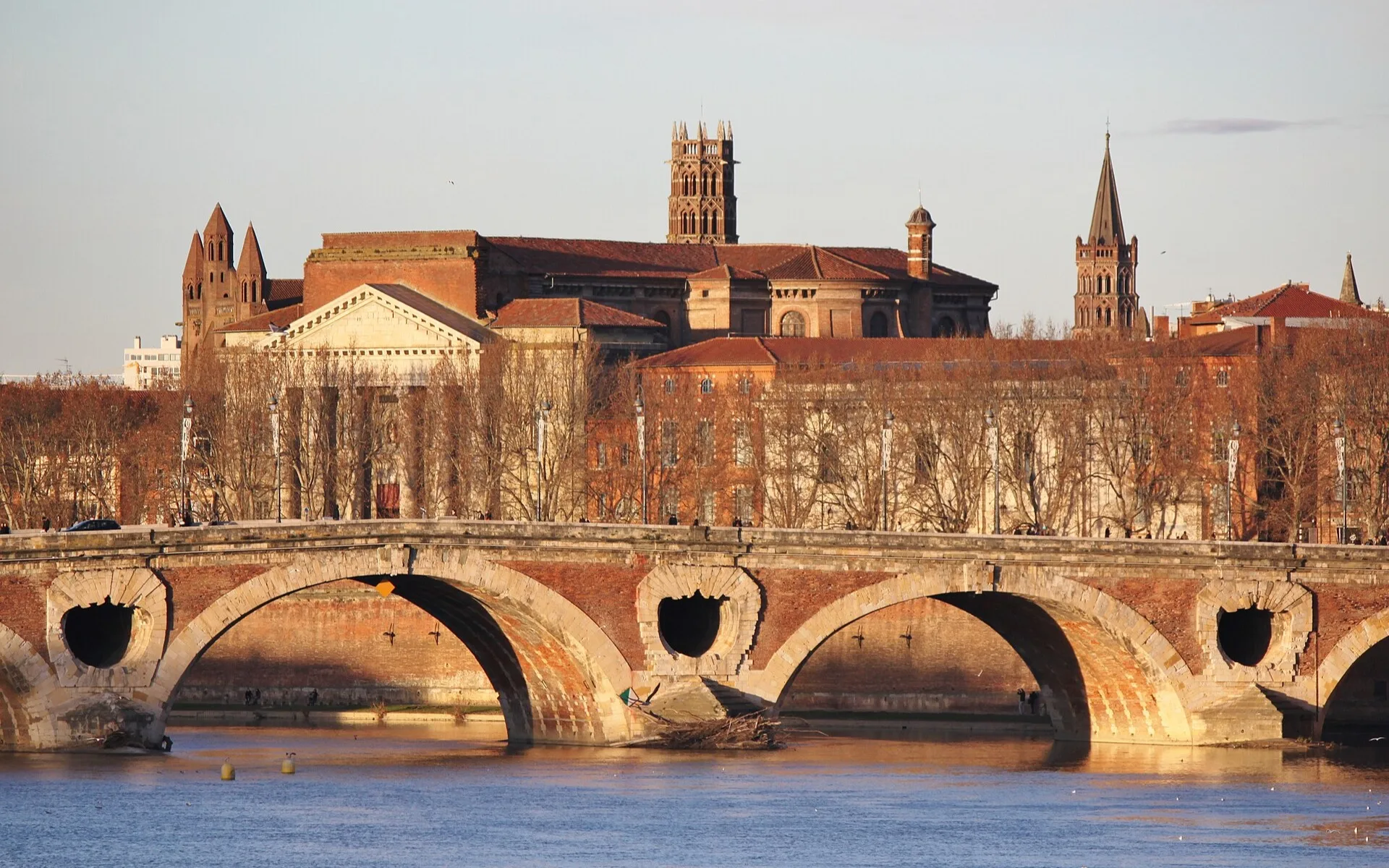
Toulouse has two strong stories: the rose-brick city built beside the Garonne and a modern aerospace centre extending beyond it. A good two-day visit does not force both Cité de l'espace and Aeroscopia into one transport-heavy day. Choose one, then give the historic centre room to breathe.
Cover photograph: “Toulouse - Garonne et Pont neuf” by Frédéric Neupont, dedicated CC0 1.0. Cropped to 16:10 and converted to WebP; no generative alteration.
Why Toulouse matters: a pilgrim church, a royal canal and a space city
Toulouse tells its story in brick and water. Saint Saturnin, known locally as Sernin, was martyred here in 250, and the basilica that carries his name became a major stop for pilgrims walking to Santiago de Compostela. Toulouse Métropole records that the present building was begun in 1080 and consecrated by Pope Urban II in 1096, with work continuing until the western end was finished in the early 14th century. It is 115 metres long, its bell tower rises 65 metres, and in 1998 UNESCO recognised it as part of the Routes of Santiago de Compostela in France.
The second great project tied the city to two seas. The Canal du Midi, designed by Pierre-Paul Riquet, was built between 1667 and 1694, according to the French Ministry of Culture, with about 2,000 workers on site when digging began. Its roughly 360 navigable kilometres created a link between the Mediterranean and the Atlantic, and Riquet died in 1681 with the work essentially complete. In Toulouse the canal's plane-tree towpaths still give the city a slower, greener edge.
The third layer is modern. Cité de l'espace lets visitors stand beside a life-size Ariane 5 rocket, the Mir space station and an Apollo lunar module, while Aeroscopia presents the region's aviation heritage through its aircraft collection.
People from Toulouse are proud of how those layers sit together: a medieval pilgrim church and a 17th-century canal in the same city that studies and builds for flight and space today, all around a centre of warm rose-toned brick that is still easy to cross on foot. The two days below give the old city and the modern one a day each.
Day one follows the brick centre
Begin at Place du Capitole, then walk to Saint-Sernin and the Jacobins. Brick changes colour with light, but its importance is structural and regional, not merely photographic. Check religious services and municipal access before entering. Place du Capitole is a natural starting point because Saint-Sernin and the Jacobins are both a short walk away.
The official two-day guidance groups these central landmarks with markets and the Garonne. Use it as a framework, not a mandate to enter everything.
Let a market shape lunch, not the whole schedule
Victor Hugo market works best earlier in the day. Browse without blocking traders, ask before photographing staff and verify restaurant hours. Carmes offers another neighbourhood food context, and a slow lunch there suits a day that has started with heavy sightseeing.
Travellers with allergies should communicate clearly in French where possible and confirm sauces, stocks and cross-contact. Cassoulet is substantial; it need not be eaten at the hottest point of the day.
End at the Garonne with options
Walk towards Pont Neuf and the riverbanks when heat and water conditions suit. The view back towards the brick city is strongest when you have already seen its landmarks. Flooding can close lower paths; obey barriers and remain on lit routes after dark.
Saint-Cyprien across the river offers a different neighbourhood texture. Return by metro if fatigue or weather makes another bridge crossing unattractive.
Make one aerospace decision
Cité de l'espace focuses on space science through exhibitions, models and activities. Aeroscopia concentrates on aviation heritage and aircraft. Airbus tours, when offered, have their own security, identity and booking requirements. They are not interchangeable.
Choose based on the traveller: families and space enthusiasts may favour Cité de l'espace; aviation specialists may prefer Aeroscopia. Check current opening, language, transport and timed activities directly.
Know what must be reserved and what can remain loose
Cité de l'espace admission can be purchased ahead, but planetarium, IMAX or special-event arrangements may have separate capacity. Read the official day's programme before travel and arrive early enough to orient yourself. Outdoor exhibits and demonstrations are weather-dependent even within a large attraction.
Aeroscopia publishes its own admission and activity information. An Airbus site tour, when available, is a different booking with identity, age or security conditions that can be stricter. Use only the authorised booking channel, enter names exactly as required and bring the stated identification. Do not promise photographs where security rules prohibit them.
The correct comparison is therefore not only ticket price. Consider total travel time, fixed-entry risk, language support, children's attention and how much technical detail the group wants. If opinions split, allow one person to choose the anchor and give the other a meaningful central activity on another day.
Read the religious buildings as different histories
Saint-Sernin is a major Romanesque pilgrimage church associated with routes to Santiago de Compostela. The Jacobins complex represents the Dominican order and is known for its distinctive vaulted interior. They are not two similar brick churches to mark off before lunch.
Check worship and visitor schedules separately. Begin at Saint-Sernin when quieter, then approach the Jacobins through the civic centre. Inside, speak softly, remove hats where expected and do not interrupt services for photographs.
Visitors with mobility needs should identify accessible entrances in advance, since monumental doorways are not always the usable route. A guided city tour can provide context, but verify language and duration before committing during hot weather.
Let the Canal du Midi solve a different need
The Canal du Midi begins in Toulouse and provides a flatter walking or cycling contrast to the historic lanes. Use a short shaded segment for recovery, not as proof that you have experienced the entire UNESCO-listed waterway. Towpaths can be busy with commuters and faster cyclists.
Rental-bike users should inspect brakes, lights and lock, then follow local traffic rules. Heat, plane-tree health works and temporary path closures can alter the route. Keep enough time to return the bicycle within staffed hours.
For an evening walk, the Garonne usually provides a stronger city view; the canal is better for morning movement or a quieter extension. Choose according to purpose instead of trying to fit both waterways into every day.
Make the city work for different energy levels
A family space day can be tiring, so keep the returning evening meal near accommodation. Travellers who dislike technical museums can use the second day for the Augustins, Saint-Étienne and Carmes. Mixed groups do not need to remain together for every hour if meeting points and phones are reliable.
Historic centre paving, summer heat and long museum standing affect older visitors. Insert a proper sitting break, not a hurried coffee. The metro can remove a return walk even when the map calls it short.
At night, the river and entertainment streets become lively. Use populated routes, keep belongings controlled and do not walk on closed lower banks. Toulouse is a functioning student and work city, not only a weekend setting.
Treat day two as a substantial excursion
Allow most of the day for the chosen site, including transit. The attraction may sit outside the compact tourist centre, so map the outward and return journey through Tisséo before departure. Save tickets or route details offline.
Return for a simple neighbourhood dinner and leave the monuments for the morning. If the site is closed, use Musée des Augustins or a Canal du Midi walk according to current access and weather.
Use public transport with the right ticket
Toulouse tourism explains that metro, tram and bus use an integrated network, while airport arrangements may differ. Check Tisséo for current fares and disruptions. Validate as required and retain the ticket until the end of the journey, as tickets can be checked.
Matabiau station is within walking reach of the centre, but metro helps with luggage. A central car is unnecessary and adds low-emission-zone and parking complications.
Plan for heat, storms and access
Summer heat changes the day: start outdoor walking early, use indoor visits during peak temperatures and carry water. Thunderstorms can affect exposed riverside plans. Do not shelter under isolated trees; a church, museum or metro station is a better refuge until the storm passes.
Historic thresholds vary, while modern attractions publish accessibility information. Ask for the correct entrance and sensory support before travel so that barriers are known before a timed slot.
The balanced 48 hours
Day one: Capitole, Saint-Sernin, Jacobins, market lunch and Garonne. Day two: one space or aviation anchor, then an easy central evening. If aerospace is not your interest, replace it with museums and the Canal du Midi; a visit made from obligation helps no one. Either version leaves the evenings free for the river.
Continue through the France hub or compare another south-western city with our guide to what makes Bordeaux special. For the national picture read what makes France special, and browse more destinations under country guides.
Questions and answers
Can Toulouse be explored without a car?
Yes. The historic centre is walkable and metro, tram and buses connect outer attractions. Space and aviation sites require separate transport planning.
What is Toulouse known for?
Its rose-brick centre and the Basilica of Saint-Sernin, begun in 1080 and listed by UNESCO in 1998 as part of the Santiago pilgrim routes; the Canal du Midi, built between 1667 and 1694 to link the Atlantic and the Mediterranean; and its space and aviation heritage.
How should I plan Toulouse in hot weather?
Walk the centre early, reserve indoor visits for the hottest hours, carry water and leave the exposed river section for later. Follow heat alerts and venue guidance.
Sources
Paris · 48.8566° N, 2.3522° E
This story belongs to France. A country that sends people to the baker twice a day, protects a cheese by law and refuses to be averaged into one postcard.