South Korea · Country Guides
Suwon Hwaseong: Walk the Fortress Without Rushing
A sectional Suwon route that explains the fortress, Haenggung, markets and modern city without making the full wall circuit compulsory.
· 5 min read
Suwon · 37.2636° N, 127.0286° E
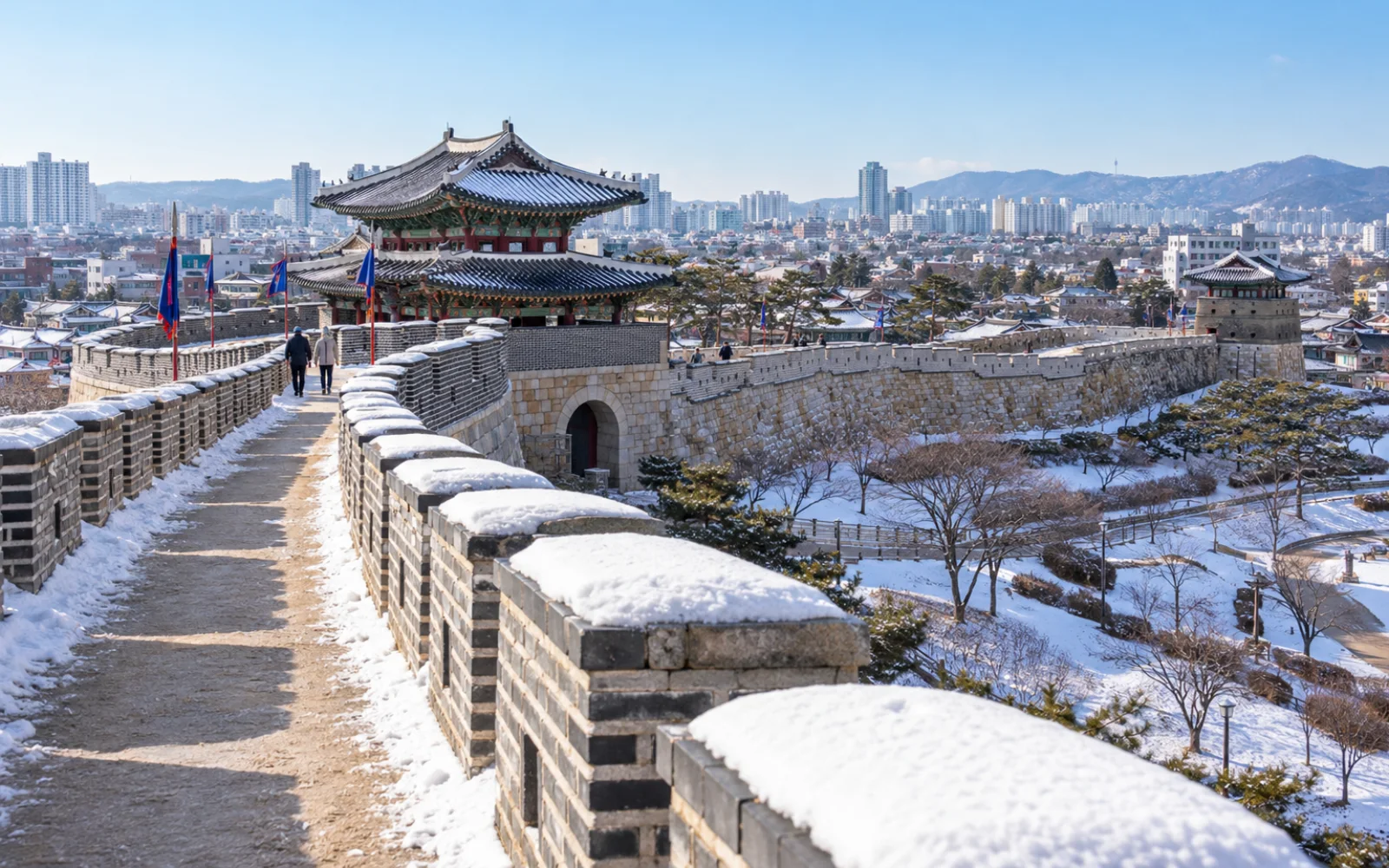
A modern city organised around an eighteenth-century fortress whose walls, gates and temporary royal palace sit within working neighbourhoods.
Hwaseong Fortress was built in about two and a half years, from 1794 to 1796, on the orders of King Jeongjo, partly to house and honour the remains of his father, Prince Sado. UNESCO inscribed it as a World Heritage Site in December 1997 for the way it combined defensive, scientific and planning ideas. The construction was documented in detail in the Hwaseong Seongyeok Uigwe, a royal record published shortly after Jeongjo's death.
Today the walls sit inside Suwon rather than outside urban life. Roads pass gates, neighbourhoods meet ramparts, and Hwaseong Haenggung, the temporary royal palace, functions beside markets and public space. The stone, brick and gate details are best read in short sections rather than as one marathon circuit.
The Suwon Hwaseong walking guide suggests routes by terrain. The South Korea collection shows how the fortress city compares with the other destinations.
South Korea · Country Guides
A sectional Suwon route that explains the fortress, Haenggung, markets and modern city without making the full wall circuit compulsory.
· 5 min read
No. A selected wall section plus one gate and Hwaseong Haenggung often provides a better visit, especially in heat, snow or with limited mobility.
No. It is in Suwon, south of Seoul, and travellers should allow for station transfers and local transport before beginning the wall route.
One short, occasional email with a useful new guide, a place story and notes on what we have updated.
Join by emailSend us that email and we will add you to the list. We only email people who ask, and you can leave any time. See our privacy policy.
