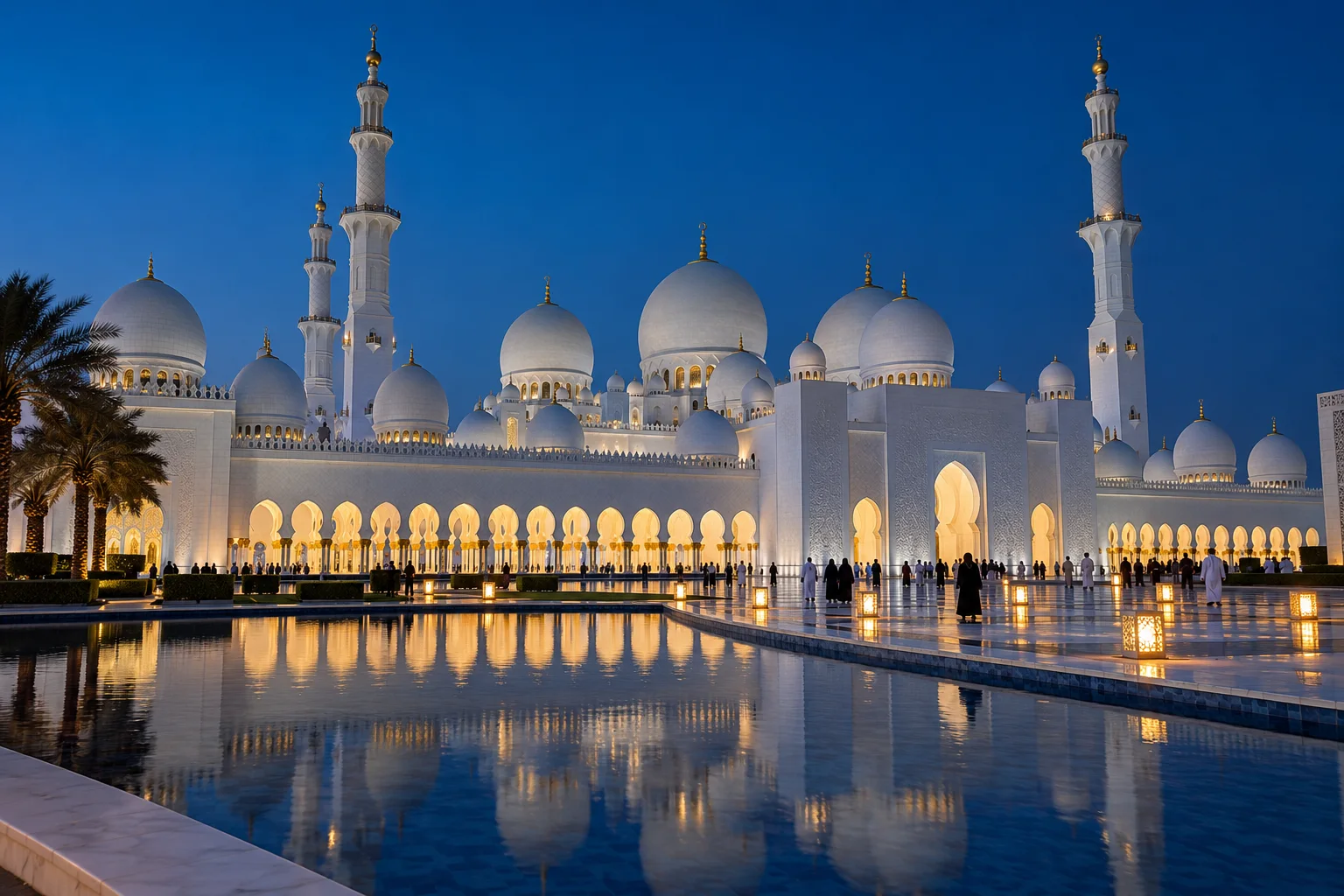
An island capital where the Corniche, the Sheikh Zayed Grand Mosque, Saadiyat's cultural district and Yas Island sit in separate zones.
A capital built across islands
Abu Dhabi's scale is easy to underestimate. The Corniche, the Sheikh Zayed Grand Mosque, Saadiyat Island and Yas Island are separate zones rather than one walkable cluster. The mosque opened for worship in 2007 and was conceived by Sheikh Zayed bin Sultan Al Nahyan, the UAE's founding president, who is buried beside it.
The emirate's story reaches back further. Liwa Oasis was the cradle of the ruling Al Nahyan family, who moved their residence to Abu Dhabi island in 1793. Al Ain, inland, holds the UAE's first World Heritage Site, inscribed in 2011. Today the capital combines major cultural institutions, mangroves and broad civic architecture, and its airport is now Zayed International.
A two-day Abu Dhabi plan that groups widely separated cultural landmarks by geography instead of wasting the visit crossing the capital repeatedly.
· 5 min read
Questions and answers
What makes Abu Dhabi distinctive?
It is an island capital where the Corniche, the Sheikh Zayed Grand Mosque, Saadiyat's cultural district and Yas Island form separate zones across considerable distances.
Can Abu Dhabi's main landmarks be walked between?
Not as one route. The Corniche, Grand Mosque and Saadiyat Island are far apart, so visitors need buses, shuttles, taxis or a car.