Regensburg Car-Free Guide: Stone Bridge, Cathedral and Danube
A rail-first Regensburg route that uses the Danube and Stone Bridge as orientation, then groups the medieval centre, Roman remains and museums efficiently.
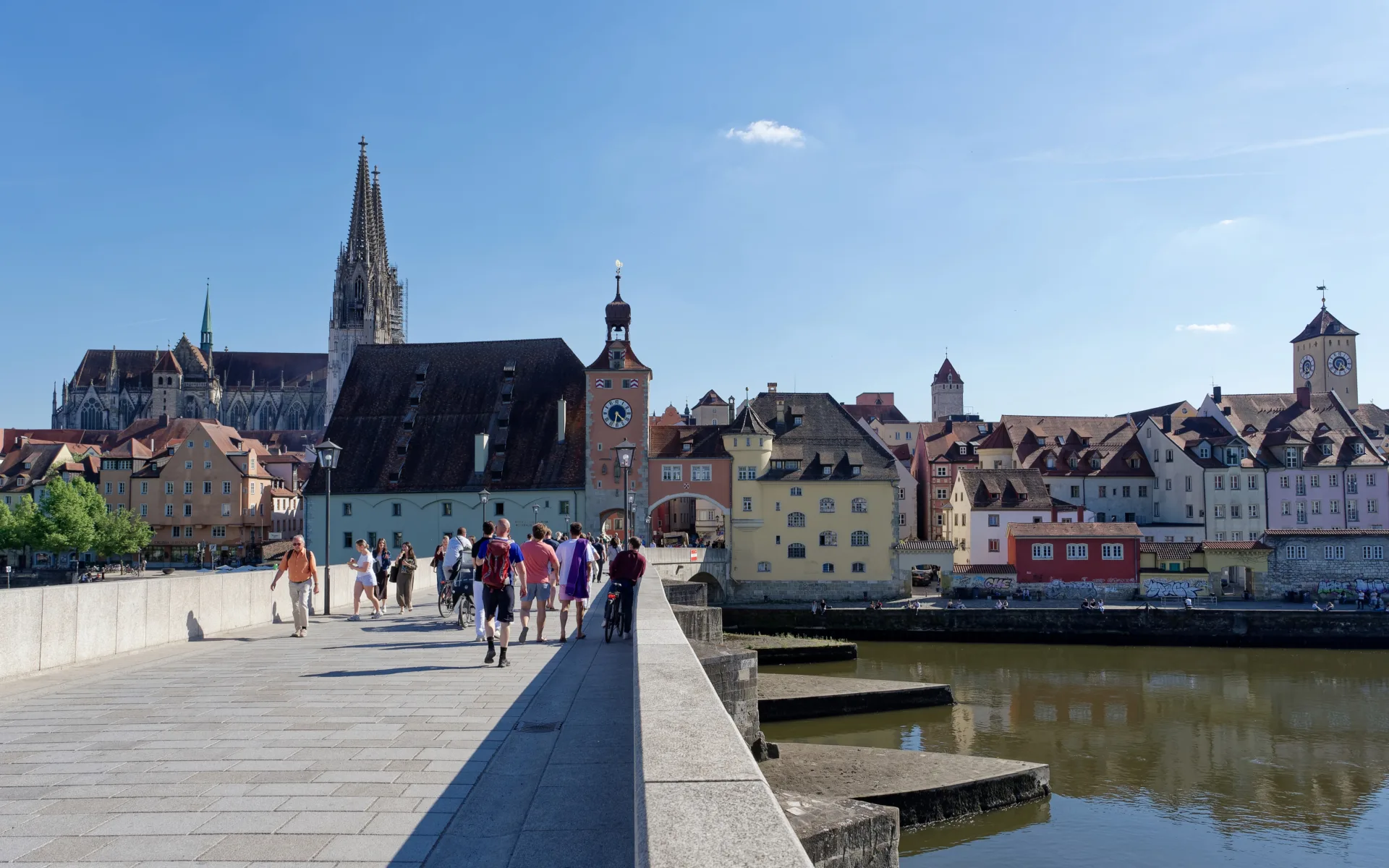
The Stone Bridge is more than Regensburg's main photograph: it is the easiest way to understand the city. Use the Danube as your horizontal line, the cathedral towers as your landmark and the bridge as the connection between Old Town and Stadtamhof. The car can stay elsewhere.
Cover photograph: “Regensburg Cathedral and Stone Bridge, Germany, 20250430 1632 8211” by Jakub Hałun, licensed CC BY 4.0. Cropped to 16:10 and converted to WebP; no generative alteration.
Why Regensburg matters: two thousand years on the Danube
Regensburg began as a Roman army camp about 2,000 years ago. Castra Regina, the legionary fortress of Emperor Marcus Aurelius, guarded the empire's frontier on the Danube, and its stones still show in the Porta Praetoria and in walls built into later houses. In 2021 that Roman layer was recognised in a second World Heritage title, when the Frontiers of the Roman Empire site was extended to include the Danube Limes.
The camp grew into one of the great trading cities of medieval Europe. Its medieval trading dynasties built tall stone houses and towers, which is why the city's own tourism office calls it the Manhattan of the Middle Ages. The Stone Bridge, begun in 1135 and stretching about 300 metres across the river, carried that trade north to Stadtamhof and beyond. St Peter's Cathedral, with its twin spires, still rises above the roofs.
Regensburg was also, for a time, a political capital. From 1663 the Perpetual Diet of the Holy Roman Empire met exclusively in the Old Town Hall for almost 150 years, and the Reichstag hall is often described as a forerunner of the German parliaments and of later international assemblies. For those decades, envoys from across the empire lived and negotiated in these streets.
The bombs of the Second World War largely spared the Old Town, and in 2006 UNESCO inscribed the Old Town with Stadtamhof as a World Heritage Site. Today it counts more than 1,000 individual monuments and is often called the best-preserved medieval city in Germany. People from Regensburg are proud that this is still a working city, with a university, markets and everyday traffic on the river, and not a museum. All of it lies within walking distance of the railway station, which is where a car-free visit begins.
Arrive by rail with the Old Town ahead
Regensburg Hauptbahnhof lies south of the historic centre. Walk through the green belt or use a city bus when carrying luggage. Choose accommodation either near the station for early departure or inside the centre for evening atmosphere; check paving and steps on the actual route.
Use the local operator for current tickets and diversions. Regional rail offers can have conditions, and a train ticket does not automatically answer every urban-fare question.
Begin where Roman Regensburg survives
Porta Praetoria and sections of Roman fabric reveal the earlier military settlement beneath the medieval city. Start here before the cathedral so the chronology remains clear. The stone fragments are modest compared with later façades; interpretation matters more than scale.
Do not describe every old wall as Roman. Use official plaques or a guided route, and allow working streets to remain functional while looking.
Give St Peter's Cathedral quiet attention
Regensburg Cathedral dominates the skyline, but it remains an active church. Check services, concerts and visitor access. Dress and speak appropriately, keep aisles open and avoid photographing worshippers.
The exterior rewards a slow circuit before entry. Visitors unable to manage long standing periods should identify seating and the accessible entrance in advance; the busy west approach may not suit them.
Cross the Stone Bridge twice, differently
The tourism office dates construction of the Stone Bridge from 1135 and describes its roughly 300-metre span. Cross first towards Stadtamhof while watching river flow and the skyline. Return later in different light.
Cyclists and pedestrians share constrained space. Keep to a predictable line, do not stop a group across the width, and follow temporary controls. High water and maintenance can change access.
Let Stadtamhof be more than a turnaround
Across the river, Stadtamhof offers cafés, quieter streets and a reverse view of the centre. A short loop through its streets is worth more than a photograph from the end of the bridge. Its inclusion in the World Heritage property reflects the relationship across the Danube.
If energy is limited, take the river view and return. The central route already contains enough history for a full day.
Choose one interpretive interior
The Museum of Bavarian History offers a modern, accessible introduction to the region beside the Danube. The document Reichstag in the Old Town Hall addresses imperial political history but normally depends on tour arrangements. Choose according to interest and language availability.
Check current opening and booking directly. One serious museum plus cathedral and bridge is a balanced day; multiple large interiors create fatigue.
Put the Imperial Diet into an understandable sequence
Regensburg's Old Town Hall is associated with the Perpetual Imperial Diet of the Holy Roman Empire. This is not obvious from the square alone. The documented rooms are normally experienced through a guided visit, so check tour times and language with the official tourism service. Arrive early because a late visitor may not be admitted to a controlled route.
Place the tour after the cathedral and before a long museum. It explains how Regensburg functioned as a political meeting place, adding civic history to the religious and trading landscape. Visitors who do not enjoy formal political history can skip it and spend longer at the Museum of Bavarian History.
Avoid calling the Holy Roman Empire an early version of modern Germany. Its structures, territories and relationships changed over centuries. Let the guide or museum define the period in its own terms.
Use food stops to reveal the river city
The historic sausage kitchen by the bridge is famous, but a queue is not compulsory. Its riverside position connects food service, bridge traffic and working urban history. Check current opening, payment and dietary options, and keep the bridge approach clear while waiting.
Elsewhere, choose a café or restaurant in Stadtamhof or the Old Town according to the route. A lunch across the Danube gives a real reason to pause on the north bank; a central lunch works better before a timed Rathaus tour. Reserve only when one establishment matters.
Bavarian menus can be meat-heavy, though vegetarian choices are increasingly available. People with allergies should ask about stocks, sauces and shared preparation. Beer is optional, and anyone drinking should use public transport and remain cautious beside the river.
Know when the Danube is scenery and when it is a hazard
Normal river levels make the banks useful for orientation and walking. High water can close paths and alter boat operations while the upper Old Town remains accessible. Follow municipal barriers and do not step onto a closed path to reproduce a photograph.
Excursion boats operate under seasonal schedules. Verify the route, departure, duration and accessibility directly; a vessel at the quay is not proof of immediate service. A cruise can add regional geography for overnight visitors but should not displace the bridge, cathedral and one interpretive site on a first day.
In hot weather, riverside air may feel cooler, but shade is inconsistent. Carry water and use the museum as a midday refuge. During thunderstorms, leave exposed bridges and banks, however dramatic the light.
Extend to Walhalla only as a separate decision
Walhalla stands outside central Regensburg and requires transport plus a climb or accessible-arrival plan. Add it only with a second day and clear interest in the monument's nineteenth-century cultural politics. Check current bus, boat or road connections and official opening before departure.
The excursion is not a substitute for understanding Regensburg itself. If time is limited, a slower Stadtamhof loop and museum produces a more coherent city visit than racing to a distant viewpoint.
Use buses to protect energy
The Old Town is walkable, not uniformly smooth. Buses help with accommodation outside the centre or reduced mobility. Historic lanes can have cobbles, gradients and delivery traffic. Ask venues for named accessible entrances, and plan a bus leg for the return to the station if the day has been long. A day ticket can make several short rides easier to justify.
Rain makes paving slick; summer heat can build in open squares. The riverside is a good cooling route only when conditions and water levels permit.
A one-day and overnight version
For one day: station, Roman gate, cathedral, bridge, Stadtamhof, one museum, then return through the centre. Overnight visitors can add a Danube evening, guided Old Town visit and a slower second morning.
Keep the final stop near the station so you are not crossing the river with luggage. Continue through the Germany hub, read what makes Germany special, or compare other Bavarian heritage cities in our Nuremberg guide and the Bamberg old town and breweries guide. More regional routes sit under country guides.
Questions and answers
Why is Regensburg a World Heritage Site?
Regensburg's Old Town with Stadtamhof was inscribed in 2006 as a medieval trading city with more than 1,000 monuments that came through the Second World War largely intact. It grew from the Roman legionary camp of Castra Regina, and from 1663 it hosted the Perpetual Diet of the Holy Roman Empire for almost 150 years.
How long should I allow for the Stone Bridge?
Allow at least an hour to cross slowly, view the skyline from both banks and account for crowds. Add time for the bridge-tower museum if it is open.
Is Regensburg Old Town step-free?
Not entirely. Historic paving and thresholds vary, though many principal routes and modern museums are accessible. Confirm entrances with individual venues.
Sources
Berlin · 52.5200° N, 13.4050° E
This story belongs to Germany. A country whose contributions to the world each belong to a particular town, and whose regions still keep their own dialects, bakeries and festivals.