Saint-Malo, Dinan and Cancale: A Practical Brittany Coast Base Guide
A decision-led Brittany guide that separates three very different bases and shows which day trips remain realistic without pretending every coast connection is frequent.
Choose Saint-Malo when transport flexibility matters, Dinan when the medieval town itself is the stay, and Cancale when the bay is the main reason to travel. They are close on a map but not interchangeable. A useful base decision considers the evening return, luggage, tides and how much of the trip should depend on a rural bus.
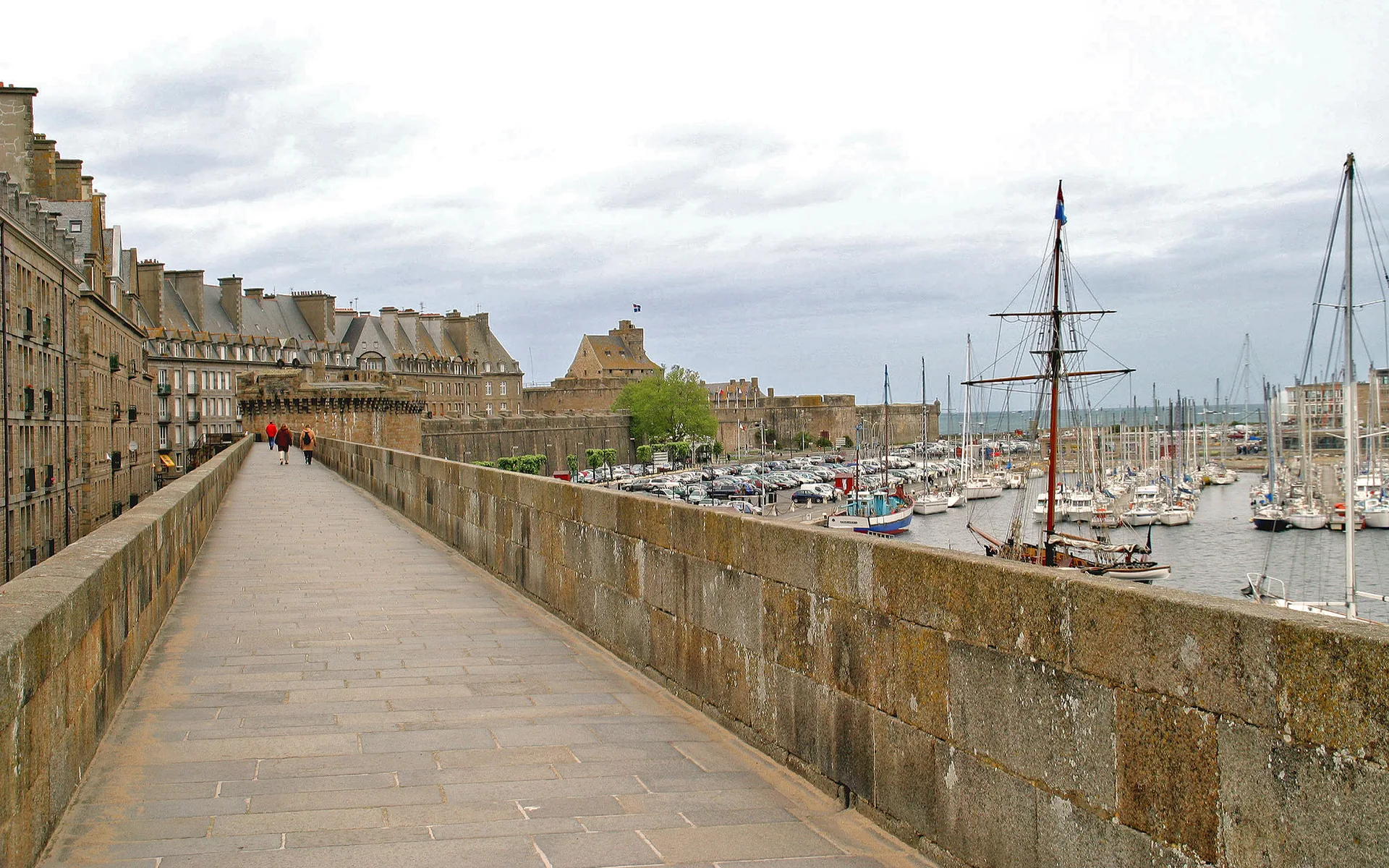
Cover photograph: “00 20128 Saint-Malo - Frankreich” by W. Bulach, licensed CC BY-SA 4.0. Cropped to 16:10 and converted to WebP; no generative alteration.
Why this coast matters: corsairs, ramparts and oysters
This short stretch of the Breton coast holds three towns with three distinct identities, all shaped by the sea and the River Rance. Saint-Malo calls itself the Cité Corsaire, the city of the privateers who sailed under royal licence. Its ramparts saw the light of day as early as the twelfth century, and Saint-Vincent became a cathedral in 1146. After a great fire in 1661 the granite wall was completely rebuilt, then extended between 1708 and 1744 by the engineer Garangeau, a disciple of Vauban. The tall granite houses of the shipowners date from the eighteenth century. Much of the walled town was badly damaged in 1944, and most of those façades were rebuilt afterwards in identical style, which is why the skyline looks old even where the stone is newer. Jacques Cartier, the navigator from Saint-Malo, is buried in the cathedral.
Dinan, upriver on the Rance, tells an older inland story. Its port was active from the eleventh century, and the steep Rue du Jerzual has linked that port to the upper town for about ten centuries. The town is encircled by 2.7 km of ramparts, the longest in Brittany, and keeps around 130 half-timbered houses built between the fifteenth and eighteenth centuries. Every two years the town celebrates that past with its Fête des Remparts.
Cancale looks across the Bay of Mont-Saint-Michel, where some of the strongest tides in the world uncover the oyster parks that made the town famous. Its flat oyster was highly prized at the table of Louis XIV, and today cupped oysters, which take three to four years to raise, are sold beside the harbour.
People here are proud of that maritime independence and of a heritage that survived war, fire and the tides. Each town suits a different kind of stay, so the first decision is where to sleep.
Pick Saint-Malo for the strongest transport safety net
Saint-Malo has the most useful rail arrival of the three and the broadest accommodation range. The station is outside the Intra-Muros walled town, so a bus, taxi or manageable walk still separates platform from historic centre. Confirm that relationship before choosing a hotel with luggage.
Use Saint-Malo as a base when an early or late train matters, when bad weather may cancel a coastal plan, or when several restaurants and indoor alternatives are valuable. Staying Intra-Muros puts the walls and lanes outside the door but brings cobbles, stairs, delivery activity and nightlife. A station-side or beach-district hotel can be calmer and more accessible.
One full day is enough for a first walls-and-harbour route, but two nights allow the tide to reveal different versions of the bay. Do not promise access to offshore forts or islets: causeways cover, conditions change and local warnings take priority.
Choose Dinan when heritage should not be a rushed excursion
Dinan's old town, walls and steep connection towards the river deserve slow walking. It works as an overnight base for travellers who prefer evening quiet after day visitors leave and who want architecture to be more than a two-hour stop.
The town's slopes and historic surfaces are genuine constraints. Ask accommodation about the route from station or bus, not merely the straight-line distance. Visitors with limited mobility can focus on the upper town and use documented accessible approaches; the descent to the port should never be treated as compulsory.
Dinan is less suitable when the trip's priority is daily coast access. Transport to Saint-Malo is possible, but every connection consumes flexibility. Check BreizhGo and regional rail information for the exact travel date; a claimed universal journey time is rarely reliable.
Use Cancale for one bay, not as a universal hub
Cancale rewards travellers who want to watch the Bay of Mont-Saint-Michel, understand oyster cultivation and walk a portion of coast. The harbour area and upper town have different elevations and atmospheres. A room described only as “Cancale” may be inconvenient for the waterfront or bus stop you expect.
It is the weakest of the three bases for spontaneous public-transport day trips. Services can be useful, but late and off-season options require care. Check the last practical return before reserving dinner elsewhere. Drivers still need to plan parking, traffic and a sober return after seafood and wine.
Oyster stalls and restaurants are part of the local economy, not a licence to discard shells anywhere. Follow the designated system, ask about origin and season, and treat the foreshore as a working and ecologically sensitive place.
Give Saint-Malo a tide-led walking order
Start on the ramparts only when wind and surfaces are safe. A full circuit provides orientation over the old town, harbour, beaches and forts, but exposed sections can be uncomfortable or hazardous in strong weather. Use lower streets as the fallback.
Walk the walls before entering museums or shops, then choose one interior connected to maritime or city history. Reconstructed Saint-Malo requires careful interpretation: much of the walled town was devastated in 1944 and rebuilt. Do not describe every apparently old façade as untouched medieval fabric.
Check official SHOM tide information and local notices. A low-tide path visible in the morning may not be available on the return. Never follow other visitors across a causeway without knowing the safe window.
Make Dinan a route with an exit, not a descent challenge
Begin in the upper town around the historic centre and walls. Select a line through major streets and one quieter section, then decide whether knees, weather and time support the descent towards the port. The steep Rue du Jerzual is picturesque but not an accessibility requirement.
If descending, plan how to return. Walking back uphill, using a seasonal service or arranging a taxi are different choices. A one-way route is sensible only when the exit is confirmed. In rain, polished stone and cobbles demand slower movement.
Respect residential doorways and workshops. Dinan is not a medieval set; ask before photographing craftspeople or private courtyards, and buy from businesses whose work you genuinely value.
Treat Cancale as weather-dependent coast time
Choose Cancale on the clearest, least windy part of the trip. Begin with a bay viewpoint, then walk only a section of the coast appropriate to conditions. The GR route continues far beyond a casual outing; distance, ascent and return transport must be planned together.
At the port, select one meal or tasting and leave the other stalls for another visit. Shellfish allergies and food safety require direct questions. Low tide can expose broad working areas, while high tide changes the scene completely. Neither state is “better”; they explain the bay's rhythms.
If fog, high wind or heavy rain arrives, shorten the shoreline and use a café, interpretation stop or an earlier return. Clifftop views are not worth ignoring barriers.
Compare three realistic trip shapes
For a rail-based weekend, stay two nights in Saint-Malo: use day one for walls and maritime history, then choose Dinan or Cancale on day two according to weather and connections. Trying both in one day creates a timetable exercise.
For three nights, use Saint-Malo as the transport hub and give each excursion its own day. Travellers prioritising historic atmosphere can instead spend two nights in Dinan and one in Saint-Malo. Cancale merits an overnight when food, dawn light or a longer coast walk is central, not simply to avoid returning by bus.
A car expands access but does not remove tide, parking or weather limits. Public transport reduces parking stress but requires disciplined return planning. Choose the constraint you prefer; neither mode is always superior.
Book in the order that protects the trip
First confirm rail arrival and departure. Second choose a base with a practical station or bus relationship. Third inspect tide and broad weather patterns. Only then reserve timed museums, restaurants or guided walks. Recheck regional services shortly before travel because works and seasonal revisions can change the best day-trip order.
The right base is the one that still works when one excursion fails. Saint-Malo has the strongest fallback, Dinan the most rewarding slow heritage stay, and Cancale the closest relationship with the bay. Let that difference shape the booking.
Continue through the France hub, browse more country guides, compare the wider region in the Normandy guide, or use the Paris first-time guide for the rail gateway.
Questions and answers
Which is the best base: Saint-Malo, Dinan or Cancale?
Saint-Malo is strongest for rail arrival, sea views and the widest evening choice. Dinan suits a slower heritage stay. Cancale works for bay atmosphere and food but needs more careful bus or driving plans.
What are Saint-Malo, Dinan and Cancale known for?
Saint-Malo is the walled corsair city whose granite ramparts and shipowners' houses were restored after 1944. Dinan keeps 2.7 km of ramparts, the longest in Brittany, and about 130 half-timbered houses. Cancale is known for oysters raised in the Bay of Mont-Saint-Michel and once prized at the table of Louis XIV.
Why do tides matter in Saint-Malo?
The bay has a large tidal range. Causeways, beaches and exposed shoreline change quickly, while wind and waves can make sea walls hazardous. Use official tide information and local barriers.
Sources
Paris · 48.8566° N, 2.3522° E
This story belongs to France. A country that sends people to the baker twice a day, protects a cheese by law and refuses to be averaged into one postcard.