Savannah Walking Guide: Squares, History and Responsible Travel
A thoughtful Savannah itinerary that uses its squares as a route while making space for African American history, food and living neighbourhoods.
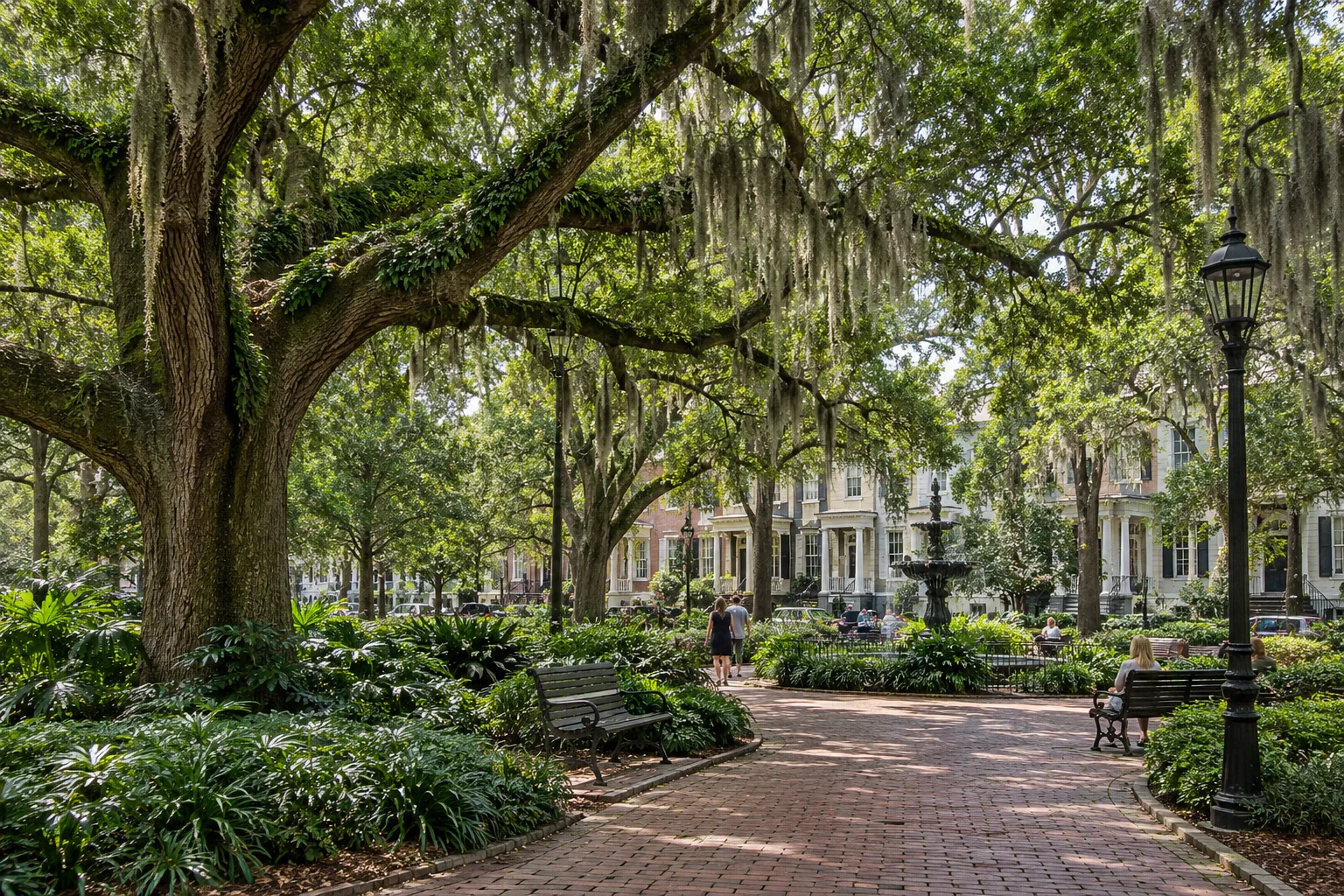
Cover: AI-generated illustration. © ANUSHKA DAHANAYAKE (PVT) LTD.
Savannah’s squares form one of the most legible historic-city plans in the United States, but following them only for moss-draped photographs misses the city’s meaning. Its port, cotton economy and architecture were inseparable from slavery; African American institutions and communities shaped its culture; and today’s centre remains a place where residents, students and workers negotiate heavy tourism. A useful visit combines beauty with historical honesty.
Build the trip around walking conditions
The historic district is compact enough for long walks, but brick, cobbles, tree roots, high kerbs and summer humidity change the effort required. Stay near the square network if walking is central to the trip. Verify the exact block, because nightlife noise and weekend events vary sharply.
Chatham Area Transit operates local buses and the fare-free dot shuttle through central Savannah. Check its current dot and ferry schedules before relying on a return connection. The Savannah Belles Ferry crosses the river to Hutchinson Island; it is a waterfront outing, not a shortcut between historic squares. The airport and Amtrak station sit outside the walkable core; check a live route or arrange a ride, because arrival beside the squares is not guaranteed.
A car is unnecessary for two central days. If you bring one, use a legitimate garage or metered space and understand street-sweeping and event restrictions. Never leave bags visible.
Day one: squares as an orientation route
Start at Johnson Square, then follow Bull Street south through Wright and Chippewa Squares, continuing through Madison and Monterey Squares to the north end of Forsyth Park. This is a continuous north-to-south spine, not a hunt for every square. The city's monument guide helps identify what you are seeing, including the Tomochichi memorial at Wright Square. Read inscriptions critically and compare them with museum interpretation; monuments reveal who held public power when they were installed, not a complete history.
If heat, rain or uneven paving shortens the walk, end after Chippewa Square and use the dot shuttle or a local bus for the next leg. Check the current stop; a shuttle does not appear at every square. Keep crossings within the marked street grid: the squares are islands amid working traffic.
Choose one house museum or civic building for detailed context. Before buying a ticket, inspect how the site discusses enslaved people, domestic labour and the origin of household wealth. A tour that focuses only on furniture and owners leaves the central story unfinished.
Pause for lunch away from the most congested corner. Savannah’s food includes coastal ingredients, African influences and Southern traditions, but a queue or celebrity name does not guarantee a thoughtful meal. Inspect menus, reserve only when necessary and ask about service charges.
Continue toward Forsyth Park, using the tree canopy without assuming it removes heat risk. Carry water, apply sun protection and rest before fatigue becomes dizziness. The fountain and paths are public spaces used by residents. Keep portrait sessions and groups from blocking movement.
Day two: waterfront, African American history and art
River Street sits below the upper historic district. Historic steps are steep and irregular; use signed accessible routes or lifts where available. Cobble-like surfaces become slippery in rain. The river remains a working shipping channel, so expect large vessels and industrial sound, not a purely picturesque promenade.
Spend meaningful time at an institution or guided experience focused on African American history. The Ralph Mark Gilbert Civil Rights Museum documents Savannah's civil-rights movement; the Beach Institute focuses on African American art and cultural preservation. These are different visits, so check each organisation's programme, access and hours before choosing. Listen, and do not use difficult history as a dramatic photograph setting.
Savannah’s art scene is influenced by students and working artists. Visit a gallery or shop where creators are identified and paid. Ask whether a print or design is original and locally produced. This is more valuable than buying a generic object decorated with Spanish moss.
Finish with a ferry journey only after confirming the last convenient return. A river crossing can help explain the port geography, but it should not replace museum context. Weather and marine operations can interrupt service.
Cemeteries, churches and ghost tours
Historic cemeteries are burial places, not theatrical sets. Remain on paths, do not touch markers and avoid photographing mourners. Bonaventure Cemetery lies outside the central walking grid; plan transport and closing time. Heat, insects and uneven ground require preparation.
Churches and synagogues have active congregations. Enter only during visitor hours, dress appropriately and do not interrupt worship. For ghost tours, select an operator that respects private homes, burial sites and documented history. Loud groups moving through residential streets late at night damage both community trust and the visitor experience.
Tybee Island and Fort Pulaski need their own plan
Tybee is not a quick extension of a downtown walk. Beach traffic, parking and seasonal crowding can consume time. Check transport, lifeguard information, surf conditions and the final return before leaving Savannah. Swim near lifeguards and observe turtle-nesting protections.
Fort Pulaski National Monument offers military, engineering and emancipation history. The National Park Service lists park hours, last entry and closures; check its current fees as well. The coastal environment brings sun, wind, mosquitoes and sudden storms. Do not combine the fort and beach with a full museum day unless the group genuinely has the time and stamina.
Weather, flooding and accessibility
Spring can be beautiful but busy. Summer brings intense heat, humidity and thunderstorms; begin outdoors early and move museums into midday. Hurricane season requires flexible bookings and attention to official guidance. Heavy rain can flood low streets. Never enter standing water or move a barrier.
The city publishes a downtown accessibility guide, yet conditions remain highly specific. Brick paving, basement-level entrances and historic steps affect different sites. Ask for the precise accessible entrance and restroom. A signed River Street elevator or ramp may avoid historic steps, but check current access before committing to the lower waterfront. Use the dot shuttle to shorten distance and build rest into the route.
Routine city safety applies: secure valuables, use lit streets after dark and watch for vehicles around squares. Horse carriages, bicycles and tour vehicles share constrained roads. Give working animals space and never step into traffic for a photograph.
Costs and final checks
Accommodation and tours dominate the budget. Balance them with free squares, parks, ferry rides when operating and self-guided public routes. One excellent historically complete tour is worth more than several overlapping entertainment tours. Buy directly from makers when shopping.
Forty-eight hours before arrival, check CAT and dot service, museum hours, weather and any river or beach plans. Save one rain-safe alternative. Continue through our United States collection, read what makes the United States special, compare another historic Southern city in the Charleston guide, or continue to the islands using our Key West guide.
Questions and answers
Can Savannah's historic district be explored without a car?
Yes. The central squares are walkable, and CAT's fare-free dot shuttle can shorten the route. The Savannah Belles Ferry crosses to Hutchinson Island; it does not replace travel between the squares. Check current schedules.
How long should a first Savannah visit last?
Two full days cover the principal squares, waterfront and several museums. Add a third day for Tybee Island, Fort Pulaski or deeper cultural visits.
Are Savannah's squares public parks?
They are public civic spaces surrounded by working streets and homes. Stay on public paths, keep noise reasonable and leave monuments and vegetation untouched.
Sources
New York City · 40.7128° N, 74.0060° W
This story belongs to Savannah, United States. A country of home towns and large ideas, from Independence Hall and the first national park to jazz, skyscrapers and volcanic islands.