Seoul: Royal Palaces, Hanok Lanes and a Restored Stream
Gyeongbokgung, Changdeokgung, Bukchon and Cheonggyecheon tell Seoul's story from the Joseon founding to a motorway removed in 2005, with a short route to see them.
Seoul has been a capital for more than six centuries, and the Joseon dynasty's choices of 1395 still shape its centre. The founding king Taejo moved into Gyeongbokgung that December, a palace laid out with Bugaksan mountain behind it and the city spread to the south. Its main south gate, Gwanghwamun, dates from the same year. Almost everything has been burned and rebuilt since.
Six centuries of palaces, burned and rebuilt
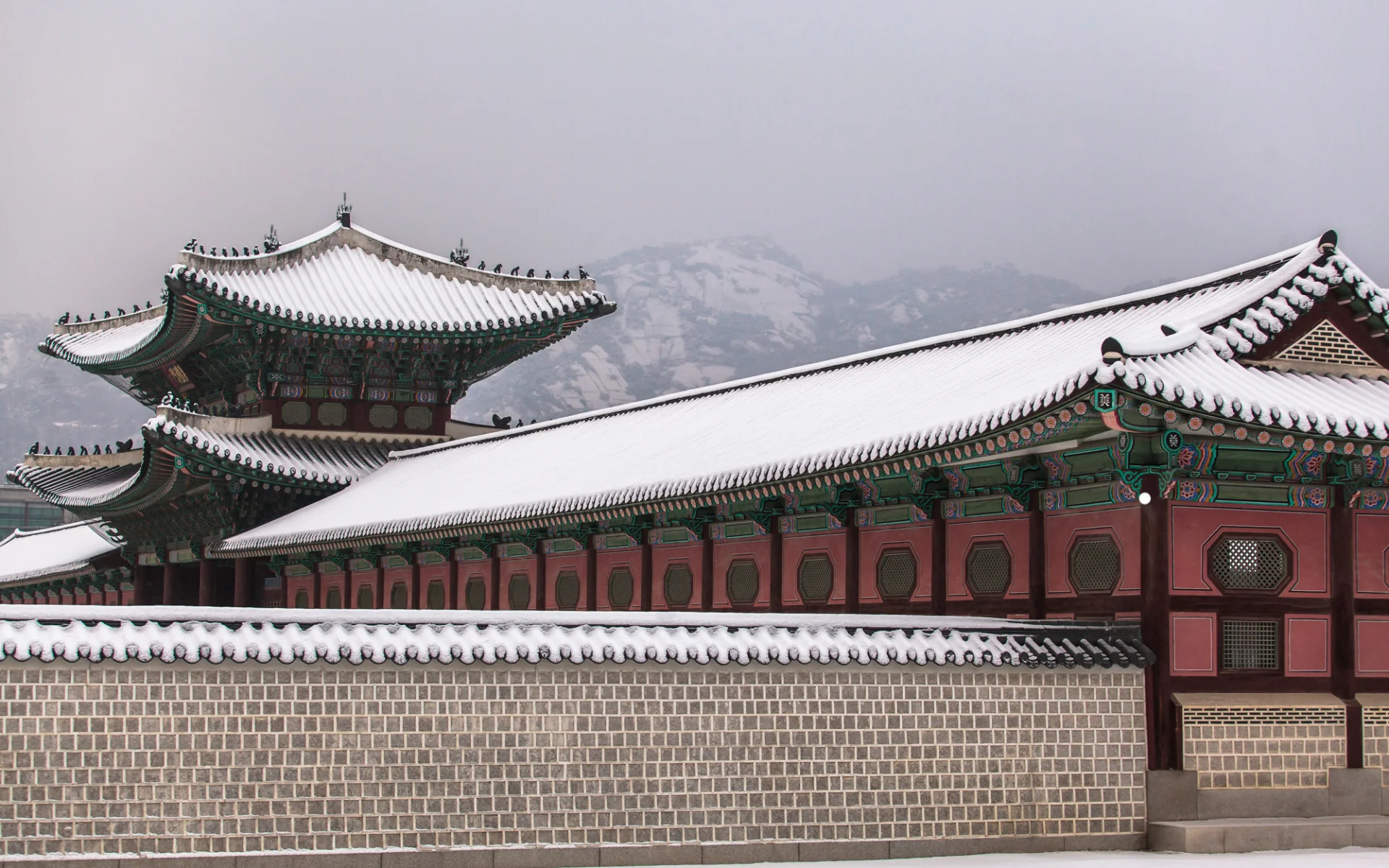
Gyeongbokgung was "completely burned down" in 1592 during the Imjin War and stayed in ruins for more than 270 years. Queen Sinjeong, regent for the young King Gojong, ordered its reconstruction in 1865. The work finished in 1888, when the compound held around 500 structures. Under Japanese rule from 1910 most of those buildings were dismantled and sold, and the colonial administration built its Government-General headquarters in front of the throne hall. By liberation in 1945 only about 40 pre-colonial buildings stood. That headquarters was demolished in 1995–1996, and Gwanghwamun's gate was restored between 2006 and 2010. The throne hall Geunjeongjeon, rebuilt in 1867, is a National Treasure and counts as the largest main hall of any Joseon palace; Gyeonghoeru, the banquet pavilion on its artificial island, is another.
Changdeokgung tells a different story. Built in 1405 as a secondary palace, it was rebuilt first after 1592 (the initial restoration was done by 1610), and then served as the dynasty's main working palace for generations. It joined the UNESCO World Heritage List in 1997, partly because its halls follow the slope and keep the native trees around them. Behind the throne hall Injeongjeon lies the rear garden, Huwon or Secret Garden, with more than 160 tree species, over 70 of them older than 300 years, and the Buyongji pond dug in 1707.
Bukchon, markets and a stream under a highway
Bukchon means "north village": the hillside north of Cheonggyecheon and Jongno where high-ranking officials lived. Around 1920 the developer Chŏng Segwŏn built compact, modernised hanok here, reportedly to keep the district out of Japanese settlers' hands. Building controls from 1976 to 1983 slowed redevelopment, and the lanes survive as a residential neighbourhood of roughly 6,100 people, now receiving millions of visitors a year.
Gwangjang Market began on 5 July 1905, when Korean investors formed the Gwangjang Corporation to run a market independent of Japanese control. It was among the first permanent markets open every day, and its mung-bean pancakes (bindaetteok) and mayak gimbap remain its calling cards.
Cheonggyecheon was dredged by King Taejong from 1406 as a drain through the city. It was covered with concrete from 1958 and carried a roughly 5.6 km elevated highway between 1969 and 1976. Mayor Lee Myung-bak launched its removal in July 2003, and the stream reopened in September 2005 at a cost of more than ₩386 billion, one of the most cited urban reversals in the world.
A palace-and-lanes route through Jongno
A full first day fits the whole historical core on foot. Start at Gwanghwamun, then choose one palace. Gyeongbokgung is the broad introduction and connects to the National Palace Museum and Seochon. Changdeokgung is the quieter, more topographic choice and carries the Secret Garden decision. The Royal Palaces and Tombs Center lists regular closures of Tuesday for Gyeongbokgung and Monday for Changdeokgung, with holiday exceptions, so check the official palace admission page shortly before travelling. Garden entry is capped, part online and part on the day, and its route changes with the weather.
Walk on through Seochon or Bukchon in the afternoon. Seoul's official Bukchon guidance limits non-resident access to the residential Red Zone to 10:00–17:00 and asks for quiet, small groups and no filming into homes. The lanes are steep, so a cultural centre or a lower palace-wall route suits anyone who cannot manage hills. Finish at Cheonggyecheon, or have bindaetteok at Gwangjang, and keep the aisles clear and ask before filming a vendor.
A second day can add one modern cluster: Hongdae and Yeonnam for performance and nightlife, Seongsu for converted factories and workshops, or the National Museum of Korea in Yongsan for a long indoor day. A third can follow the Han River at Yeouido or climb Namsan. Incheon Airport connects by the all-stop AREX, which accepts a T-money card and also reaches Hongik University, or by the non-stop Express to Seoul Station on a separate ticket. Seoul's official airport guide explains the choices.
Heat, dust, access and help in one place
Summer heat and humidity call for water and indoor breaks; winter ice makes palace stone and hanok slopes slippery, so shoes with grip matter. Fine dust is separate from the weather forecast, so check AirKorea's current Seoul readings before a river walk or mountain route. After heavy rain, stream safety guidance warns that Cheonggyecheon can rise quickly; leave when alarms sound and never shelter under a bridge.
Most subway stations have lifts, but smaller or older stations may not, and the lift can sit at a different exit from the one nearest the hotel. Seoul's accessible travel guide links the Danurim service for routes and mobility-aid rental. Save the Korean address of the accommodation and the numbered station exit.
Do not touch painted woodwork or enter closed rooms in the palaces, and do not step into a hanok doorway because it looks traditional. Serious allergies need a translated card: sesame, soy, anchovy broth, fish sauce and shellfish are common and not always visible at a market grill.
Call 112 for police and 119 for fire or ambulance. Korea's visitor emergency guide also lists 1330 for multilingual tourist information, useful for a non-life-threatening travel problem.
Cover photograph: “경복궁의 겨울” (Gyeongbokgung in winter) by Yoonj, photographed 20 January 2017, geotagged own work licensed CC BY-SA 4.0. The snowy palace roofs were centre-cropped to 16:10 and converted to responsive WebP sizes; no scene element was generated, added or removed.
Continue through the South Korea destination hub, compare the Busan coast and market guide, or read the Kyoto respectful first-time guide for another capital of palaces and living wooden lanes.
Questions and answers
How many days are enough for a first visit to Seoul?
Three full days cover one historic palace axis, one modern neighbourhood cluster and one interest-led final route without constant cross-city travel. Four or five days allow more museums, markets or mountain time.
Which Seoul palace should a first-time visitor choose?
Choose Gyeongbokgung for a broad introduction or Changdeokgung when the architecture and restricted-access Secret Garden matter more. Check the official closure and reservation rules before choosing.
Is Seoul manageable without a car?
Yes. AREX, the subway, buses and occasional taxis cover the useful visitor areas. Save Korean addresses and station exit numbers because the final walk and interchange can be more difficult than the train journey.
Sources
Seoul · 37.5665° N, 126.9780° E
This story belongs to Seoul, South Korea. A peninsula of dense cities, mountain landscapes, maritime regions and layered histories, where local identity extends far beyond Seoul.