Singapore Chinatown: A Respectful Heritage and Food Guide
A practical Chinatown route that treats temples, mosques, clan history, shophouses and hawker centres as living community places rather than props.
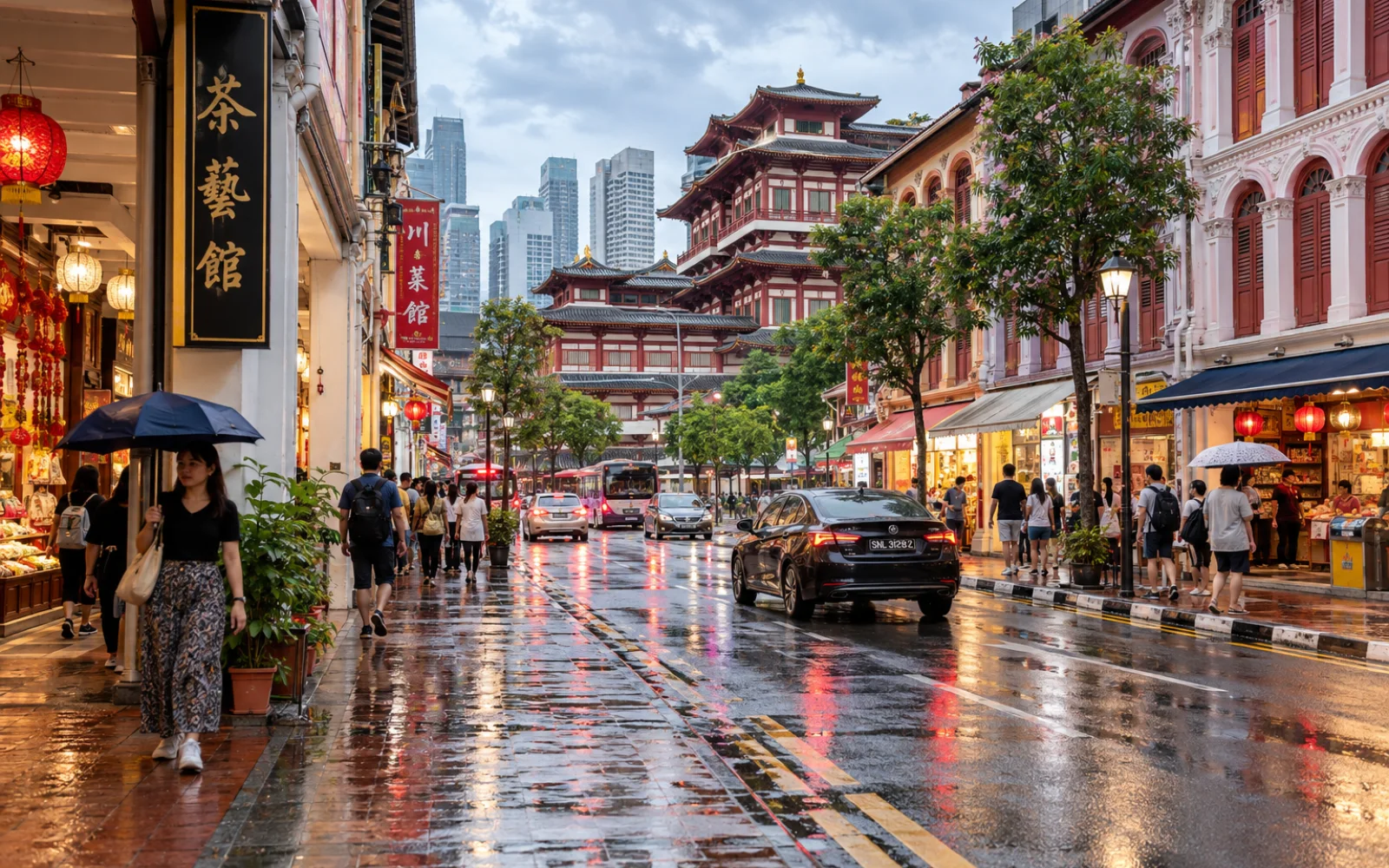
Cover: AI-generated illustration. © ANUSHKA DAHANAYAKE (PVT) LTD.
Singapore Chinatown is not one uniform Chinese enclave. Telok Ayer's early places of worship, Kreta Ayer's markets and performance histories, clan institutions, public housing and contemporary businesses overlap within a small district. A useful visit notices those layers and avoids reducing the community to lanterns, snacks and staged photographs.
Start with geography, not the souvenir street
Chinatown MRT provides convenient access, but several exits lead to different levels and streets. Save the destination name and exit before going underground. Telok Ayer MRT may be more logical for a route beginning around the early waterfront streets, while Maxwell MRT can reduce walking for the southern side.
The National Heritage Board account of Thian Hock Keng places the former shoreline along Telok Ayer Street. Thian Hock Keng began as a small prayer house by the Telok Ayer Basin and was rebuilt between 1839 and 1842 into the temple standing today, regarded as Singapore's oldest Chinese temple. It and nearby institutions make more sense when visitors understand that migrants arrived through a working port and built places for worship, mutual help and trade. Begin at an interpretation centre or heritage marker instead of trying to reconstruct the story from shop signs alone.
A manageable route moves from Telok Ayer towards South Bridge Road and Kreta Ayer, or in reverse. It should not zigzag between every popular food stall. Distances are short, yet heat, traffic lights, interior visits and crowded covered walkways make progress slower than a map predicts.
Worship spaces require different behaviour
The district contains Buddhist, Taoist, Hindu and Muslim sites close together. This proximity is historically significant, but it does not make the buildings interchangeable visitor attractions. Check each site's official opening information and current visitor areas. Ceremonies, prayer and community events take priority over tourism.
At a temple, dress modestly, silence the phone, remove shoes when instructed and do not cross ropes or raised thresholds carelessly. Avoid flash, and never photograph a worshipper, monk, offering or funeral activity without clear permission. Smoke from incense may affect asthma; step outside rather than asking a religious practice to stop for comfort.
Sri Mariamman Temple, Singapore's oldest Hindu temple, was founded as a timber-and-attap shrine in 1827 by Naraina Pillai; the brick core of the present building dates from around 1843. Follow current footwear and photography rules, and treat its sculpted gopuram and shrines as objects of worship. At Jamae Mosque or another Muslim space, observe prayer-time restrictions, use provided coverings if required and keep voices low. If access is closed, accept the exterior view and return another time.
One respectful interior teaches more than five rushed doorway photographs. Guides should be licensed where required and able to explain differences accurately and not repeat myths.
Read the conserved shophouse carefully
Singapore's shophouses combine business and residence histories, narrow plots, covered five-foot ways, internal courtyards and decorative traditions that changed across periods. Conservation protects significant external form, but the buildings still contain private homes, offices and working premises.
Do not enter a staircase or courtyard because a door is open. Keep the covered walkway passable, particularly for older residents, wheelchair users and workers moving goods. Tripods and group portraits can block the very public corridor that makes the architecture important.
Look for proportion, ventilation, shutters, ceramic details and the relationship between old buildings and new towers. Those observations reveal more about how the district responded to trade, climate and community needs than copying a façade ornament exactly. URA conservation guidance provides useful context for why restoration is controlled.
Hawker centres without queue confusion
Maxwell Food Centre, Chinatown Complex and nearby eating places have different rhythms, renovation schedules and stall rest days. No single stall is mandatory. If the famous queue is long, choose a busy alternative whose food suits the group, and do not lose an hour proving attendance.
At a hawker centre, first secure food in a way that follows local practice without occupying a table unfairly. Return trays and crockery to the designated station. Keep tissues and bags controlled, do not leave valuables unattended and share larger tables when the setting expects it.
Ask about allergens directly, while recognising that a busy stall may not guarantee separation from shellfish, peanuts, egg, gluten or pork. Vegetarian dishes can contain lard, fish sauce or stock. Travellers with severe allergies should carry translated information and choose a business able to answer confidently.
Carry a reusable bottle, but do not refill it from a sink not marked for drinking. Alcohol rules, smoking restrictions and public-cleanliness laws are enforced. Dispose of litter properly and never feed birds around food areas.
A realistic half-day route
Begin in Telok Ayer during the cooler morning. Use official markers to understand the former shoreline, visit one open place of worship and continue through Ann Siang or Club Street without treating residential façades as a photo studio. These streets include slopes; visitors with mobility needs may prefer a flatter South Bridge Road sequence.
Break for lunch before the main rush or accept that a shared table is part of the experience. After lunch, choose the Chinatown Heritage Centre or another current cultural institution when open. Exhibitions, hours and ticketing change, so verify before arrival.
Continue towards Buddha Tooth Relic Temple and Museum, Kreta Ayer Square or nearby community spaces. The temple has visitor guidance and active religious functions. The exterior photograph does not grant permission for every interior image. End at the market only if shopping serves a purpose; otherwise use the time for tea, a slower street or a return to an exhibit that deserves attention.
Rain, heat and step-free planning
Five-foot ways provide shade but are not a continuous weatherproof tunnel. Road crossings, temple courtyards and queues are exposed. During lightning or intense rain, move into a legitimate public interior or MRT station. Do not crowd a shop entrance without buying or block an emergency exit.
Stone tiles and painted kerbs become slippery. Comfortable footwear with grip matters more than an elegant photograph. Singapore heat remains significant under cloud; drink water and use an air-conditioned stop before fatigue becomes illness.
Wheelchair access varies across conserved buildings, and a step-free doorway may lead to an interior without full lift coverage. Contact the exact venue for entrance, toilet and gallery information. Chinatown MRT has accessible routes, but the most convenient lift may emerge on the opposite side of a busy road.
Choose a local keepsake with context
If you buy a print, ceramic or food gift, ask who made it, where it was produced and what the design refers to. This distinguishes work by a local maker from generic heritage goods. Treat calligraphy and religious symbols as meaningful work, and ask before photographing a calligrapher at work. A book from a museum or local writer can carry more of Chinatown's history than a mass-produced ornament.
The Singapore Chinatown place page and Singapore collection offer more context.
Continue through the Kampong Gelam culture guide to compare another trading district with different religious and political histories, or the Little India guide for the community whose temples began here. The Tiong Bahru neighbourhood guide is a short ride away and shows how the city housed its people from the 1930s. Chinatown becomes more valuable when visitors leave understanding migration, conservation and living community—not merely carrying the same red souvenir sold elsewhere.
Questions and answers
How much time should visitors give Singapore Chinatown?
Allow at least half a day for one heritage institution, two places of worship, a meal and slow walking. A full day suits visitors adding Telok Ayer and an evening food stop.
What should visitors wear for Chinatown temples?
Carry clothing that covers shoulders and knees, remove shoes where directed, follow photography signs and never interrupt prayer for a picture.
Is Chinatown suitable during tropical rain?
The covered five-foot ways help, but road crossings remain exposed and intense rain can reduce visibility. Use museums, markets or MRT access until lightning clears.
Sources
Singapore · 1.3521° N, 103.8198° E
This story belongs to Chinatown, Singapore. An island city of Malay, Chinese, Indian, Peranakan and global communities, where dense neighbourhoods and protected nature keep distinct identities.