Kampong Gelam Beyond Haji Lane: A Respectful Culture Guide
A half-day Kampong Gelam guide that connects Sultan Mosque, Malay and regional trade history, textiles, food and contemporary streets responsibly.
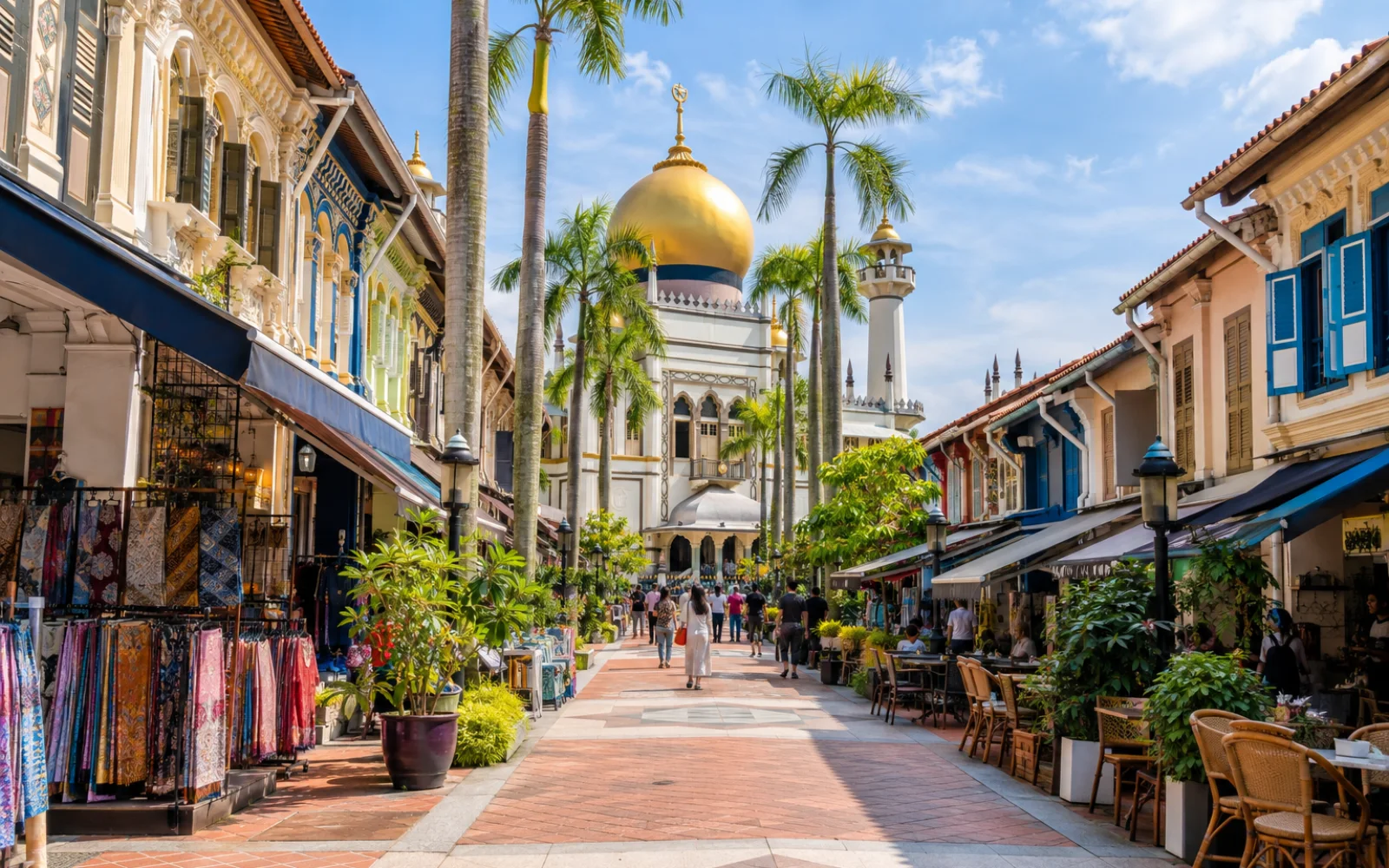
Cover: AI-generated illustration. © ANUSHKA DAHANAYAKE (PVT) LTD.
Kampong Gelam is regularly compressed into one colourful photograph of Haji Lane. That misses the district's importance as a centre of Malay royal history, Muslim life and regional commerce involving merchants and travellers from across the archipelago and beyond. A thoughtful route begins with that history, then lets contemporary shops and murals occupy their proper place.
Arrive through the wider district
Bugis MRT is the most common arrival point, while Nicoll Highway and nearby bus routes may suit other journeys. Station names do not eliminate tropical walking. Save the route to the first heritage stop and choose an exit that avoids unnecessary road crossings.
The historic district extends across streets with different uses. Bussorah Street creates the familiar approach to Sultan Mosque. Arab Street is associated with textiles, carpets and trade. Haji Lane contains bars, boutiques and murals. Sultan Gate connects with the former palace area and Malay heritage interpretation. Treating all four as the same “Instagram street” erases why their forms differ.
Weekday mornings are calmer, but not every business opens early. Friday prayers, Ramadan, festivals and private events change movement and access. A visitor does not have priority over religious or community life. Check the calendar and retain an alternative order.
Sultan Mosque as a place of worship
Sultan Mosque is an active mosque and national monument. Sultan Hussein Shah built the first mosque here beside his palace in 1824–26; the present building, designed by Denis Santry of Swan & Maclaren, was raised in stages so worship could continue and completed in 1932. Non-Muslim visitors should use the designated entrance and current visitor hours. Wear clothing that covers shoulders and knees; coverings may be available, but arriving prepared is more respectful. Remove footwear when directed and keep it where staff indicate.
Do not enter the prayer space during a closure, step in front of worshippers or photograph people praying. Silence phones and avoid using a visit as a fashion shoot. The building's golden dome is a strong orientation point, yet its decoration and calligraphy are not free design assets for commercial products.
If the mosque is closed, examine the district from public streets, read reliable interpretation and return later only if the schedule allows. Never pressure staff to make an exception because the itinerary is tight.
Visitors unfamiliar with Islam may benefit from a recognised guided tour or official material. Ask sincere questions at an appropriate time, without expecting a worshipper to become an unpaid lecturer. Distinguish religious practice from assumptions about ethnicity: Singapore's Muslim communities are diverse.
Malay heritage needs more than one building
The Istana Kampong Gelam area and Malay heritage institutions explain the district's links to royalty, trade, language, arts and regional migration. The two-storey palace was completed in 1843 by Sultan Hussein's son, later Sultan Ali Iskandar Shah, replacing a timber residence; it opened as the Malay Heritage Centre in 2005 and became a national monument in 2015. Exhibition access can change during refurbishment or programming, so confirm current status rather than relying on an old blog.
Use an official heritage trail to connect markers and surviving structures. Street names provide clues but are not a complete account. The district involved Bugis, Javanese, Arab, Indian and other networks alongside Malay political life. Good interpretation shows relationships and avoids a single simplified origin story.
Allow time to read. Museum labels and oral histories deserve more than the minutes left after shopping. Families can give children a small observation task—shutter shapes, five-foot ways, trade goods—without turning sacred spaces into a scavenger hunt.
Textiles, food and responsible buying
Arab Street and nearby lanes contain textile businesses with different levels of expertise and origin. If buying fabric, ask the fibre, width, care instructions, country of manufacture and whether the pattern has a named cultural source. “Batik” describes processes and traditions broader than one souvenir print; learn who produced the cloth before claiming it as locally handmade.
Do not photograph a merchant's pattern book or copy a custom design for later printing. A shopkeeper showing material is offering service, not surrendering intellectual property. If commissioning clothing, confirm measurements, fitting schedule, final price and collection time in writing.
The food landscape includes Malay, Indonesian, Middle Eastern and contemporary Singaporean businesses, but labels should not be treated casually. Ask whether a restaurant is halal-certified if certification matters; décor and cuisine are not proof. Respect no-alcohol policies and do not bring outside food into a small premises without permission.
Popular streets become crowded at lunch and in the evening. Reserve a priority restaurant where possible, but keep a second option nearby. A good meal at a quieter family business may reveal more than a queue selected by an algorithm.
Contemporary art without taking it
Haji Lane and surrounding walls include commissioned murals and changing commercial graphics. Public visibility does not mean the art is free to reproduce on T-shirts, posters or product packaging. Photograph for personal memory where allowed, credit the artist when known and contact the rights holder for commercial use.
Avoid using a doorway, staircase or mural wall as a long portrait set when customers and residents need access. Keep equipment compact. Drones are inappropriate in this dense urban setting without the necessary legal permissions and safety planning.
Independent boutiques vary. Prefer makers who identify the designer, production method and origin. Imported goods are not inherently bad, but they should not be sold through a false claim of neighbourhood craft. Ask a simple question—“Who made this?”—and reward a clear answer.
Build a comfortable half day
Start around Sultan Gate with historical interpretation, then visit Sultan Mosque during an open visitor period. Continue down Bussorah Street and use Arab Street for textile context. Pause for a meal before entering the tightest Haji Lane crowds.
After lunch, choose either deeper heritage reading or contemporary shops; doing both thoroughly may require more time. Walk the perimeter streets to understand the conserved scale, then finish near Bugis for straightforward transport. This route avoids retracing every lane and keeps the mosque near the beginning, when clothing and energy are prepared.
Singapore's midday heat is serious even across short distances. Carry water, use shade and add an indoor stop. A thunderstorm can make awnings unsafe and drains fast-flowing. Enter a proper public venue during lightning, and never shelter under a tree or block a shop.
Accessibility and family detail
Footways may include kerbs, tactile paving, crowded tables and older entrances with steps. A district can be broadly walkable without every venue being wheelchair-accessible. Contact the mosque, museum or restaurant for the exact entrance, lift and toilet information required.
Families should keep children close around roads and busy dining lanes. Explain worship behaviour before arrival, carry a quiet activity for waiting and schedule food before exhaustion. Pushchairs may be easier outside peak hours, but covered corridors must remain open to other pedestrians.
Visitors sensitive to sound should expect calls to prayer, traffic, music and evening crowds. A weekday morning and a short planned route may be more enjoyable than forcing the busiest period.
Choose a meaningful local keepsake
In a district shaped by textile trade, worship and changing street art, a useful purchase has a maker and a story you can check. Ask whether a textile was woven, printed or sewn locally and whether the seller can name the designer. Avoid reproductions of mosque calligraphy, sacred motifs or murals presented without the creator's permission. Leave room in the visit to learn how a shop or workshop fits the neighbourhood before buying.
The Kampong Gelam place page gives a short local orientation, while the Singapore collection helps compare other districts. For Singapore's other historic communities, compare the Chinatown heritage guide and the Peranakan streets in our Katong and Joo Chiat guide. Continue through the Little India practical guide to compare another living heritage quarter with different worship, migration and market rhythms.
A strong Kampong Gelam visit leaves money with responsible businesses, space for worshippers and a more accurate understanding than the single mural photograph that first attracted attention.
Questions and answers
How long should visitors spend in Kampong Gelam?
Allow four to six hours for one heritage visit, Sultan Mosque when visitor access is open, a meal and the surrounding streets without rushing worship or businesses.
Is Haji Lane the main reason to visit?
It is one contemporary commercial street. The district's deeper value lies in Malay royal history, regional trade, living religion, textiles and community institutions.
Can non-Muslims visit Sultan Mosque?
Visitor access is normally possible in designated periods, but prayers and events take priority. Check current guidance, dress modestly and follow staff directions.
Sources
Singapore · 1.3521° N, 103.8198° E
This story belongs to Kampong Gelam, Singapore. An island city of Malay, Chinese, Indian, Peranakan and global communities, where dense neighbourhoods and protected nature keep distinct identities.