What Makes Perth Special: River, Ocean and Noongar Country
Whadjuk Noongar country, a riverside bushland park, a World Heritage convict prison, Wadjemup and a gold mint from 1899. A guide to what makes Perth special.
In February 1962, as John Glenn orbited the Earth and passed over Western Australia at night, Perth's residents left their lights burning for him, and he called it the "City of Lights", and the city's own history still tells the story with pride. It sums up a place that has always been aware of its distance from everywhere else and has made a virtue of it: a capital on a broad river, facing the Indian Ocean, with a long Aboriginal history and a colonial story that is less than two centuries old.
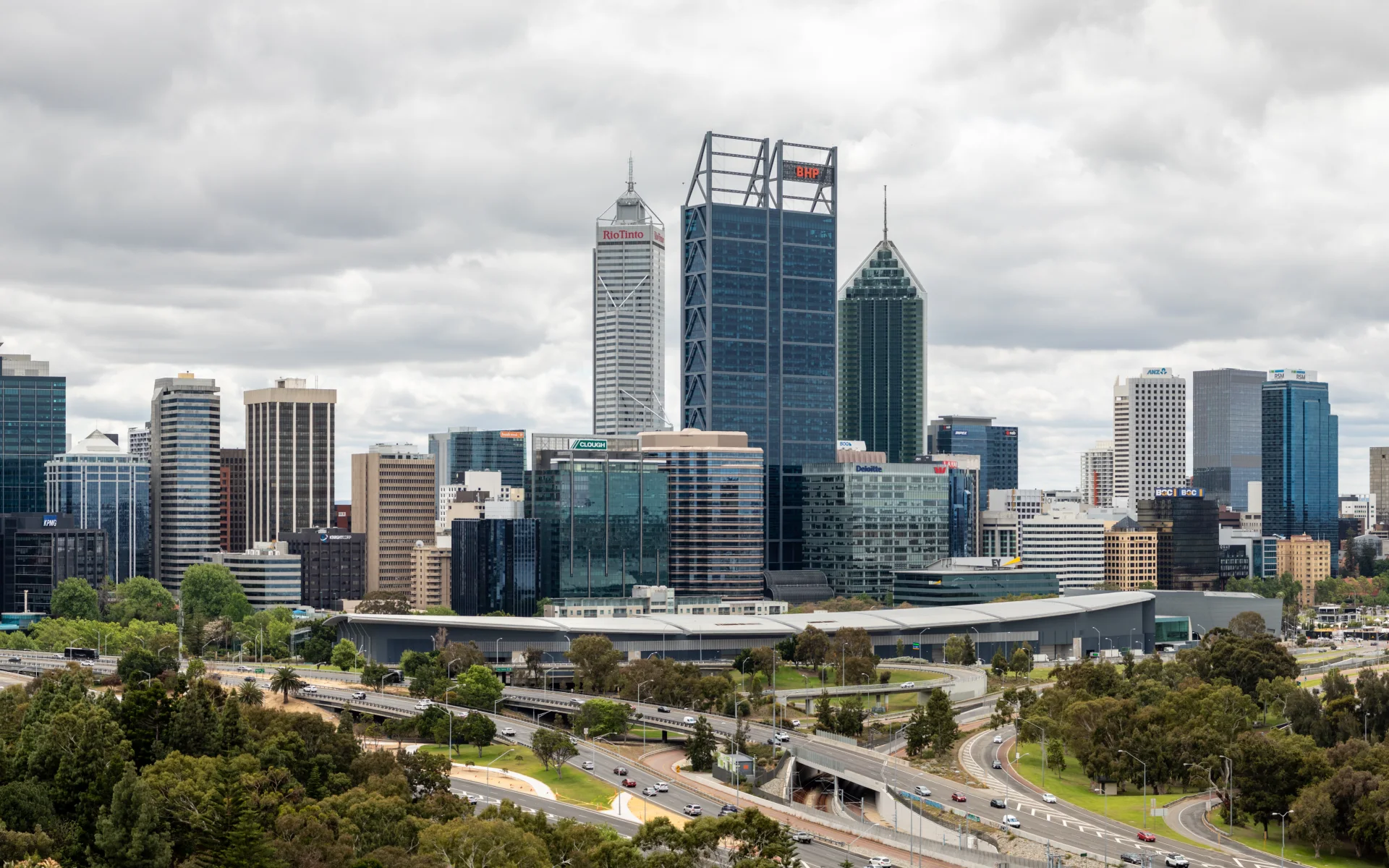
Cover photograph: Perth from Kings Park by Dietmar Rabich/Wikimedia Commons, licensed CC BY-SA 4.0; cropped for this page. It was photographed in October 2019 and does not represent current traffic or weather.
Derbarl Yerrigan and Whadjuk Noongar country
Long before the British arrived, the river now called the Swan was, and remains, Derbarl Yerrigan to the Whadjuk Noongar people, whose country the city occupies. In Noongar tradition the river and its waterways were shaped by the Waugal, the creator serpent. Noongar knowledge divides the year into six seasons read from weather, plants and animals rather than dates: Birak and Bunuru, the hot dry months of early summer and late summer; Djeran, when the weather cools; Makuru, the coldest and wettest; Djilba, the season of growth; and Kambarang, when wildflowers are everywhere. Several local councils, including the City of Cockburn, publish guides to the calendar, and it is worth knowing before planning around "spring" or "summer".
Captain James Stirling established the Swan River Settlement in 1829. The colony grew slowly until gold was found far to the east, and later mining booms gave the city its modern skyline.
Kings Park, a reserve that grew
On the bluff above the city, Kings Park and Botanic Garden began as a reserve of about 175 hectares on Mount Eliza in 1872. In 1890 John Forrest, then Surveyor General, added land that brought it to roughly 400 hectares, and in 1901 Perth Park was renamed Kings Park to mark the accession of Edward VII. Much of it is still native bushland, which is unusual for a central city park. The surrounding south-west of Western Australia is one of the world's recognised biodiversity hotspots, with thousands of plant species found nowhere else. In Kambarang, roughly October and November, and through the spring wildflower season, the garden beds and bush trails are at their most colourful.
Fremantle, convicts and a yachting summer
Fremantle, at the river mouth, is a port town of limestone warehouses, pubs and markets with an identity of its own. Its best-known building is Fremantle Prison, built by convict labour from the 1850s and used as the state's main prison until it closed in 1991. In 2010 UNESCO inscribed it on the World Heritage List as one of the Australian Convict Sites, a group of eleven places telling the story of forced migration; the Western Australian Government manages the site and its tours.
Fremantle also had its moment on the world stage. After Australia II won the America's Cup off Newport, Rhode Island, in 1983, ending the New York Yacht Club's long hold on the trophy, the defence was sailed in Gage Roads off Fremantle in early 1987. The American challenger Stars & Stripes won 4–0, but the regatta remains a proud chapter in the old port's story.
Wadjemup: island of beaches and of memory
Rottnest Island, Wadjemup to the Noongar, lies a short ferry ride offshore. Visitors come for its car-free roads, sheltered bays, reef snorkelling and the quokkas, the small marsupials that seem to smile in photographs. The island also has a painful history that is now told openly. From 1838 it was used as a prison for Aboriginal men and boys from across Western Australia; state records indicate that about 3,700 were imprisoned there before the penal establishment fully closed in 1931, and hundreds died. The Quod, the prison block completed in 1864 by Aboriginal prisoner labour, was later used as holiday accommodation. The island's own Aboriginal history pages tell this story, and visiting with that knowledge changes how the island feels.
Gold, a mint and a working river
The Perth Mint opened on 20 June 1899 as the third Australian branch of Britain's Royal Mint, after Sydney and Melbourne, to mint gold from the Western Australian rushes. It is the oldest branch of the Royal Mint still operating in its original premises, and its gold-pouring demonstrations connect the city to the goldfields that built it. The river below the city carries ferries to South Perth, sailing boats and, often, dolphins.
Sunsets into the sea, and what to eat
Perth is one of the few large Australian cities where the sun sets over the ocean. Cottesloe, with its Norfolk pines, is the classic place to watch, and the coast runs north through City Beach and Scarborough. The local afternoon sea breeze, known as the Fremantle Doctor, often brings relief on hot days. Western rock lobster and Fremantle fish and chips are the seafood staples, marron is the local freshwater crayfish, and the Swan Valley upriver has wineries, breweries and Aboriginal cultural tours.
Moving around a spread-out city
The metropolitan area is very large, so plan by geography. Transperth trains, buses and ferries share one fare system, contactless bank-card payment works for standard fares, and free CAT buses circulate in central Perth and Fremantle. The Airport Line links the airport with the city. Rottnest ferries leave from Fremantle, central Perth and Hillarys, so choose the departure point before buying a ticket. A car helps for the Swan Valley and day trips; never combine driving with winery tastings.
Heat, sun and the sea
Summer, December to February, is hot and dry and the UV index can be very high. Plan walks and beaches for early morning or late afternoon, carry water and use shade. Check Beachsafe for patrol and hazard information, swim between the red and yellow flags where lifeguards are operating, and obey local closures. Spring and autumn are milder, and winter is cool and wet. In hot, windy weather check Emergency WA and never enter a closed trail.
Four days, one city at a time
Give the first day to Kings Park in the cool of the morning, the city and the Mint, then a Cottesloe sunset. The second belongs to Fremantle: the prison tour, the harbour and the market. Use the third for Rottnest by ferry, with a bicycle or the island bus. Rottnest's wildlife rules forbid touching or feeding quokkas, so keep food sealed and give them space. Keep the fourth day flexible for the Swan Valley or the northern beaches; Margaret River deserves at least one overnight, and the Pinnacles a long day of their own. Do not put Rottnest on the morning of an evening flight, since the airport is on the far side of the city.
Book only the fixed parts first: a Fremantle Prison tour if it matters to you, then the Rottnest ferry and any island mobility equipment. Leave the coastal sunset and Kings Park movable so wind, heat or rain can decide their order. On Rottnest, compare cycling with the island bus honestly: heat, wind and distance make a bicycle a poor choice for some visitors.
Perth among Australia's cities
Perth's pride comes from the river, the Noongar seasons, a convict prison, a gold mint and a city that once lit its lamps for an astronaut. For comparison with the east coast, read what makes Brisbane special or the Melbourne first-time visitor guide, and what makes Australia special puts the west in national context. The Australia page gathers every city covered.
Questions and answers
What is a quokka?
A small, cat-sized marsupial best known from Rottnest Island off Perth, famous for appearing to smile in photographs. They are protected; do not touch or feed them.
Why is Perth called the most isolated city?
Perth is separated from Australia's other large cities by thousands of kilometres of desert and ocean, and the distance has given the city a self-reliant character.
How many days do you need for Perth?
Four days is a practical first visit: one for Perth and Kings Park, one for Fremantle, one for Rottnest Island and one for the coast or Swan Valley.
Can you explore Perth without a car?
Yes for the centre, Kings Park, Fremantle, Cottesloe and Rottnest. Hire a car only when a specific regional itinerary makes it useful, and never combine driving with winery tastings.
Sources
Melbourne · 37.8136° S, 144.9631° E
This story belongs to Perth, Australia. A continent of the world's oldest continuing cultures, a World Heritage reef and cities that each began for different reasons.