What Makes Texas Special: Big Land, Big Pride
The Alamo, the San Antonio Missions, barbecue, cowboy culture, live music and a pride like no other state's. What makes Texas special.
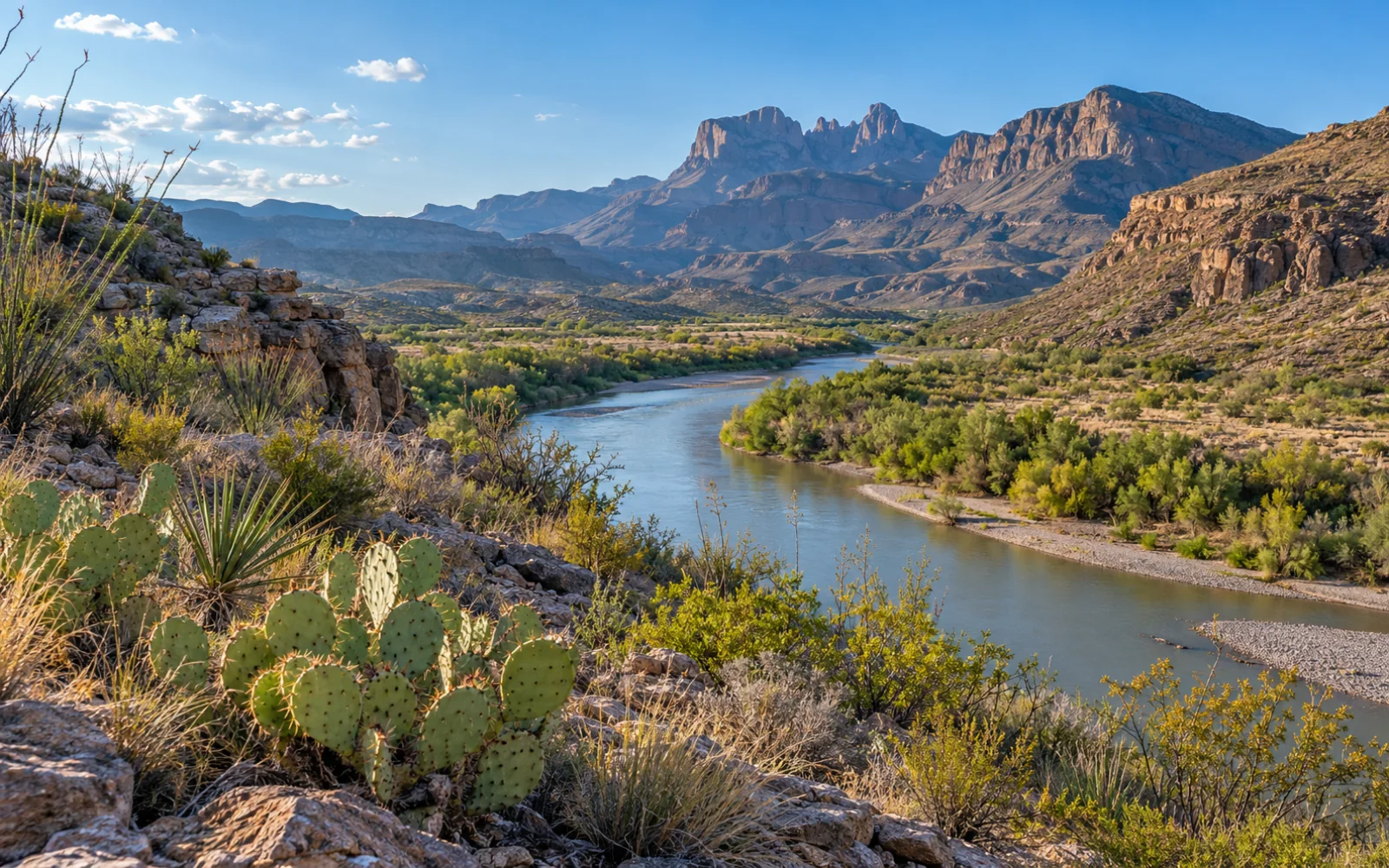
Cover: AI-generated illustration. © ANUSHKA DAHANAYAKE (PVT) LTD.
On 2 March 1836 delegates meeting in convention declared Texas independent of Mexico. For almost ten years afterwards it was a country, with its own president, army and flag, until it joined the United States as the 28th state on 29 December 1845. That spell as a republic still shapes how Texans see themselves, and the Lone Star flag flies over petrol stations and front porches across a state larger than most nations.
Five missions on one river
Long before the republic, Spanish Franciscans built a chain of missions along the San Antonio River in the eighteenth century, where Indigenous people of the region lived, farmed and worshipped alongside the friars. Four of them, Concepción, San José, San Juan Capistrano and Espada, form San Antonio Missions National Historical Park, and the fifth, Mission San Antonio de Valero, is the Alamo, owned by the State of Texas. Together they were inscribed on UNESCO's World Heritage List in July 2015. The stone churches are still active parishes, and the Espada Aqueduct, part of the old mission irrigation system, is a National Historic Landmark.
The Alamo is remembered above all for the 1836 siege, when its defenders were killed by the Mexican army under Santa Anna. "Remember the Alamo" became the battle cry when Texan forces won at San Jacinto weeks later, on 21 April 1836, the fighting that secured independence.
Juneteenth: freedom announced in Galveston
On 19 June 1865 the Union general Gordon Granger issued General Order No. 3 in Galveston, informing the people of Texas that all enslaved people were free. The Emancipation Proclamation had technically freed them two and a half years earlier, but the news had not been enforced in Texas. Black Texans kept the date as a celebration of freedom, and the tradition spread across the country. On 17 June 2021 Juneteenth National Independence Day became a federal holiday, the first new one since Martin Luther King Jr. Day. The original order is held by the National Archives.
Spindletop and the oil age
On 10 January 1901 a well drilled by Anthony Lucas on the Spindletop salt dome near Beaumont blew out, sending oil far above the derrick for nine days before it could be capped. Beaumont's population tripled within months, Texas oil output multiplied, and companies such as Gulf Oil and Texaco grew out of the boom. The Texas State Historical Association calls it the birth of the modern petroleum industry.
"Houston, Tranquility Base here"
Houston's other claim on history came in July 1969, when Neil Armstrong radioed "Houston, Tranquility Base here. The Eagle has landed" to Mission Control at what is now NASA's Johnson Space Center. The Apollo Mission Control room there has been restored to how it looked that summer. "Houston" was not literally the first word spoken on the Moon, as fact-checkers have pointed out, but the city's name is fixed in that moment.
Barbecue capital and Czech kolaches
Central Texas barbecue has deep roots in small-town meat markets. Kreuz Market in Lockhart began as one and took its name in 1900, when Charles Kreuz bought the business, and the Texas House of Representatives named Lockhart the Barbecue Capital of Texas in a 1999 resolution. Slow-smoked brisket, seasoned with little more than salt and pepper, is now the dish visitors queue for.
Czech settlers, most of them from Moravia, arrived in Central Texas from the 1850s, and they brought the kolache, a sweet bun with fruit or cheese in the centre. The town of West calls itself the Czech Heritage Capital of Texas, and roadside bakeries along the highways sell kolaches each morning. Tex-Mex, built on the state's Mexican and Tejano roots, gives Texas its everyday foods: breakfast tacos, enchiladas and chili.
Music from Willie Nelson to Tejano
Austin calls itself the live music capital of the world, and its best-known export is a television show. Austin City Limits taped its pilot with Willie Nelson in October 1974, premiered on PBS in 1975 and is described as the longest-running music series in American television history. Texas has also shaped country, blues, rock, Western swing and Tejano music, and it is heard locally first, in small-town dance halls, church festivals and honky-tonks.
Big land and a bluebonnet spring
Texas is the second-largest state, with the Gulf Coast's barrier islands, the pine forests of East Texas, the Hill Country's limestone rivers, the Panhandle plains and the desert mountains of the far west. Big Bend National Park was established on 12 June 1944 on a great bend of the Rio Grande, where the river forms the border with Mexico. In spring the bluebonnet, adopted as the state flower on 7 March 1901, covers roadsides in blue, and families stop to photograph children among them.
Ranching and rodeo are part of daily life well beyond the cities. The Fort Worth Stockyards keep the cattle-town past visible, and the Houston Livestock Show and Rodeo fills weeks of late winter.
A first trip: two cities and the hills between them
Pair Austin and San Antonio, which are roughly an hour and a half apart by road, and drive between them through the Hill Country. Spend two nights in Austin for the Capitol, live music and neighbourhood food, then move to San Antonio for the missions and the River Walk. Lockhart and Fredericksburg fit naturally on this route. Houston, Dallas–Fort Worth and El Paso each deserve their own base; Houston to El Paso is a drive of about twelve hours.
The best time to visit is spring, when the bluebonnets flower along the roadsides, or autumn; summer is very hot inland and winter is mild in the south. Book rooms early for the Houston rodeo in late winter and the State Fair of Texas in Dallas in early autumn, when demand and prices rise. A five-day itinerary fits Austin, the Hill Country and San Antonio comfortably; Big Bend, the Gulf Coast or North Texas make better second trips.
The Mission Reach trail links the four park missions along the river and can be cycled, but carry water and expect little shade. The National Park Service missions are free to visit; the Alamo Church offers free reserved entry tickets, with separate prices for some exhibits and tours. Dress and speak respectfully in the mission churches, which hold services.
Barbecue timing and heat
The famous Hill Country smokehouses open in late morning and close when the meat is gone, so arrive early, queue patiently and plan the day around a long lunch. Weekdays are calmer than Saturdays. Summer heat is serious, especially inland: schedule walks early, rest in the afternoon and never leave children or pets in a parked car. Spring storms can bring flash flooding; never drive into water covering a road. Toll roads around the big cities often bill electronically, so ask the rental company how charges work.
Big Bend needs its own plan
Big Bend is remote. Mobile reception is limited and fuel, food and rooms are far apart, so download maps, fill up at every chance and carry more water than you expect to need. Exposed trails become dangerous by late morning in summer. Check National Park Service alerts for road closures, river levels and border-crossing rules before you go, and tell someone your route. For a high-desert comparison further west, our Santa Fe art and altitude guide covers similar heat and distance.
Texas, one state among many stories
A republic's flag, mission bells, a Galveston order, a Beaumont gusher and a Czech pastry all belong to the same state. The Alamo and the San Antonio Missions show the oldest layer, barbecue and Tex-Mex the table, and live music the sound of the state. Our United States page sets Texas among the country's other regions, the Austin live music weekend guide turns the music story into a plan, and what makes Nashville special follows country music to its other home.
Questions and answers
Does Texas have a UNESCO World Heritage Site?
Yes. The San Antonio Missions, which include the Alamo, were inscribed on the World Heritage List in 2015.
Why is Texas pride so strong?
Texas was an independent republic from 1836 to 1845 before joining the United States, and that history, along with its size and distinct culture, gives Texans an identity unlike any other state's.
How many days does a first Texas trip need?
Allow at least five days for Austin, San Antonio and the Hill Country. Big Bend, the Gulf Coast or North Texas should be separate trips because driving distances are substantial.
Sources
New York City · 40.7128° N, 74.0060° W
This story belongs to Texas, United States. A country of home towns and large ideas, from Independence Hall and the first national park to jazz, skyscrapers and volcanic islands.